Product Overview
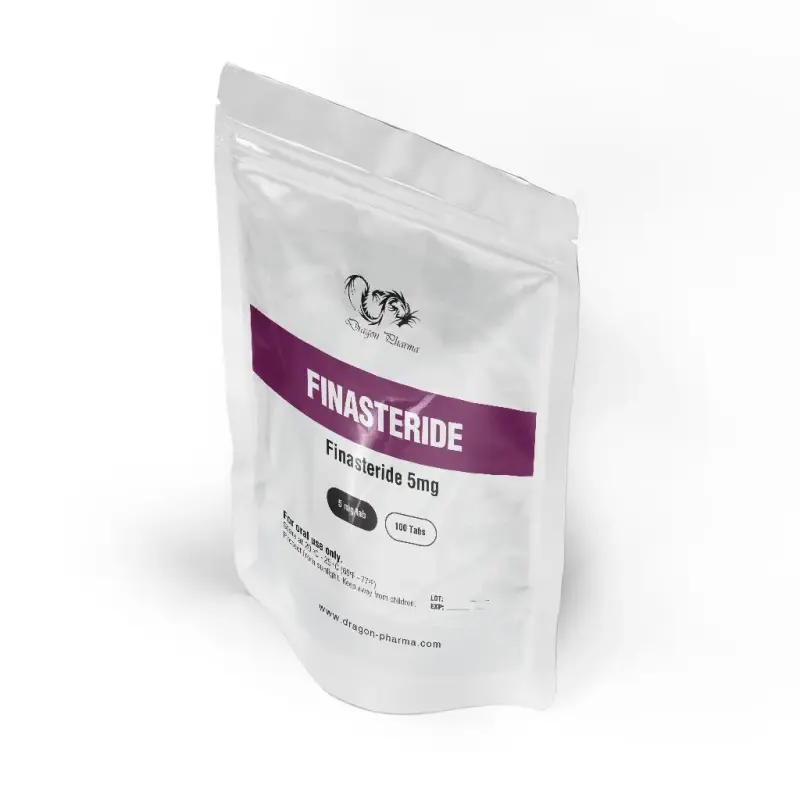
Dragon Pharma Finasteride is an oral tablet of finasteride, the drug sold medically as Proscar at 5 mg for benign prostatic hyperplasia and as Propecia at 1 mg for male pattern hair loss. It belongs to a different category from everything else in a strength-and-size catalogue: it is not an anabolic steroid, not a peptide and not a support supplement in the usual sense, but a prescription 5-alpha reductase inhibitor. Nothing on this page is a muscle-building claim, because the pharmacology does not work in that direction.
The mechanism is narrow and easy to state. Finasteride blocks type II 5-alpha reductase, the enzyme that turns testosterone into dihydrotestosterone, the far more potent androgen that drives the hair follicle miniaturisation behind androgenetic alopecia and the prostate growth behind hyperplasia. Blocking that step reduces serum DHT by roughly 70 percent and DHT inside the prostate by about 90 percent, while testosterone itself changes very little. Aromatisation is untouched, which is the key point for anyone reading this while running a cycle: the drug lowers DHT load without doing anything at all about estradiol, water or gynecomastia.
Where this becomes relevant in a sports context is the DHT-heavy part of a stack. Drugs such as Masteron 100 and Winstrol 10 are themselves DHT derivatives and do not depend on the enzyme, while a large testosterone dose raises the raw material for the same conversion through the aromatase route. Anyone considering finasteride should read it as a hair-follicle and prostate decision made on bloodwork and family history, not as a component that improves a cycle.
Dosage Protocol
The two licensed strengths exist for two different organs, and the schedule below reproduces the medical labelling rather than a sporting convention. Finasteride is taken once a day, with or without food, and the effect is judged over months.
| Hair, 1 mg | 1 mg once daily, taken for months with no cycling; this is the licensed dose for androgenetic alopecia |
| Prostate, 5 mg | 5 mg once daily for months, the licensed dose for benign prostatic hyperplasia, with size and symptom change appearing at 3-6 months |
| Higher than 5 mg | No documented benefit; the sources do not support a proportional hair effect from a larger dose |
| Frequency | Once daily at any time of day; the half-life of about 5-6 hours, longer than 8 hours in older men, keeps accumulation predictable |
| Duration | Not a course in the usual sense. Hair benefit lasts only while the drug is taken, and stopping hands the follicle back to its own timeline |
| Female | The source used here states plainly that the drug is not recommended as hair-loss therapy in women, and it is contraindicated in pregnancy |
Suggested Protocols
These cards describe how the drug is actually positioned around a cycle or alongside medical treatment. They are not combination claims, and the decision to add an oral prescription drug belongs to a prescriber.
What to Expect
- DHT falls within a day. Serum dihydrotestosterone drops during the first day of dosing and holds a plateau on 1 mg a day.
- Shedding slows before density improves. The first visible change is a reduction in hair fall, and meta-analyses put the gain in terminal hair at roughly 15 percent, so the drug mainly stops loss rather than rebuilding a full head of hair.
- Skin oiliness may ease. Some users report less sebum and fewer breakouts, an effect that tracks the DHT drop and develops over weeks.
- Prostate changes are slow. In medical use the effect on prostate size and urinary symptoms appears between three and six months; there is no fast response to expect.
- PSA reads about half its usual value. Screening results need a correction for the drug, which is a genuine safety consideration rather than a side effect.
- Limitation: no protection for everyone. Lowering DHT does not prevent androgenetic hair loss in every user and does not replace a decision made on tests and family history.
- Limitation: some complaints outlast the tablets. Reports of sexual and mood effects persisting after discontinuation are discussed in the sources as a debated phenomenon, not as a proven rule for each user.
Side Effects and Management
This is where the drug deserves more attention than its quiet reputation suggests. The events below are the ones described in the labelling and the literature, and the hormonal ones are the reason a prescriber stays involved.
Monitoring and Stopping
Finasteride has no post-cycle protocol because it does not shut down the gonadal axis and does not require a restart. What it does require is a measurement plan and a clear idea of what stopping looks like.