Product Overview
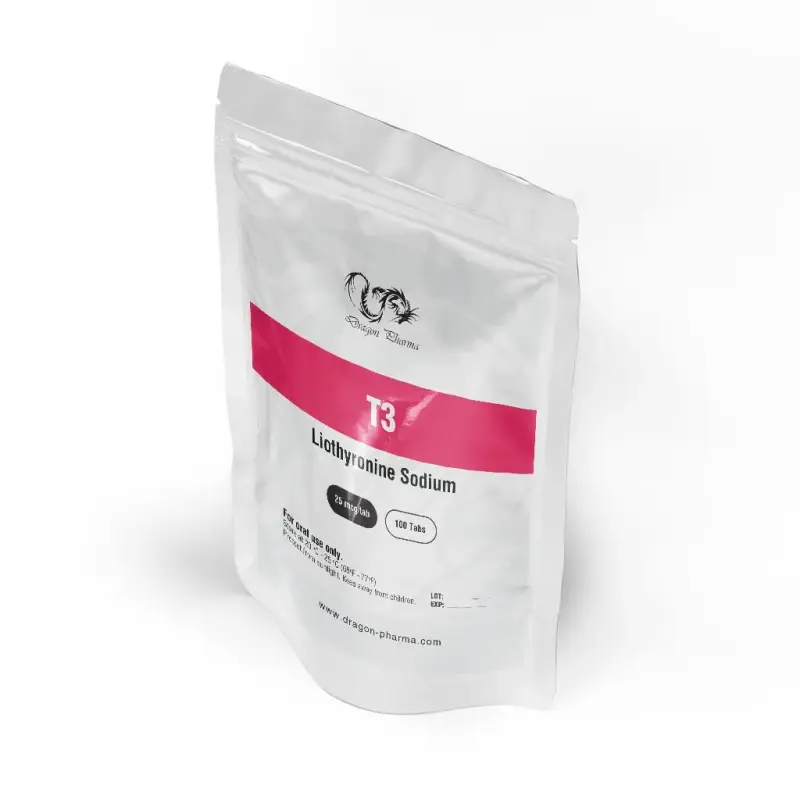
Dragon Pharma T3 is liothyronine sodium in 25 mcg tablets, the synthetic form of the active thyroid hormone triiodothyronine. The important framing is simple: this is not an anabolic steroid and it does not build muscle. It is a metabolic hormone that sets the pace of energy use, and in a physique context it is used to push expenditure up while a deficit is running. By weight it is roughly four times as potent as T4, the storage hormone the thyroid mostly releases, and about 85 percent of the circulating T3 in the body is produced by converting T4 rather than by direct secretion.
The kinetic profile is short and predictable enough to plan around. A tablet raises the level in about 45 minutes and peaks near 2.5 hours, with an elimination half-life of about 2.5 days, which is shorter than T4 but still long enough that daily dosing holds a stable level. One consequence is that, unlike a beta-2 agonist, it does not need several doses a day to keep working; splitting the daily amount only smooths the peak. A second consequence is that the hormonal effect does not stop when the tablets do, so the end of a course is managed by reducing the dose, which is covered later on this page.
The line places this compound beside the thermogenic products rather than beside the anabolic ones. It appears in the catalogue next to Clenbuterol 40mcg, which raises expenditure through beta-2 receptors instead, and next to GW501516, which works through a different pathway again. Dragon Pharma also carries the storage hormone as T4 at 50 mcg. The threshold rule that applies to all of them is the same: at replacement-level doses nothing visible happens, and above that level the cardiac and catabolic risks begin to appear.
Dosage Protocol
Doses are measured in micrograms and rise slowly. The clinical label starts at 25 mcg a day and steps up in 25 mcg increments every one to two weeks; the higher figures below are recorded as community practice rather than as validated protocols.
| Beginner | 12.5-25 mcg a day for four to six weeks; the label schedule starts at 25 mcg and increases by 25 mcg every one to two weeks |
| Intermediate | 25-50 mcg a day for four to six weeks, split into two doses because the peak is steep |
| Advanced | Up to 50-100 mcg a day in contest preparation; the recorded source for that range is community practice, and the risk of arrhythmia and muscle loss rises with it |
| Female | No validated female protocol was found in the sources; the label replacement schedule at 12.5-25 mcg is the only reference point that can be quoted |
| Administration | Oral tablets, taken in the morning and split across the day; the level peaks about 2.5 hours after each dose |
Two rules follow. Raise the dose in steps, because the gap between a productive metabolic push and an unpleasant one is narrow. And keep the course short, since the limit at the top end is the heart rather than tolerance.
Metabolic Protocols
T3 has no mass-building application, so every combination below belongs to a cutting phase and treats the compound as an accelerator on a diet that already works.
Appetite control is a separate tool and is handled by products such as Sibutramine rather than by thyroid hormone, while Dragontropin growth hormone is a different discussion entirely. Nothing in this section replaces the deficit or the cardio.
What to Expect
- Days one to three. Body temperature, sweating and pulse are the first signals, all of them from a higher basal metabolic rate.
- Weeks one to two. Energy expenditure rises, so weight moves on a food intake that previously held it steady.
- Weeks three to four. With a diet already in place the look sharpens; this is the visible part of the course and it does not arrive earlier.
- Strength may fall. At higher doses muscle is lost along with fat, which is why the dose stays low and an anabolic often runs alongside.
- Overdose looks like hyperthyroidism. Anxiety, tremor, insomnia and a racing heart are the expected picture, and atrial fibrillation is described in predisposed people.
- Replacement doses do nothing for fat loss. Within the physiological range the hormone simply normalises the system; the effect people are looking for only appears above it.
- Limitation. Cardiac disease or a thyroid condition makes this compound a medical matter, and the sources do not fix a recovery timeline for the thyroid after a course ends.
Side Effects and Management
The profile is the profile of too much thyroid hormone, driven by dose rather than by individual sensitivity. Every item below is a reason to lower the dose, not to add another product.
Tapering and Thyroid Recovery
There is no SERM protocol here, because the compound does not suppress the HPG axis. What follows the last tablet is a graded reduction and a check that the thyroid produces on its own again.