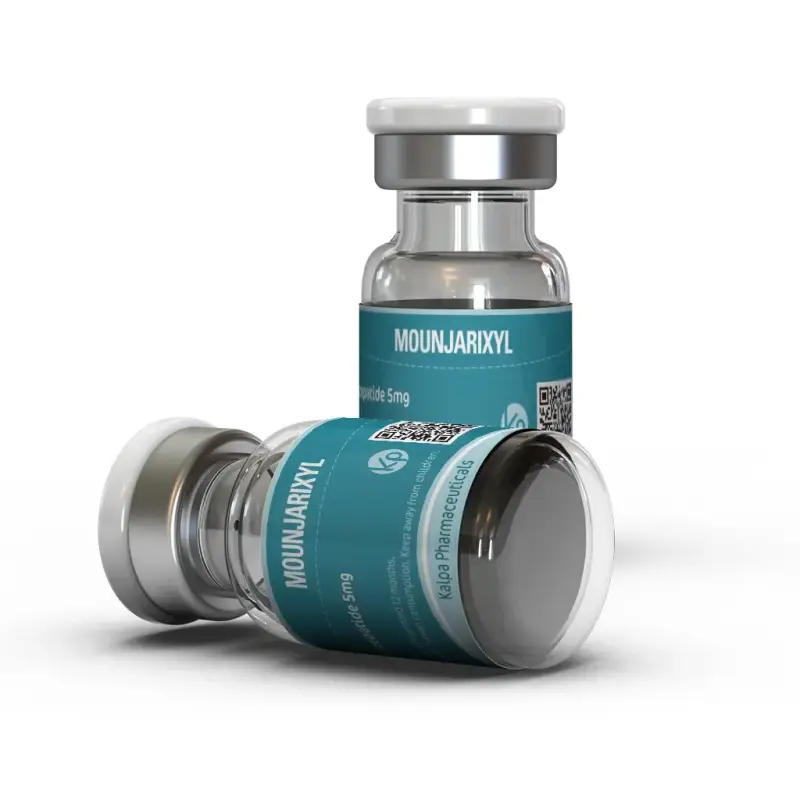
Buy Mounjarixyl by Kalpa Pharmaceuticals at Best Anabolic Steroids. The pack is a 5 mg vial of lyophilised powder that is mixed with bacteriostatic water and given as a subcutaneous injection once a week. The active substance is tirzepatide, a peptide of thirty-nine amino acids that has been modified with a fatty acid chain so that it survives in the body long enough to be dosed weekly rather than continuously.
What tirzepatide does is act on two receptors at once. GLP-1 signalling slows the emptying of the stomach and tells the brain that food has arrived; GIP signalling adds a second, separate route to the same outcome. The combined effect on appetite is the reason this molecule sits a step beyond the older single-receptor agents, and the reason its effect accumulates over months of steady weekly dosing rather than appearing over days.
Product Overview
The vial arrives as a small white pellet. Add bacteriostatic water, swirl gently, and the result is a clear solution that is measured out with an insulin syringe. Everything about handling is standard for a lyophilised research peptide: the sealed vial stays cold, the mixed vial lives in the refrigerator, and the concentration is written on the label the moment it is made. The project fact base does not fix a bottle volume for the Kali pack, so the arithmetic here is written for the 5 mg vial named in the product listing.
The pharmacology is what separates this from a simple fat burner. Reported population data put the half-life near five to six days, which is what makes one injection per week sensible; the level rises slightly over the first weeks and then settles into a steady state. The licensed product exists under two names for two different indications, while the vials traded here are research-grade and carry no approved label, no approved dose and no regulated quality chain. That gap is the single most important fact on this page, and it does not disappear because the powder looks identical. Standard mixing hardware is listed with the peptide range, from Bacteriostatic Water to the growth hormone vials such as Kalpatropin 100 IU or the double-size Kalpatropin 200 IU, and the repair peptide BPC 157 uses the identical routine.
Dosage Protocol
The weekly steps below are the ones used by the licensed injectable, which is the only place where a defined schedule exists. They are quoted for reference, not as an instruction for a research vial that has no approved dose at all.
| Beginner | 2.5 mg subcutaneously once a week, held for at least four weeks. Starting above this step is the main cause of early nausea |
| Intermediate | 5 mg weekly after titration, four weeks on the step before any further increase. This is the strength of the Kali vial per pack |
| Advanced | 10-15 mg weekly, the upper end of the clinical range, where discontinuation for side effects becomes much more common |
| Female | The same escalation is used in the clinical data. No separate female protocol appears in the sources reviewed |
| Administration | Subcutaneous once weekly, same day each week, rotating the injection site. Mixed from powder with bacteriostatic water |
Mixing arithmetic for the 5 mg vial: two millilitres of water turns the powder into a 2.5 mg per ml solution, so a 2.5 mg step measures 1 ml on the barrel and a 250 mcg draw sits at 10 units on a U-100 syringe. If a smaller injection volume is preferred, 1 ml of water doubles the concentration and halves the volume per dose.
Suggested Protocols
This class is used on its own. There is no recognised stack, and the sensible protocols are about pace and support rather than about combinations.
The opposite direction is worth naming too. An androgen course and an appetite-suppressing peptide work against each other, so anyone running something like Testoxyl Enanthate 400 for size has a different set of choices to make about calories.
What to Expect
- Appetite changes in one to two weeks. Portions start to feel too large before any meaningful weight change, which is the earliest sign the peptide is doing its work.
- Weight loss accrues over months, not days. In the licensed trials the main effect was measured at 72 weeks, with roughly 15 percent lost at the 5 mg step and up to around 21 percent at the highest step, against about 3 percent on placebo.
- Stomach upset follows the dose increase. Nausea, loose stools and constipation cluster in the days after a step up and usually settle over one to two weeks if the pace is not forced.
- Discontinuation rises with the dose. The proportion of trial participants who stopped for side effects climbed from around 5 percent at 5 mg to about a quarter at 15 mg, which is the practical argument for slow escalation.
- The weight tends to come back. After the drug is stopped, more than half of the loss returns within a year in the published data, because appetite signalling returns to where it started.
- A research vial is not a pen. Dosing precision, sterility and storage are entirely in the user's hands, with no regulated release testing behind the powder.
Side Effects and Management
Post-Cycle Therapy and Follow-Up
An incretin peptide does not suppress the hormonal axis, so there is no SERM phase to run at the end of a course. What replaces it is a deliberate exit: the appetite signal returns quickly once the drug clears, and a sudden stop from a high step is how the weight comes back fastest.
Blood work after a course is not a hormone panel. It is a metabolic one: fasting glucose, HbA1c where relevant, liver and lipid markers, and a note of how the stomach behaved at each step, because that is the record that makes the next titration easier. A refill of Bacteriostatic Water belongs in the same order as the vial, since a peptide without a solvent cannot be used at all.