Product Overview
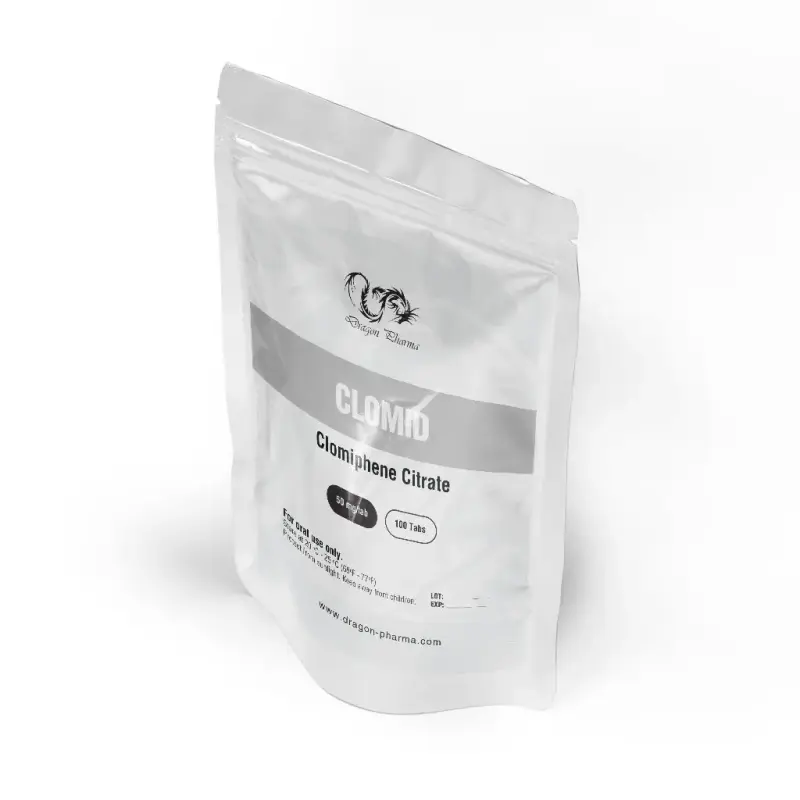
Dragon Pharma Clomid is clomiphene citrate in 50 mg tablets, supplied in a 100 tablet pack. Clomiphene is a selective estrogen receptor modulator and a progonadotropin: it occupies estrogen receptors in the hypothalamus and pituitary, the brain reads the resulting signal as low estrogen, and the answer is a larger release of GnRH followed by LH and FSH. Those two hormones are what tell the testes to produce testosterone again. It is not an anabolic steroid and it adds no muscle directly; its entire value lies in restoring a system that a cycle switched off.
Timing and clearance are the two facts that shape how it is used. The elimination half-life is 4-7 days, and the drug is a mix of isomers, one of which stays in the body considerably longer and is cleared through enterohepatic circulation. Studies on men have found the zuclomiphene marker in urine at 121 days and beyond 261 days, which matters to anyone subject to testing. Blood levels also build across a four-week protocol, so the last week is stronger than the first even at the same dose.
The pack belongs in the closing stage of a suppressed cycle. It is the standard partner of Nolvadex in recovery schemes, and it is judged by bloodwork rather than by how a user feels in week two. Cycles built on long esters such as Enantat 250 or on Deca 300 are exactly the ones that need this step, because natural production stays flat until a SERM pushes it back. The same is true of a cycle built around Trenbolone 100, where suppression is heavy and quick.
Dosage Protocol
Clomiphene is dosed once daily in whole tablets. The reference doses collected for this card are built around a four-week protocol, with the higher figure confined to the opening days.
| Beginner | 50 mg per day for 4 weeks, the standard post-cycle protocol |
| Intermediate | 50-100 mg per day for 4 weeks; the 100 mg figure belongs only to the first days after deep suppression |
| Advanced | 100 mg per day for the first days, then 50 mg per day, run for 4-6 weeks with the long half-life and metabolites kept in mind |
| Female | Not used in this context; the documented medical indication is ovulation induction under supervision, and there is no confirmed female sports protocol in the sources |
| Administration | Oral, once per day, at roughly the same time; enterohepatic circulation keeps the drug working between doses |
Starting the first tablet before the esters have cleared wastes the protocol: the residual androgen keeps the axis suppressed and the SERM is fighting a signal that is still arriving. The correct entry point is when the base compound has left the system, and that moment is set by the ester of the cycle, not by the SERM. A cycle built on Cypionat 250 clears at a different speed from one on propionate, so the waiting period is read from the product used rather than from a generic rule.
PCT and Recovery Protocols
Clomiphene is used in three recognisable recovery situations. In each one the SERM does the signalling and bloodwork decides when to stop.
What to Expect
- Signalling first. LH and FSH begin to move within the first one to two weeks, and total testosterone follows them upward.
- Strength of response. In hypogonadal men the sources report testosterone rising by roughly two to two and a half times, which is a large change from a single daily tablet.
- Slow fade. The effect outlasts the protocol because of enterohepatic circulation and the long-lived isomer, so levels do not collapse on the day the last tablet is taken.
- Typical complaints. Flushes, emotional swings and changes in vision are the most frequently reported problems during therapy.
- Testing reality. The zuclomiphene marker can be found in urine for months, which is a practical problem for any tested athlete.
- Judged by numbers. Dose and duration are set by total testosterone, LH and FSH, not by how recovery feels.
- Limitation. Outside recovery the drug has no place. It is not a testosterone booster for an otherwise healthy user with a working axis.
Side Effects and Management
Most clomiphene complaints are mild and dose related. The exception is the eye, where changes are uncommon but are a hard stop rather than something to monitor.
Bloodwork and Follow-Up After Therapy
Recovery is confirmed on paper, not by a feeling. The panel below is what closes the protocol, and it is repeated after therapy ends so that a trend is visible instead of one ambiguous reading.