Product Overview
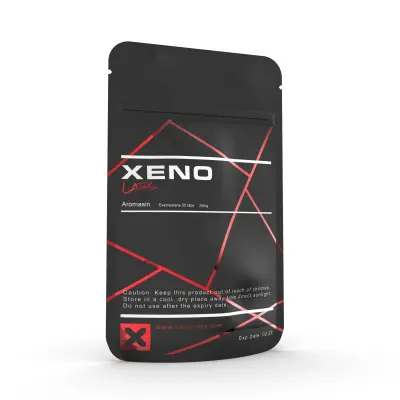
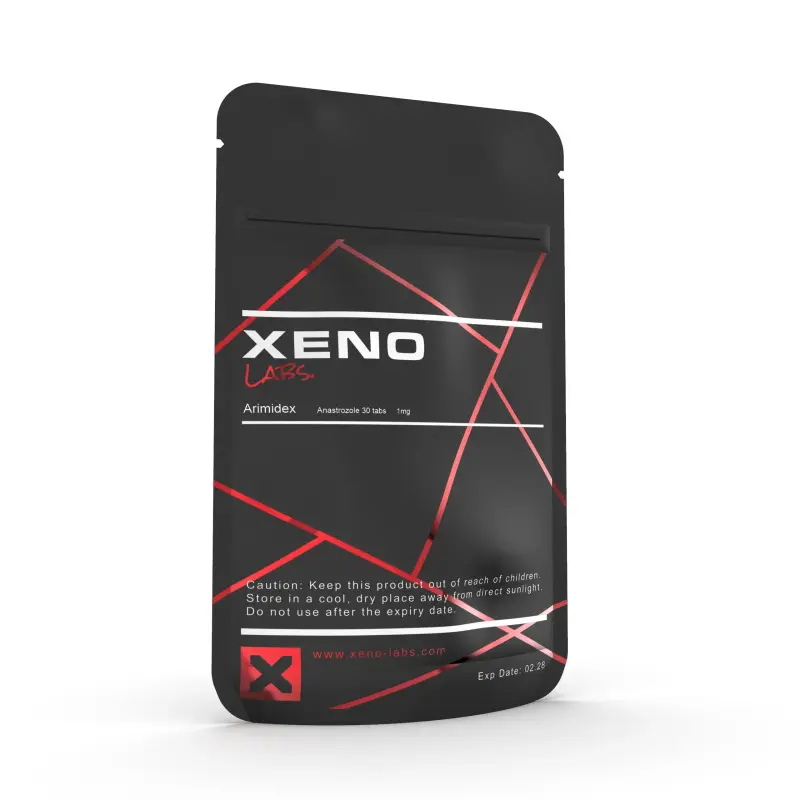
The Xeno Laboratories Arimidex pack carries anastrozole at 1 mg per tablet. It is a non-steroidal aromatase inhibitor whose block can be undone, which places it in the type II family, and it belongs to the support shelf of the range rather than the performance shelf. Nothing in it builds tissue. Its only job is to keep estrogen inside a workable band while a course beside it produces more than the user handles well, and the strength printed on the pack fixes every reference range further down this page.
The block itself is narrow. Anastrozole seats on the haem group of the aromatase enzyme and halts the conversion of androgens into estrogens, so less estradiol reaches circulation while the estrogen receptor stays open. Tamox or Clomiphene approach the same problem from the opposite side: a SERM occupies the receptor and never interferes with production. That split is why both classes exist at all. Pharmacokinetics explain the dosing rhythm as well. With a terminal figure near 50 hours in the postmenopausal label and a cited range of 40 to 50 hours, one tablet daily or one on alternate days holds a flat level, and there is no reason to spread the dose.
The tablet has a predictable home. Courses anchored on an aromatising androgen, the testosterone series or the nandrolone series, generate the surplus it is taken for, and an aromatising oral stacked on top enlarges it. In that setting the inhibitor works on fluid under the skin, tenderness in the breast tissue and the blood pressure that follows a high reading. What it never does is remove the source of the conversion. It works on the downstream output, which is the only honest way to describe its role.
Dosage Protocol
Each row is a reference starting point rather than a prescription, and each one is set against a lab result. The tablet strength exists so the smallest useful moves can be made; the test exists to say whether they were the right moves.
| Beginner | Half a tablet on alternate days as a low opening step |
| Intermediate | A whole 1 mg tablet on alternate days when the reading justifies it |
| Advanced | 1 mg daily and above, only against estrogen confirmed high on a test |
| Female | Outside this context; the tablet manages estrogen in men on an aromatising course |
| Administration | Oral; the long half-life carries the effect between doses |
| Duration | As long as the course it supports, without a finish date of its own |
Why the caution is written so heavily comes down to two numbers. In postmenopausal data a daily 1 mg dose removes at least 85 percent of estradiol, and because the half-life is long, the body does not wash an overshoot away before the next test. Splitting the tablet is the practical answer: 0.5 mg is the smallest step a 1 mg pack allows, and leaving a gap day is the second lever when a smaller adjustment is needed.
Suggested Protocols
This tablet is chosen to fit a stack. It is never taken as a course of its own, and across the three settings below the lab sheet always outranks the plan written on paper.
What to Expect
- Estradiol starts to come down over the opening one to two weeks, and the first test is placed to catch exactly that.
- Estrogen-driven fluid and breast tenderness ease off as the number falls, which is the visible half of the change.
- Because the half-life is long, the level does not swing between doses, and a missed day does not undo the week.
- Driving the dose past the point of control produces the opposite picture: dry aching joints, a smaller libido and a flatter mood.
- Lipids drift when suppression is aggressive, so a panel on the schedule is part of using the tablet rather than an extra.
- The tablet changes how much estradiol is made, not how much androgen is available to be converted, so it adds control rather than safety.
Side Effects and Management
Cycle Support and Follow-Up
There is no recovery role for this tablet, and the reference data do not describe one, because the hypothalamic-pituitary-gonadal axis was never switched off by it in the first place. A SERM taken after a course acts on the course, not on the inhibitor. What the product does need is a monitoring schedule and a rule for stopping.
Two more pages complete the picture for readers assembling it. The recovery stage after the underlying course is set out under Clomiphene and Tamox, the gonadotropin step that often precedes them under HCG 5000 IU, and the androgen-side support that often runs beside an inhibitor appears under Proviron.