Product Overview
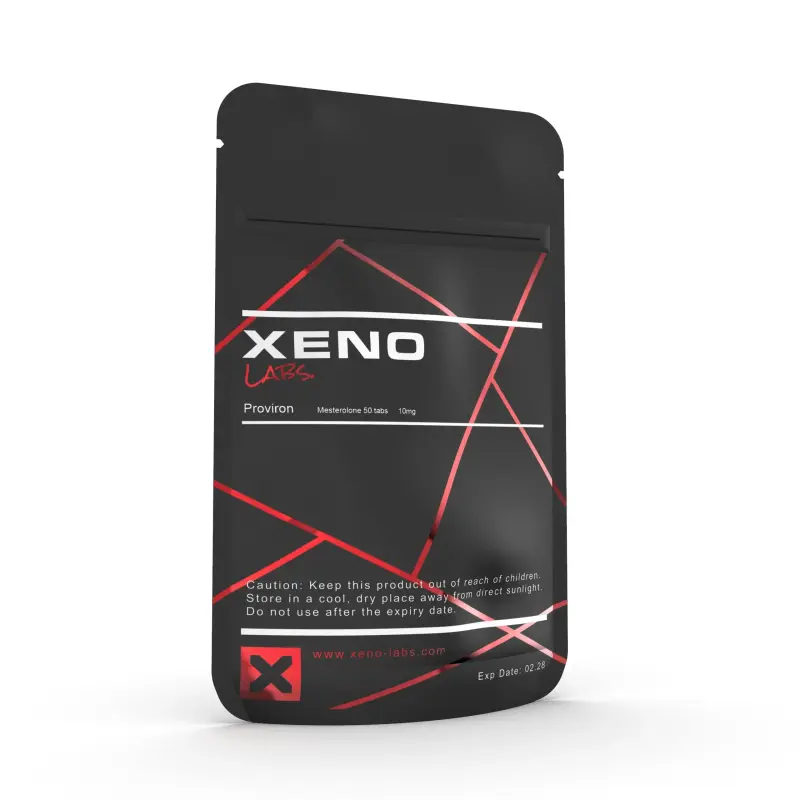
Xeno Laboratories Proviron is mesterolone at 25 mg per tablet, an orally active androgen derived from dihydrotestosterone with a strong androgenic character and only a weak anabolic one. It is a support product in the truest sense of the term on this line: it is taken beside a course to add androgen tone and to nudge the free fraction of testosterone upwards, and it is never the reason a user gains size or gets leaner.
Two chemical facts explain its behaviour. The first is that it does not aromatise, so nothing in it converts to estrogen and it cannot produce the fluid retention or the breast sensitivity that a converting compound can. The second is that it is one of the few oral androgens that is not 17-alpha-alkylated, which is why its hepatic profile is described as milder than that of most oral steroids even though it is swallowed rather than injected. The half-life is 12 to 13 hours, so the daily amount is normally divided, and the metabolite picture is what makes it detectable in urine for ten to fourteen days and often longer.
Its best-documented action at the protein level is on sex hormone binding globulin. By occupying that carrier, mesterolone can raise the free, unbound share of circulating testosterone without adding any testosterone itself, which is why it turns up beside a testosterone course rather than on its own. Users who are managing hair loss with Finasteride or Avodart have to weigh that against the fact that mesterolone is itself a DHT-derived androgen.
Dosage Protocol
Amounts below are reference steps for the substance rather than a prescription, and they assume a divided daily intake. Nothing above 100 mg a day is supported by the sources.
| Beginner | 25 mg a day, split when convenient, for the length of the supported course |
| Intermediate | 50 mg a day, usually taken in two portions |
| Advanced | 50-100 mg a day; the higher figure is the top of the documented range |
| Female | Not recommended, because the androgenic effects are strong and virilization is a real risk |
| Administration | Oral, divided across the day because the half-life is only about half a day |
| Duration | Matched to the course beside it, with no independent cycle of its own |
The clinical reference point differs from the sports one, which is worth knowing because it explains the tablet size. In replacement therapy the substance is given at 25 mg two or three times a day, so the 25 mg unit is a medical step. Sports use usually settles lower than that, and the higher rows exist for want of a better description rather than because they are needed.
Suggested Protocols
Where the tablet sits in a plan is narrow, and it is always a supporting position. The three arrangements below reflect how the sources describe its use.
What to Expect
- Androgen tone, meaning libido and a denser look, usually becomes noticeable in the first week or two.
- Free testosterone can rise because the tablet ties up the protein that normally carries it, without any extra testosterone being added.
- Fluid retention and breast risk do not appear from the tablet, because it does not convert to estrogen.
- Androgenic effects can show up instead: acne, hair shedding and, in prolonged use, voice change.
- It does not deliver meaningful anabolic effect, and the sources describe its anabolic power as weak.
- It does not replace a testosterone base, and it does not restore a suppressed axis at the end of a course.
Side Effects and Management
Cycle Support and Follow-Up
This tablet is not a recovery product. Its own suppression of the axis is mild, but the course it accompanies is the thing that has to be reversed, so the post-cycle plan belongs to that course and not to this page.
The androgen question does not end here, and the pages that pick it up are Finasteride and Avodart for the DHT side, Aromasin for the alternative estrogen tool, and HCG 5000 IU for the injected step that often precedes recovery.