
Product Overview
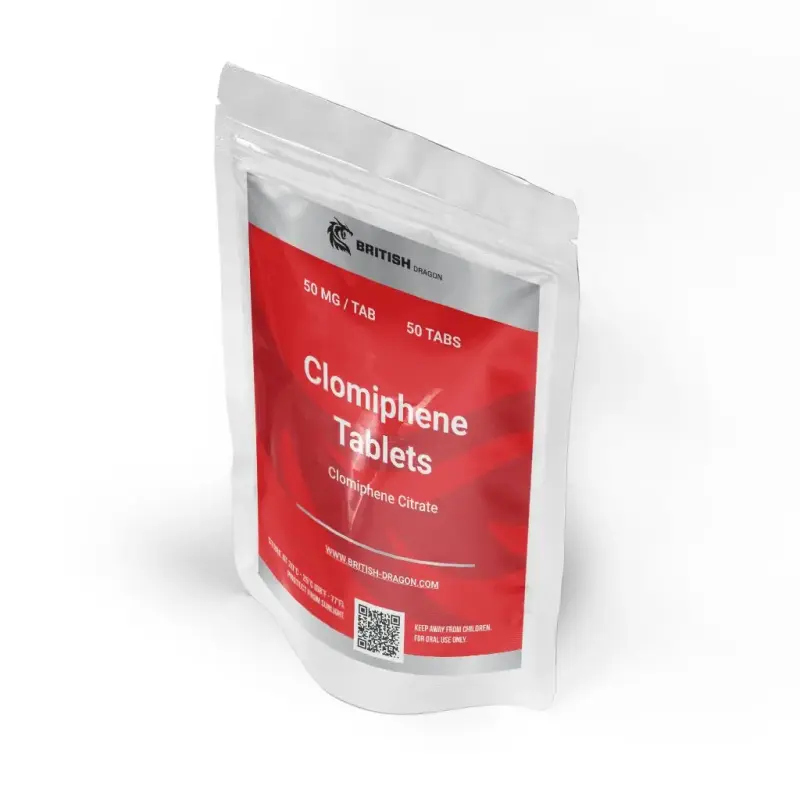
Clomiphene Tablets from British Dragon are the item on this listing. Clomiphene citrate, 50 mg per tablet, is the SERM sold as Clomid, and it is used for one purpose here: getting the hypothalamic-pituitary-testicular axis to switch production back on after a suppressive cycle.
It works upstream rather than downstream. Instead of supplying testosterone, it makes the pituitary ask for more, so the testes have to do the work themselves. That makes it effective only as long as the testes can respond, and it makes bloodwork the only honest way to judge whether the course succeeded.
Clomiphene is a mixture of two isomers rather than a single molecule, and they do not behave alike. The zuclomiphene isomer clears far more slowly than its partner, and a study in men found both isomers in urine well past the 261 day mark, which is why the detection cell on this card carries a figure in months instead of days. Enterohepatic recirculation keeps recycling the drug through the liver and gut, so its action also extends well beyond the final tablet.
What arrives is a bottle of 50 mg tablets from British Dragon, with the parent half-life quoted at four to seven days and the hepatic rating low. Because the dosage is judged by results rather than by feeling, the practical value of the pack is that a standard four-week course fits inside one bottle at one tablet a day. Nothing about the tablet is complicated; the interpretation of the cycle is where people go wrong.
How Clomiphene Tablets Work
The drug occupies estrogen receptors in the hypothalamus and pituitary and blocks the signal there. The brain reads that blockade as an estrogen deficit and increases gonadotropin releasing hormone output, and the pituitary responds by releasing more LH and FSH. Those two hormones are the direct instruction to the testes, so production restarts from the top down. Published figures describe clomiphene raising testosterone roughly two to two and a half times above baseline in men with suppressed output.
The mechanism explains both strengths and limits. It is not a hormone replacement, so it cannot substitute for an axis that has stopped responding, and it does not reduce circulating estradiol because blocking a receptor is not the same as removing a hormone. It also means the drug is only useful after suppression has ended: starting it while a long ester is still clearing wastes the course, because the pituitary signal is only half the equation when the injected hormone is still present.
Dosage Protocol
The 50 mg tablet is the standard unit, and the dose is adjusted by adding tablets rather than by breaking them. The figures below follow the reference material.
| Standard course | 50 mg a day across four weeks |
| Heavier suppression | 50-100 mg a day, with 100 mg only for the opening days |
| Extended protocol | 100 mg briefly, then 50 mg daily for 4-6 weeks |
| Women | Not used in a sports context; the medical use is ovulation induction |
| Frequency | Once daily, with the long metabolite tail doing part of the work |
Two practical rules come out of the pharmacology. Split the daily total into morning doses if nausea or insomnia appears, because both are commonly reported and both are easier in daylight hours. And do not extend the course indefinitely: the metabolites keep working after the tablets stop, so adding weeks rarely adds recovery, it just adds side effects.
Suggested Protocols
The usual question is whether to pair the two SERMs or to run one of them. Since both act on the same pituitary signal, the choice is about tolerance rather than about a stronger effect.
On a cycle built around Methanabol Tablets the oral clears within days and the course can begin almost straight away, while a long ester such as Testabol Enanthate forces a wait of several half-lives. Aromatase inhibitors are a separate class and are not part of a SERM protocol. Our listings for Anastrozole and Exemestane cover drugs that lower estradiol rather than block its receptor, which is a different job in a different phase of a cycle.
What to Expect
The changes are hormonal first and subjective second, and the two do not always line up.
Someone expecting a mood lift from clomiphene is usually disappointed, and some users report the opposite. That is a reason to judge the course on a panel, not on how the week felt.
Side Effects and Management
Most of this list is uncomfortable rather than dangerous, with one exception that should end the course immediately.
The vision entry deserves emphasis because it is reported in roughly one to ten percent of users and because the warning is in the original labelling: any visual change is a reason to stop, not to reduce the dose and carry on.
A sealed container at room temperature, kept dry and out of the sun, is all this product needs. The tablets are not fragile, but a labelled bottle is still the right home for them, particularly if you keep other recovery items at the same time.
Write the course length on the pack when it is opened. Clomiphene keeps acting for a while after the last dose, so an unmarked bottle makes it easy to run a four-week course for six, and that habit only adds side effects.
Post-Cycle Therapy
A recovery course is only as good as the panel that follows it. The list below is the minimum needed to tell real recovery from a masked number.
Two tests four weeks apart are worth more than any number of subjective impressions, and they also catch the case where the course did not work and a different approach is needed.
The card gives the exact strength and count, states the unusual detection profile openly, and explains that the two isomers behave differently rather than flattening the drug into a single half-life figure. Shipments are discreet, both pricing options are visible before payment, and the item is sold as research material. If the other SERM suits you better, see our Tamoxifen Tablets page, and the rest of the British Dragon range covers the cycle that precedes recovery. The support desk is glad to confirm what any listing contains ahead of an order.