Sep 22, 2026 · 10 min read
Injectable vs Oral Steroids: How the Two Forms Differ
BestAnabolicSteroids.com
Independent research & quality review desk
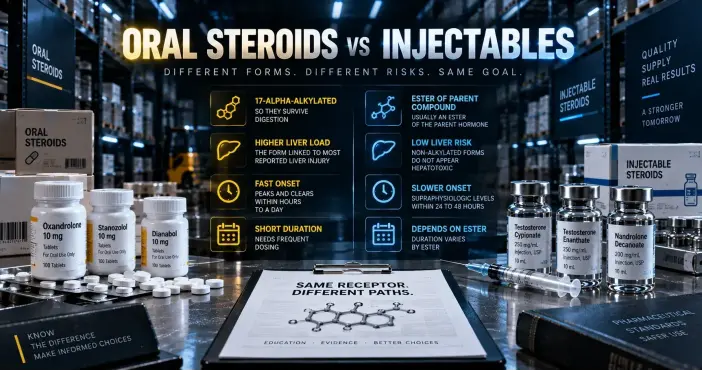
Injectable and oral steroids differ in more than the route of administration. The chemical change that makes an anabolic steroid survive digestion also changes how long it stays in the body and how much work the liver has to do, and that single difference explains most of the practical trade-off between the two forms.
The Short Version
| Difference | Oral anabolic steroids | Injectables |
|---|---|---|
| Chemical form | 17-alpha-alkylated so they survive digestion | Usually an ester of the parent compound |
| Liver load | The form linked to most reported liver injury | Non-alkylated forms do not appear hepatotoxic |
| Onset after a dose | Peaks and clears within hours to a day | Supraphysiologic levels within 24 to 48 hours |
| How long the level holds | Shorter, needs frequent dosing | Depends entirely on the ester |
Why the Form Changes the Risk Profile
A steroid taken by mouth has to pass through the liver before it reaches the bloodstream, so the molecule carries a modification at the 17-alpha position to slow that first pass. The modification works, but it has a cost: the same change that lets the drug survive digestion also retards its clearance in the liver. As one clinical review puts it, the 17-alpha-alkylation modification allows steroids to be taken orally, but the slower clearance in the liver makes them more hepatotoxic (Niedfeldt, 2018).
Injectable esters skip that problem. They are absorbed from muscle, then hydrolysed into the parent hormone, which is why the same review literature concludes that 17-alpha-alkylated steroids appear hepatotoxic while non-alkylated compounds appear not to be (Bond et al., 2016).
Which Compounds Belong to Which Group
The distinction follows the chemistry rather than the brand. The orals in clinical and sports use are the 17-alpha-alkylated compounds, which is exactly why the liver literature is written about them: stanozolol, oxymetholone and oxandrolone are the classic examples of that class. The injectable side is dominated by esters of the parent hormones, such as testosterone propionate, cypionate and enanthate, plus the 19-nor compounds that come as esters as well.
That is also why a product being "an oral" tells you almost nothing about its potency and a great deal about its liver profile.
Esters and Timing
With injectables, the ester is the clock. The parent hormone is the same; the ester determines how quickly it is released from the injection site and therefore how often a dose has to be repeated.
| Ester | Published half-life | Practical meaning |
|---|---|---|
| Testosterone propionate | Measured at up to 1.4 days in one pharmacokinetic study | Frequent administration to keep levels steady |
| Testosterone enanthate | Roughly 4 to 5 days in clinical references | Weekly-type scheduling |
| Testosterone cypionate | 7 to 8 days in clinical references, about 19 hours in others | Schedules differ between sources by a wide margin |
After a 200 mg intramuscular injection of testosterone enanthate or cypionate, serum testosterone rises into the supraphysiologic range within 24 to 48 hours. The numbers for how long it stays elevated are where sources disagree: some clinical references place cypionate at roughly 7 to 8 days and enanthate at 4 to 5, while other pharmacokinetic summaries put the terminal half-life closer to 19 hours and recommend injecting every two to three days. Both versions circulate, and they imply very different schedules. Anyone comparing protocols should notice the gap rather than assume one number is the number.
Onset and Duration: Two Different Clocks
Orals are the other extreme. Because they are designed to clear the first pass and then be eliminated, their effect rises and falls within hours, which is why they are dosed more frequently and why the hormone curve swings more between doses. Short esters land somewhere in the middle, and long esters flatten the curve at the price of a longer tail once the last injection is taken.
There is a paradox worth understanding here, because it explains why the oral form keeps its reputation despite the frequent dosing. The same 17-alpha-alkylation that makes a compound orally active also retards its metabolism in the liver, so the group of drugs that looks shortest-acting in a dosing schedule is the group that the clearance data describes as slower to leave the liver. Faster peaks do not mean a faster exit from the organ that has to process them.
Why People Assume Injectables Are Safer
The belief is not invented, but it is narrower than it sounds. A 2025 qualitative study of users put it plainly: perceptions that injectable AAS are safer than oral AAS appeared to stem from the notion that orals are more toxic to the liver (Cox et al., 2025). The liver part of that perception matches the clinical literature quoted above. What it leaves out is everything else that comes with injecting: sterile technique, sourcing, and the fact that a clean liver profile is one organ, not a health certificate.
It is also worth reading that study for what it is. It documents what people believe and how they justify their choices, which is useful context but not evidence about outcomes. The outcomes evidence in this article comes from the clinical reviews and case series, and the two should not be treated as the same kind of source.
What the Liver Data Actually Shows
The range matters more than the headline. According to the NIH LiverTox monograph, injury from anabolic steroids runs from minor, transient serum enzyme elevations to profound and prolonged cholestasis (LiverTox, NCBI). A 2022 review adds two useful details: most of the reported conditions are associated with 17-alpha-alkylated steroids, and liver function usually returns to normal after the compound is stopped (Petrovic et al., 2022).
That is the honest version of "oral steroids and liver": the oral form is the one the case reports point at, the effect is often reversible once the compound is withdrawn, and the severe end of the range exists.
What Monitoring Looks Like for Each Route
The two routes are not monitored with the same tests. With orals, the literature tracks liver enzymes, because that is the organ the case reports implicate. With injectables, the relevant question is the hormone curve itself: pharmacokinetic work on testosterone therapies is about whether serum levels sit inside the normal range and what the injection schedule does to that curve (Pastuszak et al., 2021). In both cases the measurement is a lab result, not a feeling.
What This Means in Practice
- The route is not the risk. The chemical form is. A non-alkylated injectable and an alkylated tablet are not interchangeable in terms of liver exposure.
- Frequency follows the ester. Short esters need more frequent administration to keep levels steady; long esters do not.
- Injections have their own requirements. Sterile technique, rotation of sites and proper storage are what make the route workable, and those are logistics rather than pharmacology.
- Monitoring is not optional in either case. Liver enzymes and hormone levels are how the clinical literature tracks what a compound is doing.
How to Read a Protocol You Find Online
Most comparisons of oral and injectable steroids fail at one specific step: they treat the route as the variable while changing the compound at the same time. A comparison between an alkylated oral and an esterified injectable is a comparison between two different molecules with two different liver profiles, two different half-lives and two different monitoring requirements, and the route is only part of it.
Ask three questions of any protocol or comparison table. Which compound exactly, and what ester where relevant? Which of the differences are chemical and which are just scheduling? And what source is behind the numbers, since half-life figures for the same ester differ between clinical references and web summaries. If a table cannot answer those three, it is a vibe with a spreadsheet.
Questions People Ask
Are oral steroids safer than injectables?
On the specific question of liver injury, no. The oral route requires a modification that the reviews associate with most of the reported liver problems.
Do injectables affect the liver?
The same reviews report that non-alkylated steroids do not appear to be hepatotoxic, which is a different statement from safe for everyone.
Which form works faster?
Injectables peak quickly: within 24 to 48 hours after an intramuscular dose of enanthate or cypionate. Orals rise and clear within the day, which is why they are dosed more often.
How long does a dose stay active?
For injectables it depends on the ester, from around a day and a half for propionate to several days for the longer esters. Published half-lives vary between sources, so schedules differ between protocols.
Are orals safer because they leave the body faster?
Leaving the body faster is not the same as damaging less on the way through. The liver exposure happens during first pass, and that is the step the alkylated orals were designed to survive.
Do injectables need more monitoring?
Different monitoring. Orals are followed mainly through liver enzymes, injectables through hormone levels and the shape of the curve between injections.
Can orals be taken for a long time?
The reported liver cases are concentrated in the alkylated oral forms, and function usually recovers after the compound is withdrawn. That still makes the oral form the one that needs the most attention, not the safest option.
Does the injection site matter?
It matters for absorption and for tolerating the injection, which is why clinical use specifies a site and technique rather than leaving it to chance.
Important: anabolic steroids are controlled, prescription-only medicines in most countries. This article compares published pharmacology for information only and is not medical advice. Products sold on this site are intended for research purposes.
You can browse our injectable steroids and oral steroids sections to see how the two forms are stocked, or look through the full catalog.