Product Overview
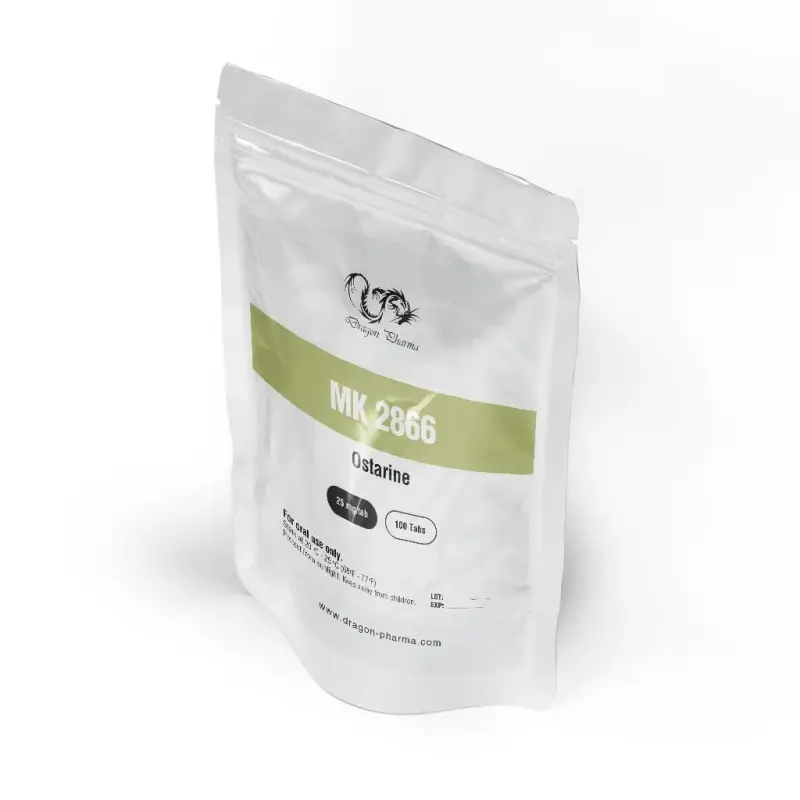
Ostarine, listed on this site as MK 2866 and known in the literature as enobosarm, is a non-steroidal selective androgen receptor modulator with an unusually deep research file for its class. Most published SARM papers rest on a handful of volunteers; this molecule has been through about 25 clinical studies covering more than 1,700 people at doses from 1 mg to 100 mg. No regulator has approved it for any indication, and in the United States it holds investigational new drug status, which is the correct starting point for anyone reading the marketing copy around it.
Dragon Pharma sells it as a 25 mg tablet, 100 tablets to a pack, a single daily unit that matches the 14-24 hour elimination half-life. The catalogue places it alongside LGD 4033 and GW501516 Cardarine, two compounds that appear in similar cycles but work through different routes.
The receptor binding is selective rather than purely anabolic, and the practical consequence is a mild profile: no conversion to estrogen, so no water or breast tissue response, but a real and dose-dependent cost in endogenous testosterone and in HDL cholesterol. Bloodwork is the only way to see that cost on paper before it is felt in training.
Dosage Protocol
There is no approved schedule. The table keeps the trial range and the non-medical range in separate rows, because the trial record runs from 1 mg to 100 mg per day and that span makes any single figure easy to misread.
| Beginner | 10 mg a day for 8 weeks, deliberately under the amount that circulates in the non-medical market |
| Intermediate | 10-25 mg a day over eight to twelve weeks, with testosterone and liver enzymes drawn mid-run |
| Advanced | 25-30 mg a day for 8-12 weeks at the top of the range, where masculinising effects in women have not been characterised at all |
| Female | Sources for this card contain no confirmed female protocol; the honest entry is that none can be quoted, and masculinising changes in women remain poorly described |
| Administration | Oral, one tablet a day; a 25 mg unit matches the middle of the non-medical range and the metabolic half-life suits a single daily intake |
| Trial reference | 1-100 mg per day across 25 studies and over 1,700 subjects; in healthy older men total testosterone dropped 31 percent at 1 mg a day and 57 percent at 3 mg a day |
Suggested Protocols
The source record contains no validated combination for this molecule, so the three cards below show groupings used with it in practice, assembled from other items in the same brand section. They are catalogue arrangements, not clinical protocols.
What to Expect
- Timeline. Two to four weeks before the difference in training becomes obvious, which is a normal SARM onset window.
- Muscle kept in a deficit. This is the application almost every user describes: holding mass while calories are reduced, rather than adding size in a surplus.
- Testosterone. The drop is dose-linked and measurable. In older men the trial figures were a 31 percent fall at 1 mg a day and 57 percent at 3 mg a day, which is why the recovery step is not optional.
- Cholesterol. HDL declines while LDL has been recorded as unchanged, a pattern that shows up on a lipid panel rather than in how anyone feels.
- Liver enzymes. Elevations are part of the study record, so a baseline and a mid-run ALT/AST pair are the sensible minimum.
- Status. The compound holds no approval anywhere and remains an investigational new drug in the United States.
- Safety caveat. The safety data that exist were gathered at doses below what the non-medical market uses, so the top of the range is undocumented territory.
Side Effects and Management
The profile is mild next to an oral anabolic, as the comparison with a compound such as Anavar 10 makes clear: no aromatisation, no water, but the same need for bloodwork.
Post-Cycle Therapy
Two things decide this step: how long the drug takes to leave the body, which is short, and how long the axis takes to answer, which is not.