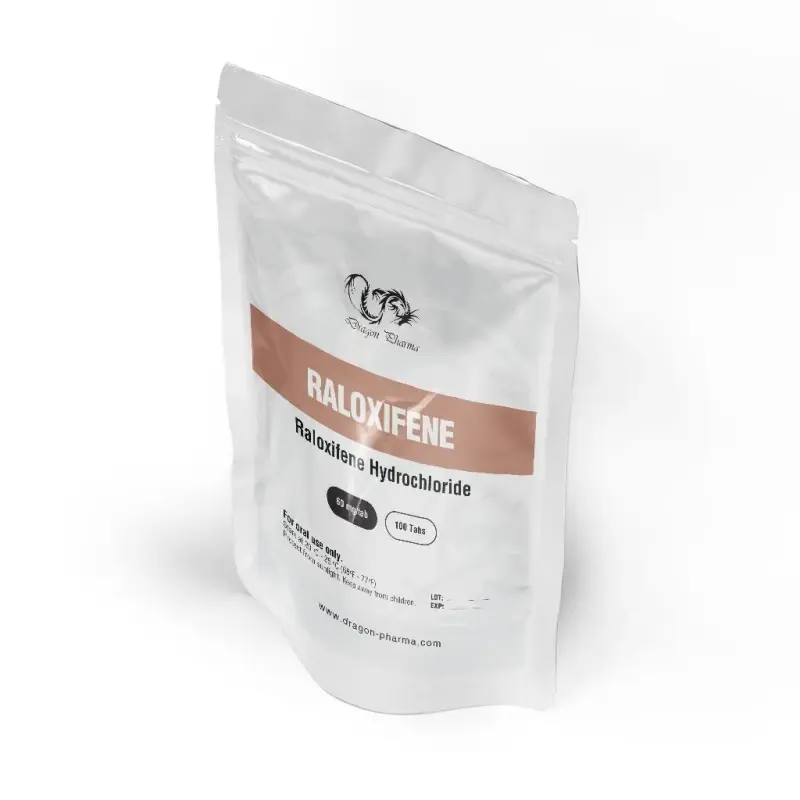
Product Overview
Raloxifene Hydrochloride from Dragon Pharma is an oral tablet line, 60 mg per tablet and 100 tablets to the pack. The molecule belongs to the selective estrogen receptor modulator family, which means it does not simply switch estrogen signalling off: in breast tissue it blocks the receptor, while in bone it behaves like an agonist. That split behaviour is the reason it turns up in two different conversations at once, one about gynecomastia during a course and one about restoring hormonal balance after it.
Compared with the older SERMs, the practical difference sits in receptor selectivity and in the growth factor picture. The compound acts by occupying the estrogen receptor rather than by lowering the amount of estrogen in circulation, so it does not stop aromatisation and does not remove the need for an aromatase inhibitor when estradiol itself is running high. Vendor material claims that it leaves IGF-1 alone in a way tamoxifen does not; the project file behind this card marks that claim as unconfirmed, and it is repeated here as an unconfirmed claim rather than as a fact.
The tablets are discussed alongside the rest of the support shelf: Nolvadex 20mg and Clomid 50mg as the other SERM options, Toremfine 20mg as the closest relative in the line, and Arimidex 1mg or Aromasin 25mg when the task is to lower estradiol rather than block its receptor, while HCG 2500 iu covers the gonadotropin side of a recovery plan. Raloxifene is not an approved medicine for men, and every figure on this page comes from the clinical labelling for women plus the reference material for this class.
Dosage Protocol
The approved tablet strength is 60 mg and the doses below follow that labelling, with the sports context added only where the sources discuss it.
| Beginner | 60 mg a day for 4-6 weeks; in a course context this is a short block driven by lab results rather than a fixed schedule |
| Intermediate | 60 mg a day for 4-8 weeks; amounts above 60 mg a day are not used routinely |
| Advanced | 60 mg a day, occasionally 120 mg a day for a short block; 120 mg is the upper approved step in osteoporosis and no sports data exists for it |
| Female | 60 mg a day, the approved dose for postmenopausal women; in women of reproductive age the thrombosis risk changes the calculation |
| Administration | Oral, once a day at the same time; the long half-life is what keeps the daily level even without splitting the dose |
The half-life supports that simple schedule. A single dose clears in roughly 28 hours, while repeated 60 mg doses settle at around 33 hours in steady state, so the concentration moves slowly and a missed or shifted tablet does not produce a sharp swing.
On-Cycle Control and Recovery Positioning
Two jobs are described for this tablet, and they are not interchangeable. During a course the target is estrogen signalling in breast tissue, where the receptor block is the point. After a course the target is the gonadotropin signal, where a SERM helps the axis find its way back. The tiles below show how the line is assembled around each job, and each opens the product page.
What to Expect
- Weeks 1-2. Do not expect estrogenic symptoms to vanish immediately. The tablet modulates the receptor instead of clearing estrogen, so the shift is gradual.
- Weeks 2-4. Reports discuss a reduction in breast tenderness and lumpiness when it is used for prevention; the clinical data for that specific use is thin, so treat the reports as reports.
- Weeks 4-8. The typical window for a short block, after which the decision is made on labs rather than on feel.
- Bone. Estrogen receptor agonism in bone tissue is an approved property of the drug, not a course effect.
- Clot risk. SERMs as a class raise the chance of venous thrombosis, which is the one limitation that can turn serious.
- Sport eligibility. WADA keeps the class under S4 at all times and a therapeutic exemption is not issued for gynecomastia control.
- Regulatory position. The drug is not approved in men; the adolescent gynecomastia evidence base consists of small trials only.
Side Effects and Management
The profile is class-typical: nuisance effects are common and dose-dependent, while the dangerous one is rare and needs screening rather than management after the fact.
Recovery Blocks and Monitoring
Timing matters more than the dose here. A SERM has nothing useful to do while a long ester is still releasing, so the block starts when the injection has cleared and the labs say so.