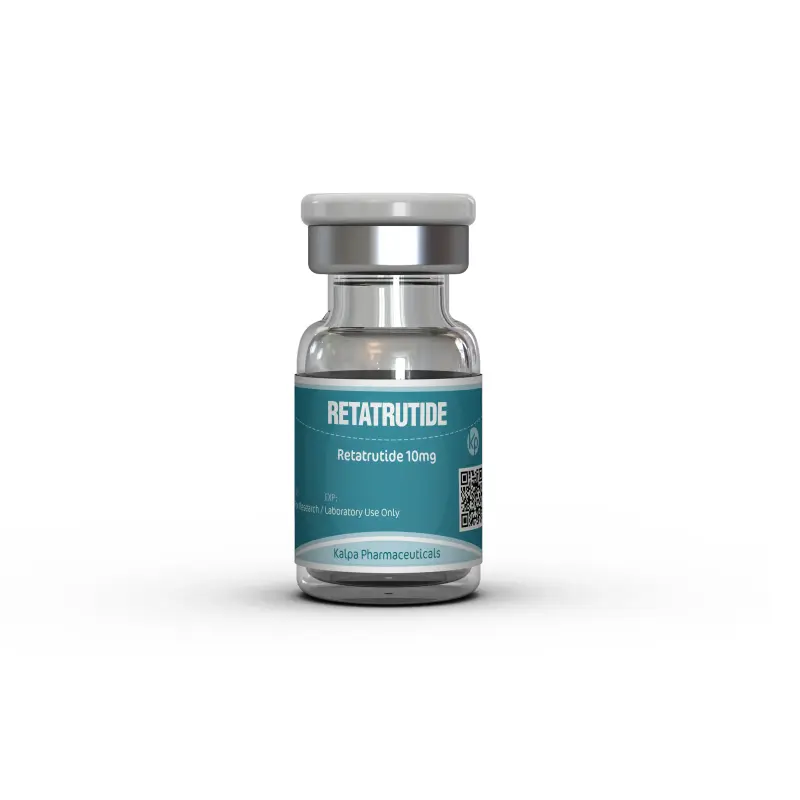
Retatrutide 10 mg from Kalpa Pharmaceuticals arrives as a freeze-dried triple agonist peptide, and the figure that matters most sits in the trial reports rather than on a label, because the compound is still in late-stage development and has no approved leaflet.
That status shapes the page. The section on amounts is a record of what the trials used and what the mixing arithmetic produces, not a prescription. Where the literature is silent, the text says so rather than filling the gap with a plausible figure.
Product Overview
One molecule here switches on three receptors: GIP, GLP-1 and glucagon. The first two are the incretin targets behind the appetite-suppressing drugs already on the market, and the third is what separates this compound from them, since glucagon signalling adds an energy-expenditure component rather than only reducing intake.
In phase 2 work the weight change at forty-eight weeks was staged by dose, reported at roughly nine percent on the lowest arm and reaching the low twenties of percent on the highest. The phase 3 programme reported eighty weeks of treatment in a population of more than two thousand adults. The direction of the appetite effect appears within the first weeks, long before body weight moves much, and the body-composition change accumulates over months rather than days.
Two practical points belong here. There is no published human half-life, which is why the once-weekly interval is taken from the trial designs rather than from a pharmacokinetic figure. And the substance is not on the World Anti-Doping Agency prohibited list, although the broader GLP-1 class sits in its monitoring programme, so the status could change.
Dosage Protocol
The columns below follow the research staircase, where every rung is held a minimum of four weeks before the next increase, since phase 2 tolerability suffered when treatment began higher.
| Beginner | A low first step, kept for a minimum of four weeks before any increase |
| Intermediate | The middle steps of the phase 2 design, over twenty-four to forty-eight weeks in total |
| Advanced | The top steps studied, up to eighty to one hundred and four weeks in phase 3; no approved dose exists |
| Female | No separate protocol published in the sources reviewed; the trial populations were mixed |
| Administration | Subcutaneous, once weekly, with the amount changed only between steps |
For a 10 mg vial the arithmetic is plain division. Add one millilitre of water and each millilitre then carries 10 mg, so a ten-unit mark on a U-100 barrel equals 1 mg. Add two millilitres and the strength per millilitre halves to 5 mg: twenty units then equal 1 mg, and a 5 mg draw fills the whole barrel, so only two such draws come from one vial. Diluting further makes small amounts easier to measure but shortens the life of the vial. Mix with Bacteriostatic Water by swirling, never shaking, and store the prepared solution refrigerated and inside the vendor window.
Titration Lanes and Line Context
The peptide is a monotherapy in every protocol published so far, so the lanes below are about pacing and context rather than stacking.
The same catalogue holds repair and growth vials such as BPC 157 and the Kalpatropin 100 IU growth hormone pack. They act through entirely different systems, and none of them substitutes for the appetite route this peptide takes.
What to Expect
- Appetite drops before weight does. Reduced hunger is reported in the first weeks, while the scale barely moves at that stage.
- Weight loss accumulates over months. The recorded figures are measured at the end of long treatment periods, not at week four.
- Gut reactions cluster around dose increases. Slower steps and smaller meals soften them rather than eliminating them.
- A modest pulse rise was recorded. Heart rate peaked around week twenty-four in the trial data and declined afterwards; stimulants on top of that are a poor idea.
- Appetite suppression can overshoot. Losing the desire to eat enough protein is a real risk, and it costs lean tissue.
- Nothing is regulator approved. No leaflet exists, no dose is licensed, and no human half-life has been published for this peptide.
Side Effects and Management
Stopping, Stability and Follow-Up
Nothing here reaches the gonadal axis, so a SERM-based recovery plan has no target in this protocol. The relevant questions are weight regain and storage.
Storage is the other half of the discipline: keep the sealed vial cold and dark, keep the mixed solution refrigerated, and do not freeze and thaw it repeatedly. The vial is listed in the Kalpa Pharmaceuticals catalogue beside the other peptide packs, and the batch code and expiry on the box are worth reading before the first draw.