Best Anabolic Steroids

Press Enter to search the full catalog.

US Domestic discreet shipping
Third-party batch tested
HPLC & MS verified purity
Trusted Anabolic Manufacturers Only
US Domestic discreet shipping
Third-party batch tested
HPLC & MS verified purity
Trusted Anabolic Manufacturers Only
Back to all products
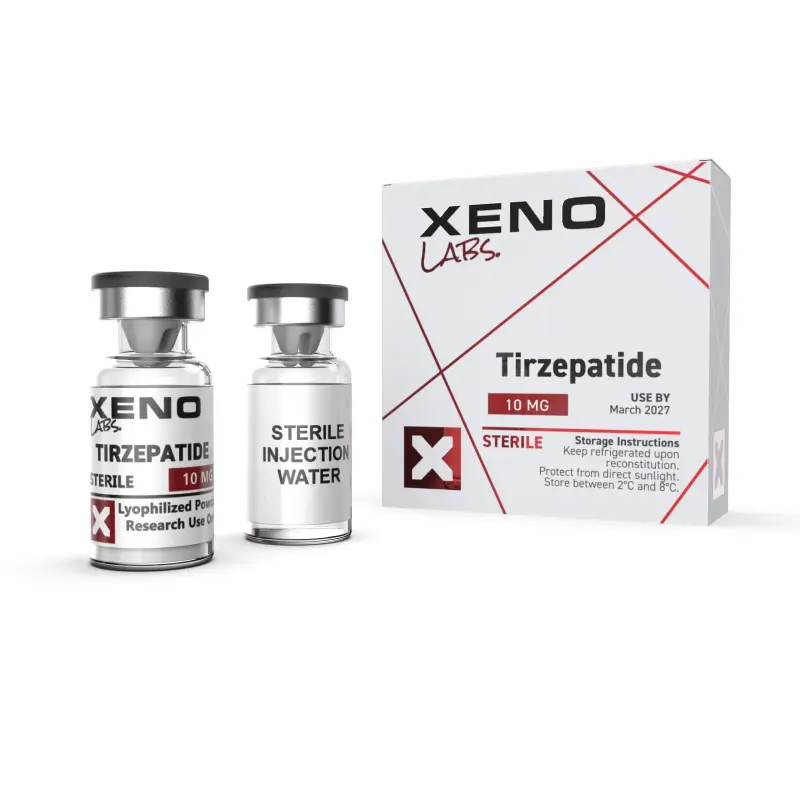
Tirzepatide GIP GLP-1 Vial - Xeno Laboratories

Xeno Laboratories

Tirzepatide GIP GLP-1 Vial - Xeno Laboratories

Injection · 10 mg · vial

Out of stock
CompoundTirzepatide
ClassGIP and GLP-1 agonist
Half-lifeAbout 5 days
DetectionMonitored, not banned
Liver toxicityLow
Water retentionLow
One vial of 10 mg lyophilised peptide, a 39 amino acid dual agonist supplied in the research format rather than as an approved pen. The weekly steps below belong to the prescription product and are given as a scale, not as an instruction. Effects accumulate over months, so this is not a compound for short cycles, and most of the lost weight returns after stopping.
Tirzepatide GIP GLP-1 Vial - Xeno Laboratories
Order Now, Ships Today
Quality First

All products are manufactured under strict quality standards and independently tested before release. By purchasing, the buyer agrees to use these products in compliance with all applicable laws.

Product Overview

Xeno Tirzepatide is a 10 mg vial of lyophilised peptide. The molecule is a lipidated 39 amino acid chain that activates two incretin receptors, GIP and GLP-1, rather than one, and that dual action is the main pharmacological difference between it and the single-receptor GLP-1 products.

It is supplied in the research format. The approved prescription versions are pre-filled pens with a fixed dose per step, and the difference matters: a vial leaves reconstitution, concentration and sterility to the user, and regulators have warned specifically about unapproved versions of this class.

Mixing and Weekly Arithmetic

Bacteriostatic water dissolves the powder and the fill decides the strength. Put the 10 mg fill into 5 ml and every millilitre holds 2 mg, so a ten unit draw on a U-100 barrel delivers 200 micrograms. Use 10 ml of diluent instead and the solution is 1 mg per ml, so the same draw delivers only 100 micrograms. Since the reference doses are written in milligrams per week, that factor of two is worth writing down.

Keep the powder refrigerated and the solution at 2-8 C, used within weeks and never frozen. Because the half-life is about five days, the weekly interval is comfortable and a missed day does not collapse the level, but the accumulation over weeks is why effects build slowly rather than in a rush.

Trial Dose Ladder

The reference ladder comes from the approved product and the SURMOUNT-1 programme. It is presented as a scale for the medicine, not as a protocol for the vial.

Start 2.5 mg a week for at least 4 weeks, a tolerability step rather than a treatment dose
Second step 5 mg a week, held for 4 weeks, where the trial effect was already clear
Upper steps Up to 10 mg and 15 mg weekly by tolerance, the ceiling of the SURMOUNT-1 range
Female Identical steps beginning at 2.5 mg; the sources give no separate protocol for women
Administration Subcutaneous once a week; a five-day half-life supports the weekly interval

In that programme average weight change at 72 weeks was around minus 15 percent at 5 mg and up to minus 20.9 percent at 15 mg against minus 3.1 percent on placebo, with discontinuation for adverse effects rising as the dose climbed, from about 5 percent at 5 mg to roughly 25 percent at the highest step. Both halves of that sentence matter.

Suggested Protocols

  • Slow titration is the whole protocol. Gastrointestinal tolerability and the dropout rate both follow the speed of escalation rather than the final dose.
  • Compare the two incretin routes. The Semaglutide page covers the single-receptor option, which is dosed on a different step scale.
  • Protect lean mass. Protein targets and resistance training are the practical counterweight to appetite suppression so deep that intake falls below needs.
  • Do not stack with another incretin. Adding a second GLP-1 agent duplicates the same mechanism and multiplies the gastrointestinal load.
  • Plan the exit. Tapering rather than stopping abruptly is the pattern the sources describe, because appetite returns sharply at the top doses.

What to Expect

  • Appetite drops within a week or two. The change is noticeable on the starting step, long before weight moves.
  • Weight loss accumulates over months. The trial's main readout was at 72 weeks, which is why short cycles do not fit this class.
  • Gastrointestinal effects arrive with each increase. They usually ease over one to two weeks if the tempo is not pushed.
  • Food intake can fall too far. Under-eating protein and calories is a real risk and shows up in the composition of the weight lost.
  • Pancreatitis and gallbladder events are rare class concerns. Severe abdominal pain warrants immediate medical attention.
  • Stopping brings the weight back. Over half of the loss typically returns within a year without a maintenance plan.

Side Effects and Management

Nausea, vomiting, diarrhoeaSlow titration, smaller meals, hydration. Dose dependent, worst at each step up.
Constipation and abdominal discomfortFibre, water, and a step back in dose if it persists. Dose dependent.
Appetite suppressed to under-eatingTrack protein and calories. A direct consequence of the mechanism.
Hypoglycaemia with glucose-lowering drugsMedical coordination and glucose monitoring. Depends on the other medicines.
Dizziness, dyspepsiaPause or step the dose back. Less common, usually at titration.
Pancreatitis and gallbladder riskSeek immediate care for severe abdominal pain. Rare with case reports.

Stopping and Follow-up

The compound does not suppress the gonad axis, so a classical recovery block is not required. The end of treatment is about appetite returning and weight following it, which is why the follow-up list is metabolic.

PCTNot applicable: no effect on natural testosterone
Instead of a recovery courseStep the dose down gradually and keep protein and training in place
Abrupt stop from a high doseAppetite returns sharply; a taper is the pattern described in the sources
Follow-upWeight, gastrointestinal symptoms and metabolic markers; most of the loss returns within a year
Not banned in sportIncretin agonists are not on the prohibited list but are placed in the monitoring programme

Buying This Vial

Tirzepatide is listed in the Xeno Laboratories range beside Semaglutide, BPC-157 and Epitalon, and beside the injectable HCG 5000 IU and the metabolic support pages T3 and T4. Each page states fill weight, format and current availability.

The dual mechanism also explains the side-effect pattern more clearly than a generic description. Because both incretin receptors are engaged, gastric emptying slows and appetite signalling changes at the same time, which is why nausea, early fullness and reduced intake arrive together at the start of each step rather than one after the other. It does not follow that a higher step is a better one: the trial data show more discontinuations as the dose rises, so the middle of the ladder is where the balance usually lies.
This page is educational and laboratory reference material. Xeno Tirzepatide is presented as a research-grade peptide supplied for experimental work, not as a drug and not as a treatment for diabetes, obesity, sleep apnoea or any other condition. The trial ladder is quoted as a reference point for the prescription medicine and is not a dosing instruction for this vial. Nothing here is medical advice. Keep the products away from children and follow local regulations.
What is tirzepatide?
A lipidated peptide of 39 amino acids that switches on both the GIP and the GLP-1 receptors, engineered as a once-weekly metabolic agent. The Xeno vial is a 10 mg lyophilised fill for research use.
How does tirzepatide work on GIP and GLP-1?
It stimulates two incretin receptors instead of one, which broadens the hormonal signal behind appetite suppression and gastric slowing. That dual action is what separates it from single-receptor GLP-1 products.
What is the dose ladder used in trials?
2.5 mg a week for at least four weeks, then 5 mg, with 10 mg and 15 mg reached by tolerance. Each step is held for around four weeks before the next increase.
How do you reconstitute the vial?
Add bacteriostatic water. With 5 ml of diluent the 10 mg fill gives 2 mg per ml, so a ten unit draw on a U-100 barrel holds 200 micrograms; with 10 ml it gives 1 mg per ml and the draw holds 100 micrograms.
How long does tirzepatide stay in the system?
The half-life is about five days, which is why the interval is weekly. Full clearance takes weeks, and the effect accumulates over that time rather than appearing at once.
What are the side effects?
Nausea, vomiting, diarrhoea, constipation and abdominal discomfort, all dose dependent and worst during escalation. Hypoglycaemia is a risk when combined with glucose-lowering drugs, and pancreatitis or gallbladder events are rare class concerns.
Do I need a recovery course after tirzepatide?
No. It does not suppress the gonad axis, so a classical recovery block is not involved. What needs planning is the taper, because appetite returns sharply and most of the weight comes back without a maintenance plan.
Where to buy tirzepatide online?
The tirzepatide listing in the Xeno Laboratories range takes in the 10 mg lyophilised vial and current availability, next to Semaglutide, the research peptides and the metabolic support products.

No reviews yet

Be the first to share your experience with Tirzepatide GIP GLP-1 Vial - Xeno Laboratories

Log in to write a review

Complete the protocol

Stack it with

View all →
Added to cart