Product Overview
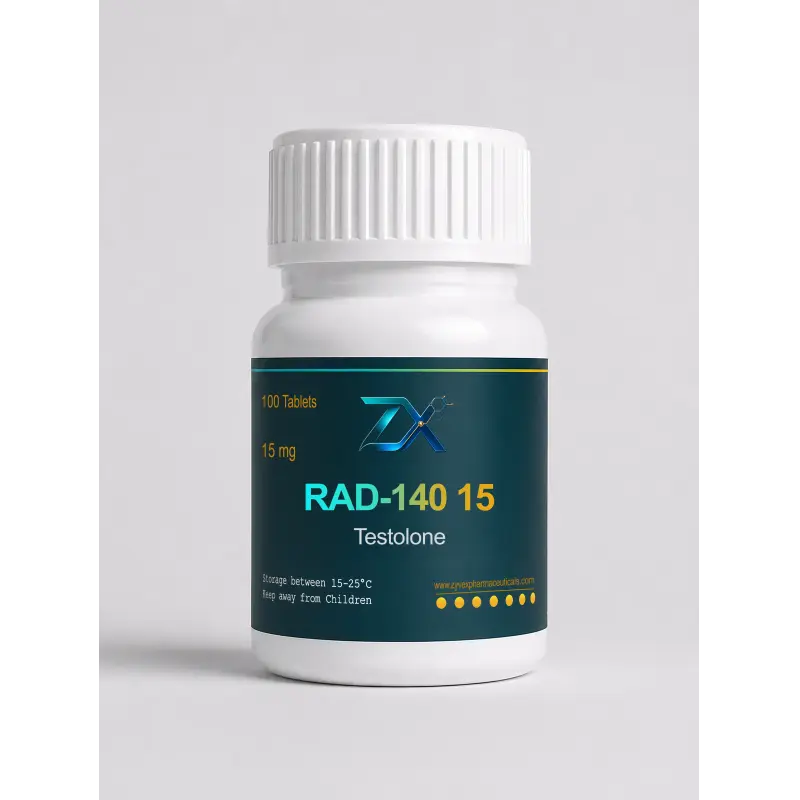
Zyvex Pharmaceuticals offers Testolone as one hundred tablets, and the compound behind the name is RAD 140, also written vosilasarm. It is a non-steroidal agonist at the androgen receptor with a high affinity for that target, which is the reason a small oral amount produces a measurable androgenic signal at all. The long half-life of 45 to 60 hours makes the once-daily tablet arithmetic simple and keeps the level steady between doses.
What the compound is not is a steroid, and the practical differences are easy to list. It does not aromatise, so fluid retention and breast tissue effects do not belong to it and an aromatase inhibitor has no role. It does suppress natural testosterone, which was shown directly in primate work where the fall reached roughly half of baseline. And it carries a liver signal that is unusual for something without the methyl group of an oral steroid: preliminary clinical work reported rises in both AST and ALT, and the literature on non-medical use describes cases of liver injury.
The development history is worth knowing before the numbers. The compound was studied for breast cancer and later considered for muscle-wasting conditions, and those programmes were stopped. That leaves the consumer with a research compound whose human dataset is small and whose selling amounts sit well above the amounts anyone studied. It is filed with the other oral products in the range, from Ligandrol LGD 4033 through to Ostarine MK 2866, and it is the most potent of the three on paper.
Dosage Protocol
No approved dose exists for any indication. The rows below separate research convention from the higher amounts used outside it.
| Level | Amount | Length | Note |
| Beginner | 5-10 mg daily | 8-10 weeks | Research convention rather than a labelled figure |
| Intermediate | 10-20 mg daily | 8-12 weeks | The band used most often; one dose a day is enough |
| Advanced | Up to 30 mg daily | 8-12 weeks | Above the clinical reference points, with side effects rising accordingly |
| Female | Not confirmed | - | Virilisation risk with no safe protocol in the sources |
| Route | Oral tablet | Once daily | Long half-life holds the level; liver enzymes, lipids and testosterone belong on the schedule |
For contrast, the breast cancer research used 50 to 150 mg a day with a maximum tolerated dose of 100 mg a day, which is an oncology context and is quoted here only to show how far the consumer range sits from an approved setting. Nobody has published a safety dataset for 10 to 30 mg a day in healthy men.
Suggested Protocols
These are catalogue arrangements rather than tested stacks, and the compound is the receptor arm in every one of them.
What to Expect
- Users describe the first noticeable change around weeks two and three, which is a community timeline rather than a formal finding.
- Strength and size move gradually when training and calories are already in place, and the change is smaller than a steroid cycle produces.
- The 45 to 60 hour half-life means one tablet a day holds a flat level, so splitting the amount across the day adds nothing.
- Testosterone falls: primate work showed a suppression of around fifty percent, and that is what lies behind late-course fatigue and low interest.
- Lipids shift in models, with changes in triglycerides, LDL and HDL, so a panel belongs in the plan.
- Liver enzymes and PSA rose in early clinical work, and prostate-specific antigen plus SHBG are worth reading for anyone monitoring closely.
Side Effects and Management
Post-Cycle Therapy
The recovery question is not whether this compound suppresses the axis, because it does, but how quickly the signal fades. With a half-life of 45 to 60 hours the tablet is largely gone in a week, so the recovery window opens sooner than after a long injectable ester and later than after a SARM with a shorter tail.