Sep 22, 2026 · 10 min read
How to Read a Certificate of Analysis (COA)
BestAnabolicSteroids.com
Independent research & quality review desk
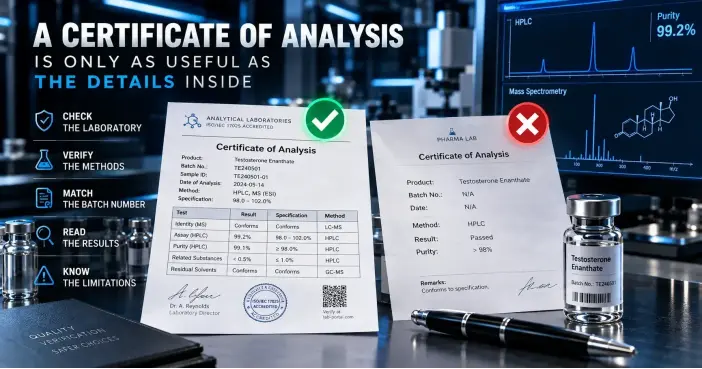
A certificate of analysis is only as useful as the details inside it. Two documents with the same layout can mean very different things depending on which laboratory produced them, what method was used, and whether the batch number matches the vial in your hand. This guide covers what to look for, in the order that matters.
What a Certificate of Analysis Is
A COA is a quality document used across pharmaceuticals, food and chemical supply: it reports which tests were run on a specific batch and how the results compare with the agreed specification. In practice that means identity, potency and purity rather than a general statement that a product is good. If you want to compare it with documents we publish for our own batches, they are collected on our certificates page.
1. Check the Laboratory, Not the Logo
The first thing to look at is who performed the test. ISO/IEC 17025 exists precisely so that laboratories can demonstrate that they operate competently and generate valid results, and it promotes confidence in their work internationally (ISO). Accreditation bodies and regulators use that standard to recognise competent laboratories, which is why a report from an accredited lab can be checked and a report from an unnamed one cannot.
Practical checklist for the header of the document: laboratory name and address, an accreditation reference, the method used, the batch or lot number, and the test date. A certificate without a laboratory named on it is a marketing sheet, not a lab report.
2. What Should Be on the Document
Industry checklists for reading a COA converge on the same short list, and it is worth using as a template when something is sent to you (COA checklist):
- Laboratory identity. Name, address and the accreditation reference, so the claim can be checked independently.
- Sample identity. What was submitted, in what form, and by whom.
- Methods. Named analytical methods rather than the word "tested".
- Results with units. Numbers against a specification, not adjectives.
- Batch or lot number and dates. Sample receipt, analysis and report issue.
- Authorisation. A named analyst or approver, which is what makes the document traceable to a person and a laboratory.
3. HPLC and Mass Spectrometry Do Different Jobs
Two instruments dominate the reports you will see. HPLC separates the components of a sample and is used to measure purity, usually reported as a percentage. Mass spectrometry confirms identity: it looks at the mass of the molecules present and shows whether the compound in the vial is the compound on the label. A report that states a purity figure with no identity confirmation answers only half the question, and a report with identity but no purity figure answers the other half (industry COA guide).
Broader laboratory testing for this kind of product usually also covers potency and, depending on the material, contaminants. The point of reading the method column is to know which of those questions the document actually answers. Potency answers how much active compound is present, which is a different question from how pure it is: a sample can be 99 percent pure and still be underfilled, and assays for content exist precisely because purity alone does not tell you the dose. Contaminant screening covers what else might be in the material, from residual solvents to microbial load, and it usually appears as a separate panel rather than as part of the purity figure.
4. Match the Batch Number
A COA describes one batch. If the number on the report does not match the number on the packaging, the document tells you nothing about what you are holding, even if it is genuine. This is the single most common gap in certificates shared online: a real report for a different batch.
5. Understand What a COA Does Not Prove
- It is not a licence. A tested compound can still be unapproved for human use. The FDA's warnings about bodybuilding products sold online are about that gap, where the product and the supply chain sit outside the regulated system.
- It does not audit the seller. The report covers the sample submitted; it says nothing about how the rest of the inventory was stored or handled.
- It can be copied. Documents get reused and edited, which is why the accreditation reference and the batch number are the parts worth verifying.
- It has a date. Purity measured two years ago says nothing about what has happened to a vial since.
- It describes a sample, not a shipment. A result measured on one vial is evidence about that vial. Whether every unit in the batch behaves the same way is a question about manufacturing consistency, which is a different question from analysis.
6. How to Verify the Laboratory
Verification is the step almost nobody performs, and it is the one that separates a real certificate from a well-formatted one. Take the accreditation reference on the document and check it with the accreditation body that issued it. Accreditation is not a general badge: it covers the methods in a laboratory's declared scope, so the useful question is whether the test printed on your certificate falls inside that scope. If a vendor cannot tell you which body accredited the lab and under what reference, the document is unverifiable by design.
7. What to Compare Between Two Reports
When two suppliers publish certificates, compare them like a reviewer rather than a shopper. Same laboratory or different? Same methods? Real batch numbers, or one report reused across a catalogue? Are the results reported as numbers with units and a specification, or as a single word such as "verified"? A document that cannot be read as data is not evidence of anything.
It also helps to sort documents by origin. A report from a named, accredited third-party laboratory is one kind of evidence. A summary produced in-house by the seller, with a logo and no laboratory details, is a different kind, and the phrase third-party tested only means something if the third party can be identified.
8. What Good Documentation Looks Like
Judging a supplier's documentation as a set is more revealing than judging any single certificate. Five signals are worth checking before you read the numbers at all.
- One report per batch. A catalogue where the same document appears under different products is a catalogue with one analysis, not a testing programme.
- Recent dates across the range. If every report is from the same month two years ago, the documents describe the past rather than the stock.
- Named methods and units. HPLC with a percentage, mass spectrometry with an identity confirmation, results against a specification.
- A verifiable laboratory. A named lab with an accreditation reference that survives being checked.
- Consistent formatting. Real reports differ from one another; a single template with changing values is a red flag, not a sign of consistency.
None of this makes a product approved or legal, and none of it replaces medical advice. It does tell you whether the documentation in front of you is the output of a laboratory or the output of a marketing department.
Questions People Ask
What is the difference between a COA and a lab report?
In everyday use they are the same thing: a document from a laboratory stating which tests were run on a batch and what the results were. What matters is whether the laboratory is named and accredited.
Is HPLC purity the same as quality?
No. Purity tells you how much of the sample is the target compound; mass spectrometry tells you whether that compound is the right one. Quality claims need both, plus a batch match.
Do accredited laboratories test steroids?
Accreditation is granted to a laboratory for the methods in its scope, so the question to ask is whether the specific test you need is covered. That reference number on the certificate is what allows you to check.
Can a certificate be faked?
Yes, easily. That is why the useful checks are the ones that require effort to fake: a named accredited laboratory, a real method, a batch number that matches, and a recent date.
Why do some certificates have no numbers?
Because a summary with a logo is cheaper to produce than an analysis. If a document does not state results with units against a specification, treat it as a claim rather than a measurement.
Should every batch have its own certificate?
In a properly documented system, yes. A single report reused across a catalogue tells you about one batch, not about the stock it is attached to.
How old can a certificate be?
The date on the document starts a clock rather than proving anything permanent. A result describes the material at the time of analysis, and storage since then is not covered by it.
Important: this article explains how to read laboratory documentation for information only and is not medical, legal or regulatory advice. Products sold on this site are intended for research purposes.
More about how we source and test is on the about page, and shipping and ordering questions are answered in the FAQ.