Sep 22, 2026 · 10 min read
SARMs vs Steroids: What the Difference Actually Is
BestAnabolicSteroids.com
Independent research & quality review desk
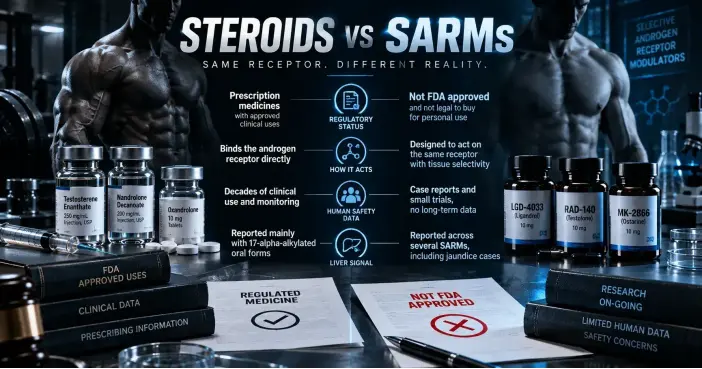
SARMs are usually marketed as the safer, more selective alternative to anabolic steroids. The comparison that actually matters is not marketing copy but three plain things: what regulators say about each, what human safety data exists, and what has been reported in people who use them.
The Short Comparison
| Point | Anabolic steroids | SARMs |
|---|---|---|
| Regulatory status | Prescription medicines, with approved clinical uses | Not FDA approved, and not legal to buy for personal use |
| How it acts | Binds the androgen receptor directly | Designed to act on the same receptor with tissue selectivity |
| Human safety data | Decades of clinical use and monitoring | Case reports and small trials, no long-term data |
| Liver signal | Reported mainly with the 17-alpha-alkylated oral forms | Reported across several SARMs, including jaundice cases |
Where SARMs Came From
The idea behind SARMs was selectivity: compounds intended to act on the androgen receptor while sparing tissues where androgenic effects are unwanted. The FDA's own description is less technical, calling them chemical substances that mimic the effects of testosterone and anabolic steroids, and noting that they are not approved (FDA consumer update).
How the Two Categories Differ on Paper
A 2026 review compares classic anabolic androgenic steroids and SARMs directly across molecular mechanisms, pharmacokinetics and safety. Its summary of the state of play is careful rather than promotional: SARMs offer partial tissue selectivity and reduced adverse effects in some measures, which is the promise, while the comparison of pharmacokinetics and safety is exactly where the open questions sit (Vasilev et al., 2026).
Selectivity is a spectrum, not a switch. An anabolic steroid delivers a broad androgenic signal, which is why its effects and its adverse effects arrive together and are well characterised. A SARM is designed to push that signal toward specific tissues. What the design does not do is make the compound approved, tested over decades, or free of hepatic effects.
The Approval and Legal Question
This is the part that separates the two categories most clearly. A 2023 systematic review opens with a sentence that deserves to be quoted without softening: SARMs are not FDA approved, and obtaining them for personal use is illegal (Vignali et al., 2023). Anabolic steroids, by contrast, are controlled prescription medicines with recognised clinical applications, which is why their risks are documented in prescribing information rather than in forum posts.
Two clarifications help here. First, that regulatory statement is about the United States market, where the FDA is the relevant authority; other countries have their own schedules and their own enforcement, so a product being sold openly somewhere is not evidence that it is approved anywhere. Second, SARMs were not invented as supplements. They were developed as candidate medicines, which is why the same review excluded patients with cancer and chronic disease on the grounds that the risk-to-benefit balance of SARM therapy differs sharply in those populations. The recreational market is a side effect of that research programme, not its purpose.
What the Safety Data Shows
That same review collected the safety evidence on SARMs in generally healthy adults. The case reports included 15 instances of drug-induced liver injury, one Achilles tendon rupture, one case of rhabdomyolysis and one case of mild reversible liver enzyme elevation. In the clinical trials it examined, elevated ALT was commonly reported, with a mean of 7.1 percent across trials.
The authors also describe the trend rather than a single event: between 2020 and 2022 the number of published cases of liver injury associated with SARM use rose sharply, and they call the combination of growing popularity, serious adverse events and social media influence an emerging public health concern.
Other sources point the same way. The NIH LiverTox monograph notes multiple reports of clinically apparent liver injury with jaundice in people taking SARMs for bodybuilding (LiverTox, NCBI), and a 2024 case report on LGD-4033 (Ligandrol) describes it as associated with significant adverse effects including hepatotoxicity and cardiovascular risk (Labban et al., 2024).
Tendon rupture and rhabdomyolysis are worth pausing on, because they are not the risks people expect when they buy something advertised as the mild option.
The size of the evidence base is itself part of the story. To assemble that review, the authors searched four databases and registered trial records, started from over a thousand titles and, after removing duplicates and screening, ended up with a set of case reports and small trials in generally healthy people. Their own framing is that the safety picture in the population that actually uses these compounds recreationally was not well described before this work. A category with a decade of use behind it and a literature that thin is a category whose risk profile is still being written.
The Compounds Behind the Cases
The case literature is not about one molecule. LGD-4033 has a dedicated case report and is the most frequently named, but the 15 liver injury cases in the systematic review span multiple compounds sold as SARMs, and the review's inclusion criteria were any SARM and any generally healthy user. That matters for how the risk is read: the problem is attached to the category as it is sold, not to a single bad batch or a single product line.
What Is Still Unknown
The honest summary of the evidence base is that it is thin in the ways that matter. The data comes from case reports and from trials that were not designed to answer long-term safety questions, and there is no equivalent of the decades of monitoring that prescription androgens carry. As one clinical overview puts it, the risks of misusing anabolic steroids have been studied and understood for years (Cleveland Clinic). The same sentence cannot yet be written about SARMs.
Anyone comparing the two categories needs to weigh that asymmetry: one has a documented safety record and a prescription pathway, the other has a growing list of case reports and a market that sits outside the regulated supply chain.
What to Check in a Product Sold as a SARM
Because these compounds are not approved and are sold largely through vendors, the label tells you less than the category name suggests. The FDA has issued warnings about bodybuilding products containing SARMs, and the review literature describes the market as the reason case reporting has accelerated. If a product cannot state who made it, under what quality system, and what analytical testing was performed, there is no basis for treating its contents as known.
It is also worth noticing how the claims are worded. The review authors attribute part of the growth in popularity to social media influence, which is a useful signal when reading any comparison: a claim that arrives with a discount code attached has not been through the process that turns a molecule into an approved medicine. The published evidence on SARMs is case reports and small trials in healthy adults, and the published evidence on anabolic steroids is decades of clinical use. Those two sentences are the whole comparison, and no marketing page changes them.
Questions People Ask
Are SARMs safer than steroids?
The marketing says yes, the data does not. SARMs are unapproved, and the published case series include liver injury with jaundice, tendon rupture and rhabdomyolysis.
Are SARMs legal to buy?
No. According to the FDA and to the systematic review quoted above, they are not approved, and obtaining them for personal use is illegal.
Do SARMs affect the liver?
Yes, that is the most consistent signal in the literature: 15 liver injury cases in one review, a mean 7.1 percent rate of elevated ALT across trials, and jaundice reports in the LiverTox monograph.
Do SARMs need a recovery protocol afterwards?
The safety reviews do not cover recovery protocols, and this article will not pretend otherwise. Hormone levels after any suppressive compound are a clinical question answered with bloodwork, not with a forum template.
Can SARMs be used instead of steroids to avoid injections?
That is the sales pitch. The trade-off is not injections versus tablets; it is a documented prescription medicine versus an unapproved compound with case reports of serious harm.
What is in a SARM product?
That is a separate problem. Products sold online as SARMs sit outside the regulated supply chain, which is one reason the FDA has issued warnings about bodybuilding products containing them.
Which SARMs have been linked to liver injury?
LGD-4033 has its own case report, and the systematic review's 15 liver injury cases span several compounds sold as SARMs rather than a single one.
What does the FDA say about SARMs?
That they are not approved and that they are described as substances mimicking testosterone and anabolic steroids, sold largely by online vendors outside the regulated supply chain.
Important: this article summarises published research and regulatory statements for information only and is not medical advice. Products sold on this site are intended for research purposes.
You can see how research compounds are listed in our SARMs section, check the full catalog, or read the FAQ for ordering details.