Nov 11, 2026 · 7 min read
Liver Support on an Oral Cycle: What Actually Helps
Best Anabolic Steroids
Independent research & quality review desk

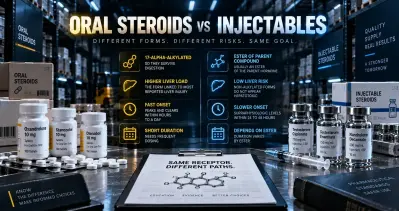
Oral steroids have a reputation problem that is half deserved and half misunderstood. Injectables pass through the liver with little consequence; the C17-alpha-alkylated orals do not. That single chemical change, added to survive digestion, is what makes the liver work harder. This page is about what that actually means, which blood markers move, and what is worth doing about it.
Why orals stress the liver
Testosterone taken by mouth is destroyed in the gut and on the first pass through the liver. To survive that trip, every oral anabolic has a molecule added at the 17th carbon position. The change works: the drug reaches the bloodstream. It also means the liver has to process a compound it cannot easily clear, and bile flow is the first thing to suffer.
The practical consequence is a split inside the same class. Injectables such as testosterone enanthate, nandrolone or trenbolone avoid the 17-alpha step and rarely produce liver injury on their own. Orals carry the risk: oxandrolone, stanozolol, methandienone, oxymetholone, methyltestosterone, turinabol. Dose and duration decide how much of that risk you take on.
What the case data shows
Two recent case series describe the pattern better than any forum anecdote.
Stanozolol, 18 patients, Latin American DILI Registry, 2013 to 2023. All were men aged 19 to 48 using the drug for appearance. The mean time from starting to first symptoms was 55 days. Jaundice and itching were the leading complaints, bilirubin was raised in every case, GGT stayed normal or only slightly above it, and transaminases rose only mildly. The authors describe this as a distinctive cholestatic phenotype: bile is the problem, not raw cell destruction (Nunes et al., J Clin Exp Hepatol 2025;15(3):102506).
Australia, 23 cases across nine hospitals, 2017 to 2023. Anabolic steroids, SARMs and bodybuilding supplements combined. Median age 30, median latency 58 days, 21 of 23 symptomatic, 17 of 23 admitted to hospital. Median time for liver biochemistry to return to normal was 175 days, with a wide spread from 70 to 292 days (Nash et al., Aliment Pharmacol Ther 2024;59(8):953-961).
Two numbers worth remembering: symptoms usually appear around the second month, and recovery takes months, not days. Both series also note that many users took more than one compound at a time, which makes attribution harder and the injury more likely.
Which markers matter
| Marker | What it tells you | What to watch for |
|---|---|---|
| ALT and AST | Liver cell stress | Mild rises are common on orals. A rise above 3x the upper limit that does not settle after stopping needs a doctor |
| GGT and ALP | Bile flow | Often normal even when bilirubin is high, which is exactly the stanozolol pattern |
| Total and direct bilirubin | How well bile drains | The marker that matters most. Any visible jaundice is a stop signal, not a monitoring note |
| Albumin and INR | How well the liver still works | Falling albumin or a rising INR means synthetic function is affected. Urgent |
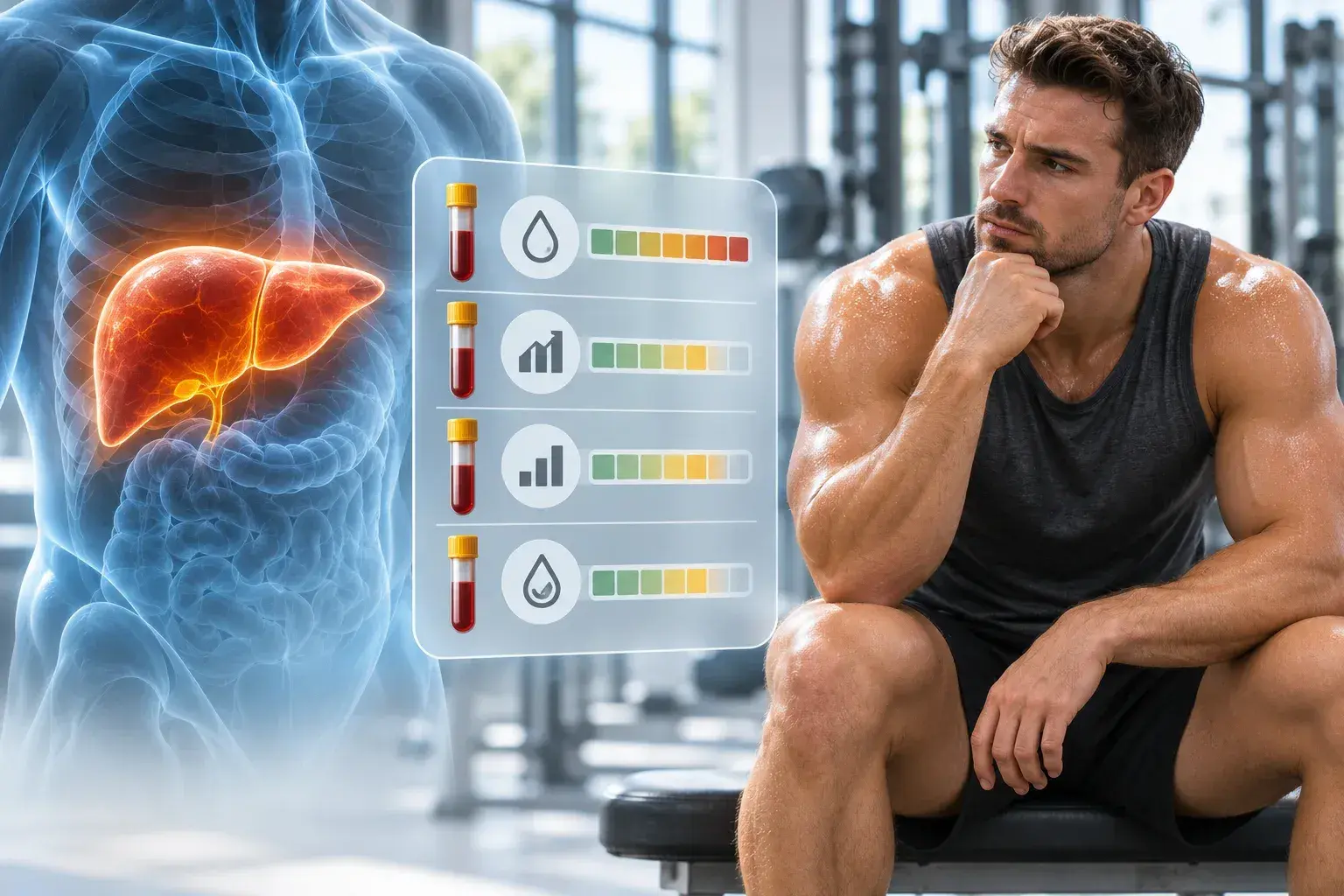
The combination that worries clinicians is a high ALT together with a raised bilirubin and no sign of gallstones. In drug safety work this is called Hy's law, and it flags a risk of serious injury rather than a transient blip.
Red flags that mean stop
- Yellowing of the eyes or skin, dark urine, pale stools.
- Itching that keeps you awake, especially on the hands and feet.
- Pain under the right ribs, nausea, loss of appetite.
- Any bilirubin result above the reference range with symptoms.
None of these is a reason to wait for the next blood test. Stopping the oral is the first move, and a doctor is the second.

What actually helps
Stopping the oral. The only intervention with a clear record behind it. In both series above, biochemistry improved after the drug was withdrawn, though slowly.
Not stacking orals. Two methylated compounds at once do not give twice the result and do put twice the load on the same pathway.
Shorter courses, lower doses. The latency data, around eight weeks, lines up with how long most oral kickstarts run. Extending an oral to twelve or sixteen weeks is the single most common way people turn a manageable elevation into a cholestatic episode.
Alcohol and paracetamol. Both compete for the same liver capacity. Neither belongs in a heavy oral block.
UDCA and TUDCA. Ursodeoxycholic acid is a real treatment for cholestasis of other causes, and tauroursodeoxycholic acid is its taurine conjugate, sold as a supplement. For steroid-induced cholestasis the evidence is case-level, not trial-level: there is no controlled study showing it shortens recovery. It is reasonable to discuss with a doctor, not reasonable to treat as insurance that lets you run a longer cycle.
NAC and milk thistle. N-acetylcysteine is established for paracetamol poisoning and used experimentally in other liver injuries; silymarin has been studied for decades with inconsistent results. Neither has data specific to anabolic steroid injury. They are not harmful at normal doses, but they are not a substitute for the two things that work: lower exposure and stopping.
Monitoring schedule
| Point | What to test |
|---|---|
| Before starting | ALT, AST, GGT, ALP, bilirubin, albumin, full blood count. A baseline is what makes later results readable |
| Week 4 | ALT, AST, GGT, bilirubin |
| Week 8 | Same panel. This is where the published cases started to show symptoms |
| Any time symptoms appear | Full liver panel plus INR. Do not wait for the scheduled draw |
| 4 to 8 weeks after stopping | Full panel. Expect slow normalisation, up to several months in reported cases |
FAQ
Sources
- Nunes V. et al. Stanozolol-induced liver injury: a distinctive cholestatic clinical and biochemical phenotype. J Clin Exp Hepatol 2025;15(3):102506. doi - latency of 55 days, bilirubin raised in all 18 cases, GGT normal or near normal.
- Nash E. et al. Drug-induced liver injury from SARMs, anabolic-androgenic steroids and bodybuilding supplements in Australia. Aliment Pharmacol Ther 2024;59(8):953-961. doi - 23 cases, median latency 58 days, 17 admissions, median 175 days to normalise.
- Dukewich M., Stolz A. Anabolic steroid-associated liver injury. Clin Liver Dis (Hoboken) 2024;23(1):e0196. doi - spectrum of injury from enzyme elevation to cholestasis.
- Petrovic A. et al. Anabolic androgenic steroid-induced liver injury: an update. World J Gastroenterol 2022;28(26):3071-3080. doi - mechanism, 17-alpha-alkylation and bile flow.