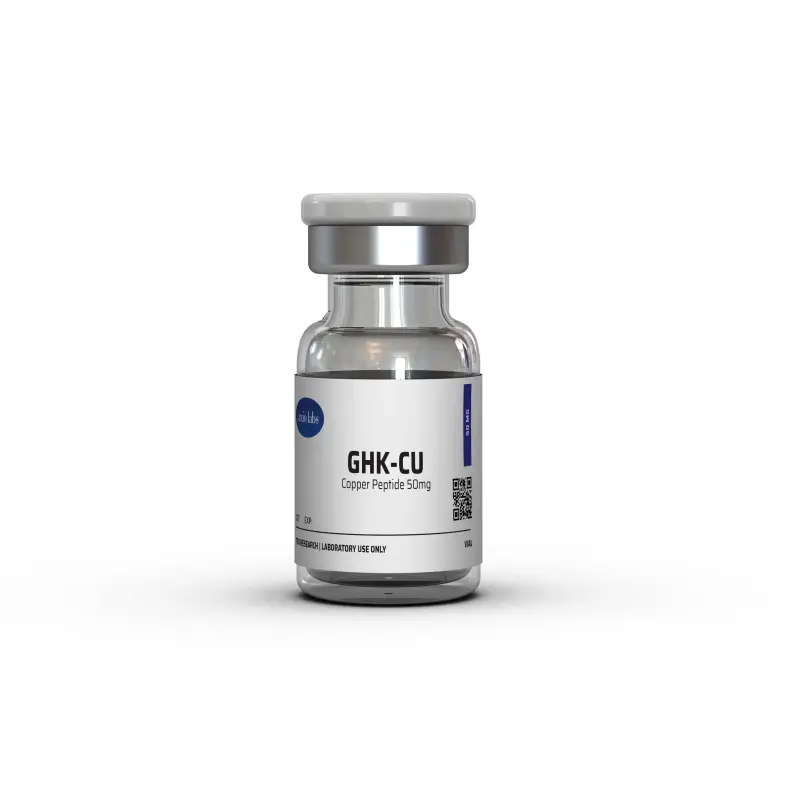
Buy GHK-Cu 50 mg by Axiolabs at Best Anabolic Steroids. The vial holds 50 mg of the copper tripeptide complex as a lyophilised powder: three amino acids, glycine, histidine and lysine, bound one to one with a copper ion. It is mixed with bacteriostatic water before use, and the concentrate is deep blue-green because of that copper.
It is a research material rather than a medicine. Copper peptides are best documented in skin biology and in experimental wound models, and the reference sheets for this catalogue state plainly that no human half-life, no validated human dose and no human safety file exist for the vial on this page.
Product Overview
The peptide was first isolated from human plasma and later found in saliva and urine, where it appears to serve as a copper carrier. In laboratory work on fibroblasts it is associated with collagen and glycosaminoglycan synthesis, antioxidant activity and an anti-inflammatory effect, and copper itself is a cofactor in enzymes involved in connective tissue maintenance.
Two limitations follow from that evidence base. The first is route: almost everything published concerns topical application or cell cultures, while injection data in humans are absent. The second is pharmacokinetics. No human elimination half-life exists, so any dosing discussion is arithmetic on a label rather than modelling of a curve. On the competitive side the substance was not found in the WADA prohibited list, though that is an absence of a finding rather than a licence to use it.
Dosage Protocol
Nothing about this peptide is approved, so the figures below are laboratory and vendor reference points. With a 50 mg vial the arithmetic is straightforward, and it is worth writing the numbers down before the first draw.
| Reconstitution | 2-5 ml of bacteriostatic water in the 50 mg vial, giving roughly 10-25 mg per ml depending on the volume chosen |
| Research reference | Around 1-2 mg daily has been used in models; this is a laboratory figure, not a human dose |
| Duration | Determined by the study design; no validated human course length is published |
| Women | No separate female protocol appears in the sources; nothing is confirmed |
| Route | Topical application dominates the literature; subcutaneous use in humans is not documented |
Working with a 50 mg vial
Five millilitres of water in a 50 mg vial yields 10 mg per ml, so 0.1 ml carries 1 mg and reads as 10 units on a U-100 syringe. Two millilitres yields 25 mg per ml, which triples every draw for the same reading on the barrel. Copper is the reason the solution looks the way it does, and it is also the reason a vial should not be treated casually by anyone who reacts badly to the metal.
Suggested Protocols
Practical use clusters into short, exploratory blocks rather than long schedules, and the mixed vial is the part that needs discipline. Because the peptide is not hormonal, there is no cycle stacking logic to follow, and the same vial supports skin-focused work or experimental systemic use without any change to its handling.
Where the vial is used alongside a training plan that already includes hormones, the hormonal side is planned separately: a base such as Testaplex P 100 on its own injection rhythm, Arimiplex held in reserve for a genuinely high estradiol reading, and Exeplex as the second option when an inhibitor is warranted in a longer block. The peptide itself does not interact with any of them.
What to Expect
- Timelines in people are unknown. Wound contraction and faster healing are model findings; the reference material lists no human schedule at all.
- Skin cells respond in culture. Fibroblast studies describe more collagen and more glycosaminoglycan, which is the biological basis usually quoted for cosmetic interest.
- Topical work is the bulk of the data. Anything injected is extrapolation from topical and laboratory findings rather than a tested route.
- The copper colour is expected. A blue-green tint after mixing means the complex is intact, not that the product has spoiled.
- Sterility is entirely on the user. A research vial carries no guarantee of dose accuracy beyond the supplier label.
- Cold chain matters more than dose tinkering. A warm or repeatedly thawed solution is the most common way to waste a vial like this.
Side Effects and Management
After the Course and Follow-Up
No post-cycle therapy is needed, and there is no hormonal reason to plan one. The tripeptide does not touch the gonadal axis, so testosterone production continues as before, and the only follow-up worth doing concerns the mixed vial and the condition of the skin or site being studied.
Anti-estrogens such as Tamoxiplex 20 and Clomiplex 50, and growth hormone support such as AxoTropin, belong to other plans in the same catalogue and are listed with everything else in the Axiolabs range on Best Anabolic Steroids.