Product Overview
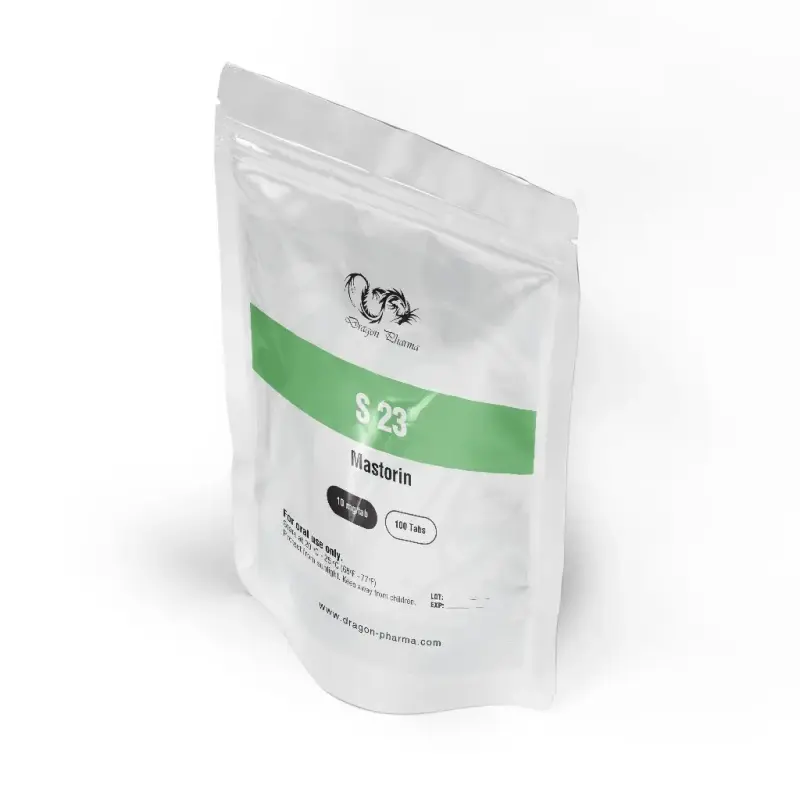
S 23 Mastorin by Dragon Pharma is what this card covers. The listing here is the 10 mg tablet, 100 tablets to a box, and S 23 is the compound the catalogue files under the name Mastorin. It is a research SARM that went into development as a candidate male hormonal contraceptive, and that single fact frames everything else on this page: the molecule was studied for its effect on sperm production, not for its effect on a physique. Human dosing was never published, no elimination half-life has been established, and most of the practical numbers in circulation come from non-medical use rather than from controlled work.
S-23 belongs to the selective androgen receptor modulator class, a group of non-steroidal molecules built to bind the androgen receptor with some tissue selectivity. S-23 sits at the potent end of that group: published receptor work places its binding affinity above that of older SARMs, which is exactly why it attracted attention as a contraceptive candidate rather than as a training compound. In that programme the target was dose-dependent suppression of spermatogenesis, and suppression of that kind is the opposite of what someone buying a SARM for performance usually wants.
Your order is a box of 100 oral tablets at 10 mg each, manufactured by Dragon Pharma. The catalogue name Mastorin carries no pharmacological meaning; the active substance is S 23 in both spellings, S-23 and S23. Because the compound is sold for laboratory and reference use, the pack is the unit of interest: strength per tablet, count per box, and the fact that no clinical label, no validated dosing schedule and no pharmacokinetic dataset accompanies it. Treat what you receive as a research material with a known identity and an unknown human profile.
Mechanism of Action
The mechanism is receptor binding. S-23 docks onto the androgen receptor and switches on the same gene programme that testosterone switches on, but without the conversions that make a steroid messy: it is not aromatised to estrogen and it is not reduced to DHT, so neither water retention nor gynecomastia is part of its profile. Androgen receptor activation in skeletal muscle is the reason people look at it at all, and the same activation in the testis and pituitary is the reason the contraceptive programme existed.
The suppression story is the important one. Gonadotropin signalling from the pituitary drives testicular testosterone production and sperm maturation, and a strong androgen signal tells the pituitary to cut that signalling down. In the published work this produced the intended fall in sperm output while testosterone itself was held within range, which is coherent for a contraceptive and awkward for anyone planning a training block, because the axis that supports natural production is being deliberately quieted. Nothing in the literature establishes how quickly that state reverses in humans at any given dose, so recovery timelines should be read as open questions rather than as known quantities.
Dosage Protocol
There is no studied human protocol to reproduce, so the table below is explicit about where each line comes from. The only figures with any following behind them are the lower end of the non-medical range, and even those are practice rather than data.
| Studied human dose | Not established: the research programme published no human dosing schedule |
| Non-medical range | 10-25 mg a day, oral, reported practice rather than trial data |
| Reported cycle length | 4-8 weeks in practice; no controlled comparison supports the figure |
| Administration | One oral tablet daily, 10 mg per tablet, 100 tablets to the box |
| Upper limit | Nothing above the reported range appears in peer-reviewed work |
| Female use | No data; no female protocol is given here |
Dividing the daily figure is a habit carried over from shorter-acting orals. Since nothing is known about how long a single S-23 dose lasts, splitting it is guesswork dressed as care.
Suggested Protocols
Because the compound suppresses the gonadotropin signal, anyone stacking it would normally be stacking it around a testosterone base rather than beside another suppressive SARM. The layouts below are drawn from the way SARMs are arranged in practice, and they are offered as structure, not as tested protocols.
What to Expect
Expectation has to start with a warning about expectation. There is no body of human performance data to draw a month-by-month picture from, so the points below are drawn from what the published work does and does not describe.
Read the result the other way round as well: an unproven compound is not a weak compound, and the absence of numbers is an absence of safety information, not evidence that nothing happens.
Side Effects and Management
Class-level warnings are all that can be offered honestly. Case reviews of SARM users describe cholestatic and hepatocellular liver injury, and while S 23 is not named in every report, there is no reason to assume it is exempt from a risk that runs across the group.
The practical precaution is dosage discipline. With no studied ceiling, the reported range is a boundary set by practice rather than by pharmacology, and going above it does not buy better data, only more exposure to a compound whose organ effects have not been characterised.
Tablets of this kind are supplied for laboratory reference, so keep them in the original blister and box and store them at room temperature, away from direct sunlight, heat and damp. A bathroom cabinet is the wrong place because of the humidity; a dry cupboard with a stable temperature is the right one. Keep the batch identification with the pack so that any later test can be tied to a specific lot, and keep the material out of the reach of children and pets.
Do not move the tablets into an unlabelled container and do not combine them with anything else in one bottle. If you are holding the compound alongside other research items, record the date the pack was opened and check the tablets for chipping or discolouration before use. Anything that has changed colour, crumbled, or smells of solvent should be set aside rather than taken.
Post-Cycle Therapy
This is the section that matters most with this compound, because sperm suppression was the whole point of the research programme it came from. Anyone using it should assume the gonadotropin axis needs support afterwards and should plan the exit before the first tablet.
A restarted axis is usually attempted with a SERM such as Nolvadex or Clomid in the way these drugs are used after a suppressive steroid cycle, and some protocols add HCG 5000 iu while the compound clears. None of that has been validated against S-23 specifically, so the sensible position is that you are borrowing a protocol from a different drug class and should follow it with bloodwork rather than with confidence.
Every listing on this page states the exact strength, the exact tablet count and the manufacturer before you commit, so the pack you are reading about is the pack that ships. Orders are dispatched discreetly, pricing is shown in both international and US domestic terms on the product page, and the material is supplied as a research reference rather than as a medicine. If S 23 is not the right fit, the same catalogue carries the rest of the Dragon Pharma line, from injectable bases to recovery compounds, and our support team will talk through what a card actually contains before you order.