Product Overview
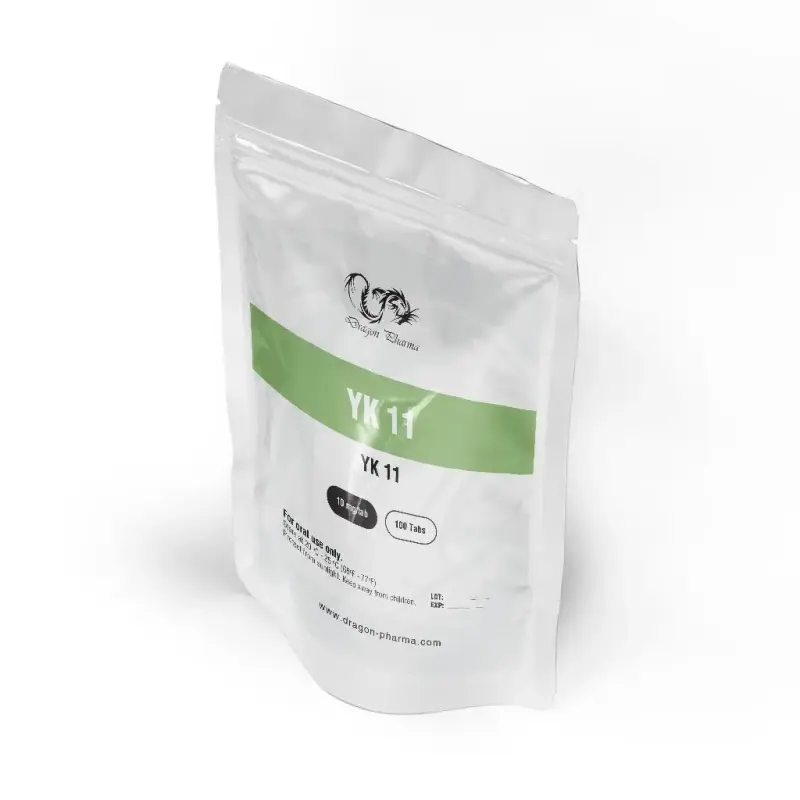
YK-11 is the odd one out in the SARM shelf: a molecule with a steroidal backbone rather than the non-steroidal frame that LGD-4033 or ostarine use, classed as a selective androgen receptor modulator because of how it behaves at the receptor rather than because of its chemistry. It acts as a partial agonist there, and laboratory work places its anabolic potency above DHT in cell models. The name attached to the card in this catalogue is Myostatin, which comes from the line of research the compound is best known for, and the pack itself is a single 10 mg tablet, 100 tablets to a box.
What the card cannot offer is a human profile. There is no published pharmacokinetics for YK-11, which means no elimination half-life, no clearance curve and no measured window for a drug test. The published work that exists is mechanistic and largely pre-clinical, so the material is presented here as a research compound rather than as something with an established course. Anyone comparing it with LGD 4033 or MK 2866 should note that both of those have trial data behind them and this one does not.
The one structural expectation that does carry over is a lack of aromatisation, so water retention and estrogenic effects are not part of the expected picture. The rest of the profile - suppression of the natural axis, liver load, how long any effect lasts - is reasoned from the SARM class rather than from YK-11 itself, and that distinction is worth keeping in view on every page that sells it.
Dosage Protocol
No human dose for this compound has been established, and extrapolating from cell-culture work is not a medical recommendation. The rows below therefore report the state of the sources rather than offering a schedule.
| Beginner | Not established: no human dose appears in the literature, and the 10 mg tablet is the only fixed unit the pack offers |
| Intermediate | Not established: amounts used in the non-medical market are copied across from other SARMs rather than studied for this one |
| Advanced | Not established: no upper range can be quoted, and no source describes a tolerance ceiling |
| Female | No confirmed female protocol exists in the sources; the compound carries an androgenic profile, and nothing on the female side has been characterised |
| Administration | Oral tablet; the pack is a single 10 mg strength, and the sources record no dosing interval to follow |
| Reference point | Published research is in vitro and animal work on myostatin inhibition and AR signalling, not a human dose-finding study |
Research Context and Laboratory Notes
The intellectual case for YK-11 rests on myostatin, a signalling protein that puts a brake on muscle growth. A 2021 paper describes the compound in that role, and the mechanism is genuinely interesting: block the brake and the same training stimulus may produce more tissue. In vitro work reports anabolic activity above DHT, while animal data raise a separate flag about oxidative stress and mitochondrial function. Both findings come from models, not from people.
That gap shapes how the material should be treated in a laboratory setting. Because no human clearance data exist, no washout period can be calculated and no accumulation profile can be predicted; sequential work with the same subject has no evidence base to stand on. Basic handling is the ordinary one for a sealed oral product: keep it in the original pack, dry and out of direct light, and respect the printed expiry date. The sources behind this card record no stability study for the tablet, so no shelf life beyond the manufacturer marking can be quoted.
Where a comparison is wanted inside the same catalogue section, GW501516 Cardarine is a different class of research material altogether, and MK 677 works through the growth hormone axis rather than the androgen receptor, so the three cannot be treated as interchangeable bench reagents.
What to Expect
- Timeline. The only timeline available is the SARM pattern, two to four weeks before anything is noticeable; no measurement exists for this molecule specifically.
- Strength and density. The reported picture is force output and a denser look without subcutaneous water, which follows from non-aromatisation rather than from a trial result.
- Partial agonism. Because receptor activation is partial, the effect profile cannot be read across from a full androgen, even when the doses look comparable on paper.
- Libido and drive. A falling libido is described as a class effect of suppressive SARMs, so it belongs in the expected list rather than the surprise list.
- Honest limit. No human data cover dose, adverse events or pharmacokinetics for this compound, so every expectation here is class-level.
- Regulatory limit. SARM products as a group have drawn FDA warnings, and user reports of liver injury are documented in review literature.
- After stopping. Recovery has to be planned the way it is planned after any suppressive SARM, with a SERM and follow-up bloodwork.
Side Effects and Management
Nothing here is quantified for YK-11 itself, so each entry names the class risk and the monitoring route that would catch it early.
Post-Cycle and Follow-Up
Recovery cannot be dated for this compound, because there is no clearance figure to count from. What can be described is the shape of the restart used across the SARM group in this catalogue, applied with that uncertainty stated openly.