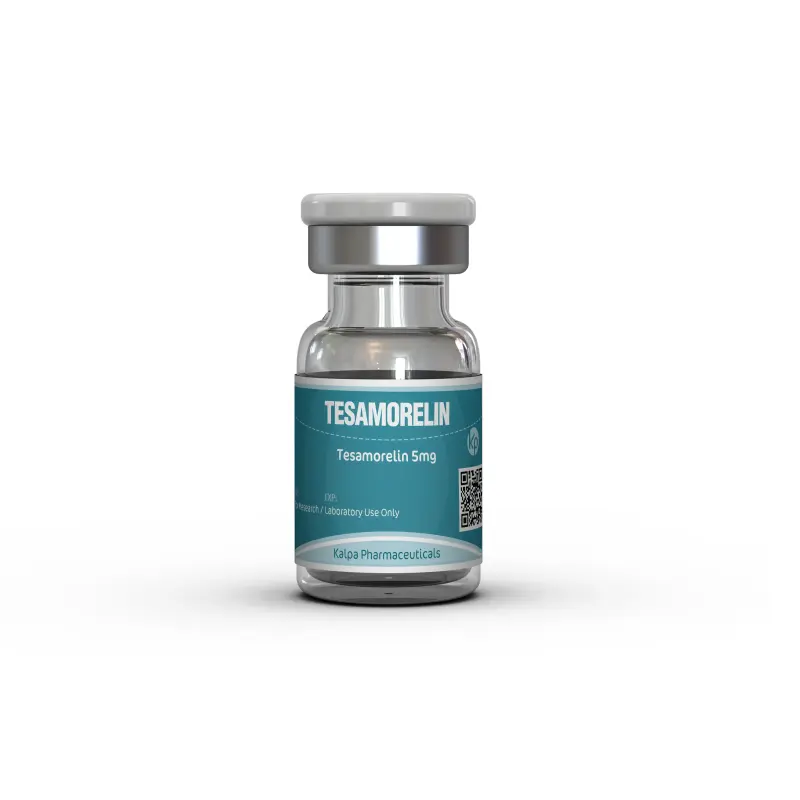
Tesamorelin 5 mg from Kalpa Pharmaceuticals is a growth hormone releasing hormone analog carrying a chemical alteration that slows its breakdown, and that one change separates it from the older releasing hormone fragment sold in the same catalogue.
It is also one of the few peptides in this class with a licensed product behind it, approved for a specific patient group rather than for general use. The distinction matters, because the approved dose belongs to that population and to that indication, not to a healthy person buying a research vial.
Product Overview
Tesamorelin is a synthetic releasing hormone analog that docks onto the pituitary receptor and sets off a burst of the body's own growth hormone, with IGF-1 rising downstream. The modification makes it more resistant to enzymatic breakdown than the plain fragment, although its measured half-life is still very short: around eight minutes after a 1.4 mg subcutaneous dose in the label data for the more recent approved form, about eleven minutes for the frozen form, and a range of twenty-six to thirty-eight minutes reported in general pharmacokinetic sources.
The approved indication is visceral fat accumulation in patients with a specific condition, and the clinical programmes treated people daily over long periods rather than in short blocks. Results in that setting are real and measured, but the population was not athletes, and the sources say nothing about how the drug behaves in healthy people training for physique.
The vial offered here is not the approved medicine. It is research-grade material with the same active substance, and it ships without a licensed label, which is a distinction worth keeping in view when reading any dose table. The same shelf holds a short-acting releasing hormone fragment, sermorelin, and a ghrelin-receptor approach in the growth hormone packs such as Kalpatropin 100 IU, which supplies finished hormone instead of asking the gland to make it.
Dosage Protocol
The reference amounts below are the doses of the approved injectable product. They are quoted so the arithmetic can be seen, not as a recommendation for a research vial.
| Beginner | No separate research protocol; the lowest approved daily dose is 1.4 mg subcutaneously |
| Intermediate | The other approved daily amount is 2 mg, given subcutaneously once a day |
| Advanced | Clinical programmes ran long term and daily; no research block length is validated |
| Female | No conditioning protocol for women is present in the reviewed sources |
| Administration | Subcutaneous injection once a day, usually into the abdomen under the approved directions |
Everything turns on the vial arithmetic. Mix a 5 mg bottle with 1 ml of water and every millilitre carries 5 mg, so each ten-unit graduation of the barrel reads 0.5 mg; use 2 ml and each millilitre drops to 2.5 mg, so the same graduation reads 0.25 mg. At the approved 1.4 mg a day a single 5 mg vial empties in under four days, and at 2 mg a day in two and a half. That is arithmetic, not a verdict on quality, and it is why the product is usually discussed as a short stretch rather than a season. Mix with Bacteriostatic Water and keep the solution refrigerated.
Suggested Protocols
The lanes below describe how the peptide is positioned against its neighbours rather than how to combine it with anything, because the class is used as a single agent.
Every other vial on the peptide shelf takes a different route altogether, whether that is the repair work of BPC 157 or the appetite-lowering action of Mounjarixyl, which cuts intake instead of raising growth hormone.
What to Expect
- A short pulse per injection. Growth hormone and IGF-1 rise for a limited window after each shot, which is the reason for daily dosing rather than weekly.
- Visceral fat change is a long game. In the clinical data the reduction was recorded after months of daily treatment, not after a fortnight.
- The evidence belongs to another population. The approved use is in patients with a specific fat-distribution condition, and transfer to healthy users is unproven.
- Vial coverage is the binding constraint. Five milligrams does not stretch to a week at the approved amounts, so any course is really a series of bottles.
- Growth-peptide side effects apply. Swelling, joint aching and injection site reactions are described for the class and scale with the amount.
- Testing is permanent. Releasing hormone analogs are prohibited at all times, and this one is named in the list.
Side Effects and Management
After the Block and Follow-Up
The peptide sits upstream of the gonadal axis, so no SERM phase belongs after it. What matters afterwards is metabolic and observational.
When a hormonal course runs at the same time, its own esters set the recovery calendar, whether that base is a blend such as Sustaxyl 350 or a lone ester such as Testoxyl Enanthate 250. This peptide takes no part in it.
Storage and Ordering
The unmixed vial stays cold and dark, and the reconstituted solution is kept refrigerated and used inside the vendor window without repeated freezing and thawing. When the parcel arrives, inspect the batch code and expiry, satisfy yourself that the stopper is sealed, and set the label against the Kalpa Pharmaceuticals catalogue listing for this strength.
Everything ships discreetly, and delivery choices are listed on the product page.