
Nov 28, 2026 · 7 min read
Clomid vs Nolvadex: Half-Life, Warnings and Which Fits
Best Anabolic Steroids
Independent research & quality review desk

- Dragon Pharma Clomid 50 mg
- Geneza Clomiphene 50 mg
- Kalpa Clomixyl 50 mg
- British Dragon Clomiphene 50 mg
- Zyvex Clomid 50 mg
- Xeno Clomiphene 50 mg
What each drug actually is
Clomiphene citrate, sold as Clomid. The approved label describes it as a drug for ovulation induction. It is a mixture of two isomers, and the label is explicit about what that means: zuclomiphene (cis) has a longer half-life than enclomiphene (trans), and detectable levels of zuclomiphene persisted for longer than a month in single-dose studies in normal volunteers. That single sentence explains most of what people notice in practice: the drug is doing something long after the course is over.
Tamoxifen citrate, sold as Nolvadex. The label describes a treatment for breast cancer, with a terminal elimination half-life of about 5 to 7 days and a boxed warning covering endometrial cancer, uterine sarcoma and thromboembolic events, including deep vein thrombosis and pulmonary embolism.
Neither label mentions post-cycle recovery. That is not a technicality: it means everything in the next section is about documented pharmacology, not about an approved indication.
Where they differ
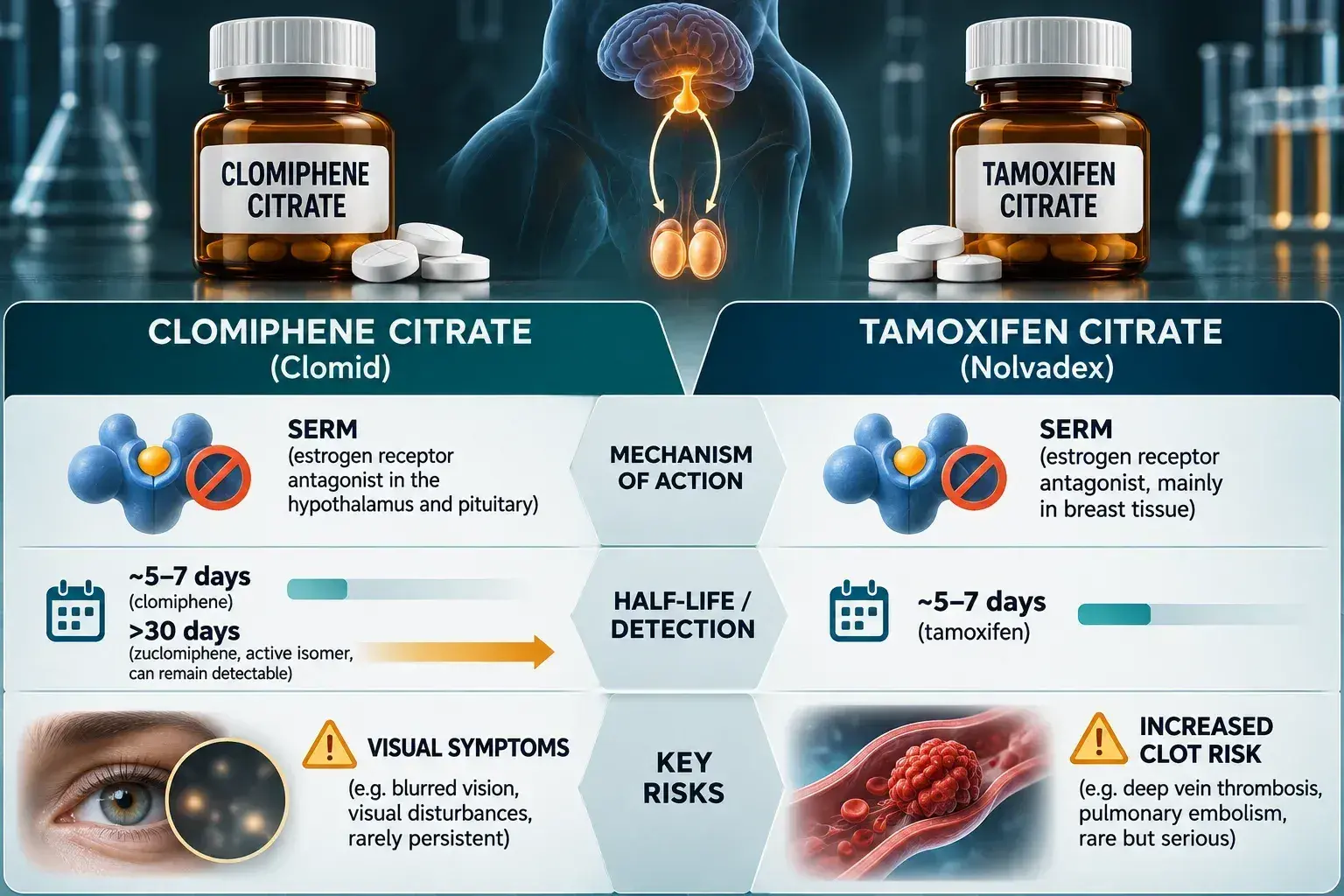
| Property | Clomiphene (Clomid) | Tamoxifen (Nolvadex) |
|---|---|---|
| Class | SERM, isomer mixture | SERM |
| Approved use | Ovulation induction | Breast cancer treatment and risk reduction |
| Half-life, per label | Zuclomiphene detectable beyond one month after a single dose | Terminal half-life about 5 to 7 days |
| Pituitary effect | Blocks oestrogen feedback, raises gonadotropin output | Same receptor, different tissue balance |
| Boxed warning | None | Endometrial cancer, uterine sarcoma, thromboembolism |
| Signature side effects | Visual symptoms: blurring, spots, flashes | Clot risk, endometrial changes, hot flushes |
Why they are used after a cycle
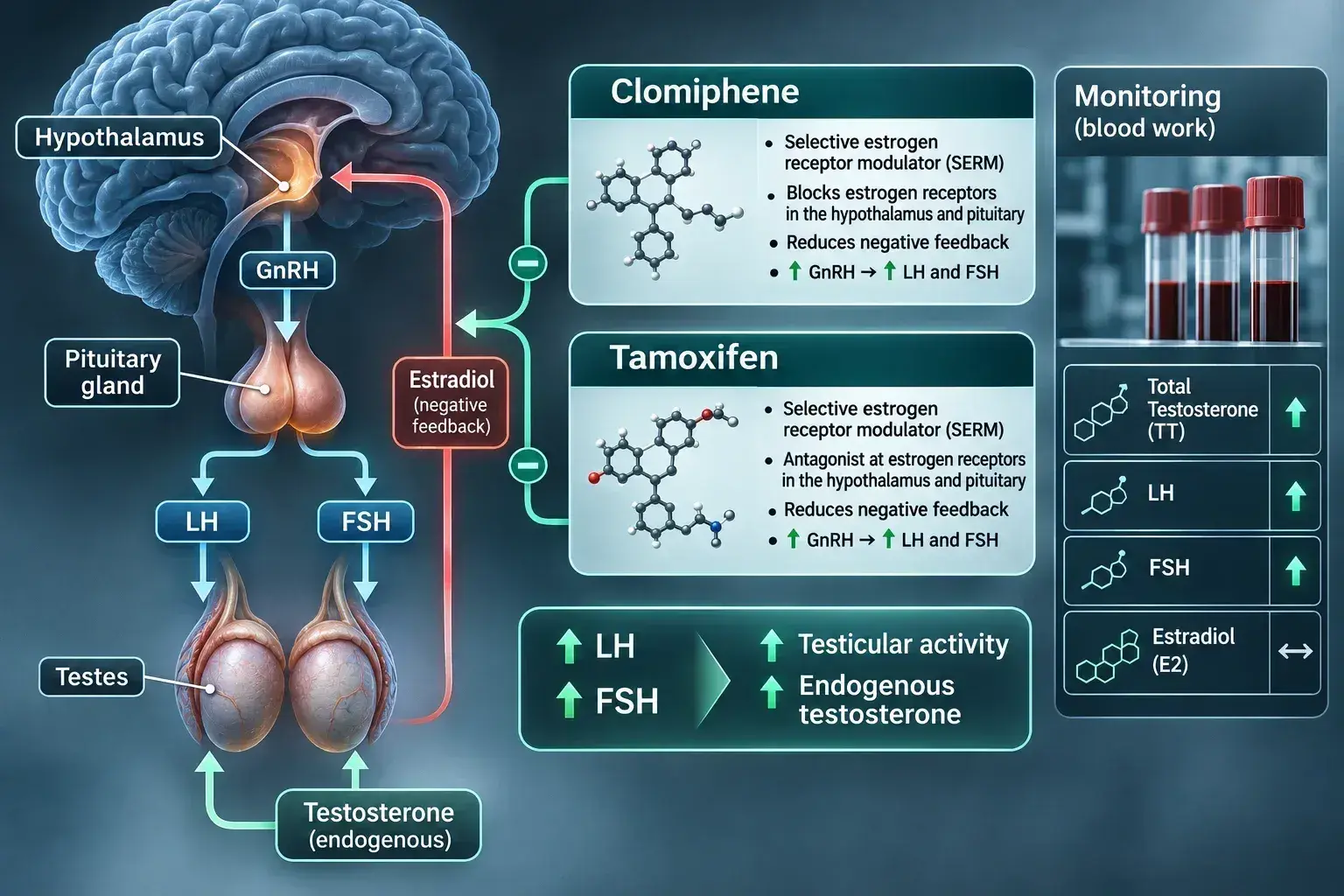
Exogenous androgen suppresses LH and FSH. When the exogenous hormone clears, the pituitary has to start signalling again, and a SERM is used to block oestrogen feedback at the hypothalamus and pituitary so that gonadotropin output rises faster.
Clomiphene has the better published record in men, even though that is not its approved use. A 2026 systematic review and meta-analysis compared clomiphene with testosterone replacement in male hypogonadism and framed clomiphene as an approach that restores endogenous testosterone while preserving fertility, in contrast to replacement therapy which suppresses spermatogenesis (Constantinou et al., Eur J Clin Pharmacol 2026). That is the closest thing to a clinical basis for using it in this context, and it is still not a post-cycle trial.
Tamoxifen's human evidence sits in oncology, where long courses are used and the clot and endometrial risks are managed with that in mind. The relevant lesson for a short course is not that it is safer, but that the risk profile was serious enough to require a boxed warning.
Side effect profiles
Clomiphene. The label warns about visual symptoms: blurring, spots or flashes described as scintillating scotomata. These are rare but they are the reason the label tells patients to report them, and the practical rule is the same: if vision changes, stop and get it checked rather than continuing the course.
Tamoxifen. The boxed warning is about thromboembolism and uterine malignancy. In a short course the absolute risk is low, but the direction of the risk is not in doubt, and anyone with a personal or family history of clots should be discussing it with a doctor rather than reading a forum.
Both. Hot flushes, mood changes, headache and fatigue are commonly reported with SERMs and are not dangerous in themselves. They are also the reason people stop early, which matters because a half-finished course does not answer the question it was meant to answer.
Choosing between them
Four factors worth weighing, in order:
- What you are trying to achieve. If the goal is restoring your own gonadotropin output and fertility matters, clomiphene has the closer evidence base. If it is short-term oestrogen blockade at the breast tissue level, that is tamoxifen's territory.
- Clot and uterine history. Any personal or family history of thromboembolism moves tamoxifen down the list. This is a doctor conversation, not a forum one.
- Vision. Any prior episode of visual disturbance on clomiphene means the next discussion starts with an alternative.
- Duration. Clomiphene's long-acting isomer means the effect does not stop when the tablets do. That makes short courses more sensible than extended ones.
Combining them is common in practice and has no trial behind it. Two SERMs at the same receptor do not produce two mechanisms.
What to monitor
Whatever is used, the useful measurements are the same: total testosterone, LH, FSH and oestradiol before starting and four to eight weeks in, plus a full blood count and liver panel if anything else was in the stack. The timing and the meaning of each marker are covered in our guide to blood work on cycle, and the broader recovery picture is in post-cycle therapy.
Frequently Asked Questions
Sources
- DailyMed. Clomiphene citrate tablets, prescribing information. label - ovulation induction, zuclomiphene half-life and detection beyond one month, visual symptom warning.
- DailyMed. Tamoxifen citrate tablets, prescribing information. label - boxed warnings for endometrial cancer, uterine sarcoma and thromboembolism, terminal half-life 5 to 7 days.
- Constantinou B.T. et al. Clomiphene citrate versus testosterone replacement therapy in male hypogonadism: systematic review and meta-analysis. Eur J Clin Pharmacol 2026;82(8):204. PMID 42435198 - clomiphene restores endogenous testosterone while preserving fertility.