Product Overview
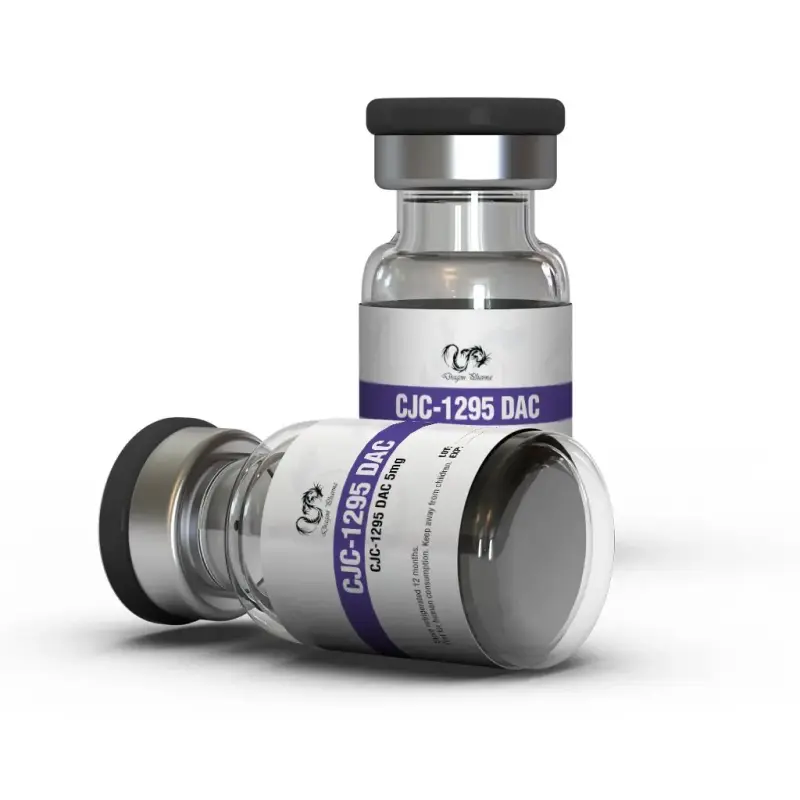
Dragon Pharma CJC-1295 is one 5 mg lyophilised vial of CJC-1295 with DAC, a peptide that also circulates in catalogues under the descriptive label tetrasubstituted 30-amino acid peptide hormone. DAC stands for drug affinity complex, a small albumin-binding anchor grafted onto the GHRH(1-29) backbone, and that anchor is the entire reason this vial behaves differently from the short secretagogues sold next to it. After injection the analogue associates with circulating albumin instead of being cleaved in minutes, which pushes its reported half-life out to roughly six to eight days, with reviews quoting a spread from 5.8 to 8.1 days.
The receptor target itself is unchanged. The molecule attaches to the GHRH receptor carried by pituitary somatotroph cells and drives growth hormone release, which in turn lifts IGF-1. Data from the ConjuChem clinical programme are the only human pharmacokinetic anchors available, and they are reproduced here as reference rather than as a schedule: one injection lifted plasma growth hormone 2 to 10 fold across six days or more, IGF-1 by 0.5 to 3 fold across 9 to 11 days, and with repeated dosing elevated IGF-1 was still measurable at 28 days. That is the opposite shape to a pulse peptide, and it explains why research conventions around the DAC version describe occasional injections rather than a nightly rhythm.
Two limits belong early rather than in a footnote. No approved dosage form, no ATC code and no licensed regimen exist for this material, because the phase II programme was halted in 2006 after a participant death, which makes everything numeric below reference arithmetic. Growth hormone releasing factors are also named in WADA class S2.2.4 and prohibited in and out of competition. The short-acting counterpart is discussed alongside Ipamorelin, while the direct exogenous route belongs to the Dragontropin somatropin page.
Research Use and Reconstitution
The vial is a powder and has to be dissolved before any bench work, so the arithmetic of that step matters more here than a dose table would. Values below are reference figures for laboratory handling.
| Presentation | One sealed 5 mg lyophilised vial, vacuum-packed; a research material, not a medicine |
| Diluent | Bacteriostatic water directed down the inner glass wall, then swirled; a peptide solution is never shaken |
| Concentration | 5 mg plus 2 ml gives 2.5 mg/ml, so a 0.1 ml draw carries 250 mcg, which is the 10 unit mark on a U-100 barrel |
| Research amounts | No single figure for the DAC version is fixed in the sources used here; vendor and research writing describe infrequent injections on the order of once a week, and the individual number stays unconfirmed |
| Interval | Days rather than hours, a direct consequence of the six-to-eight-day half-life and the albumin-bound fraction still releasing hormone between administrations |
| Route | Subcutaneous injection is the route described for this peptide class; rotate the point of entry and keep the volume small |
| Female | The sources consulted hold no confirmed female schedule for CJC-1295 with DAC |
| Reference driver | IGF-1 response, not a calendar, is what the clinical programme data actually describe, and even that is reference information |
Suggested Protocols
There is no validated combination protocol in the reviewed sources, so these are bench pairings taken from growth hormone peptide writing. Every pill opens the matching product page, and all of them sit in the same Dragon Pharma section.
An oral growth hormone secretagogue such as MK 677 is sometimes cited as the convenient alternative, but it works through the ghrelin receptor and shares neither the mechanism nor the duration of an albumin-anchored GHRH analogue.
What to Expect
- Growth hormone response. The clinical programme recorded a 2 to 10 fold rise in plasma growth hormone lasting six days or longer after one injection.
- IGF-1 lags and lasts. The 0.5 to 3 fold IGF-1 increase develops more slowly over 9 to 11 days, and repeat dosing kept the level raised for up to 28 days.
- Skin, sleep and recovery reports come first. These are what users describe during the early weeks; strength and training output are not the leading observations with this class.
- Fluid and joint sensations. Puffiness, stiffness in the hands and general joint ache are the class effects described for extended growth hormone exposure.
- Development takes weeks, not days. Even with a half-life measured in days, the visible side of the response builds over repeated administrations.
- Limitation: no approved reference point. There is no licensed dose to compare against, so nothing on this page is a target.
- Limitation: the long view is unstudied. No data in the sources used here cover the remote safety of holding GH and IGF-1 above physiological levels for months.
Side Effects and Management
Reported events are the ones attributed to the growth hormone secretagogue class as a whole. They follow exposure and duration more than the individual molecule, and the human safety literature for this peptide specifically is thin.
Monitoring and Storage
Cold chain and readout markers are the two practical subjects left once the profile is clear. Neither replaces an approved monitoring standard, because none exists for a research peptide.