Product Overview
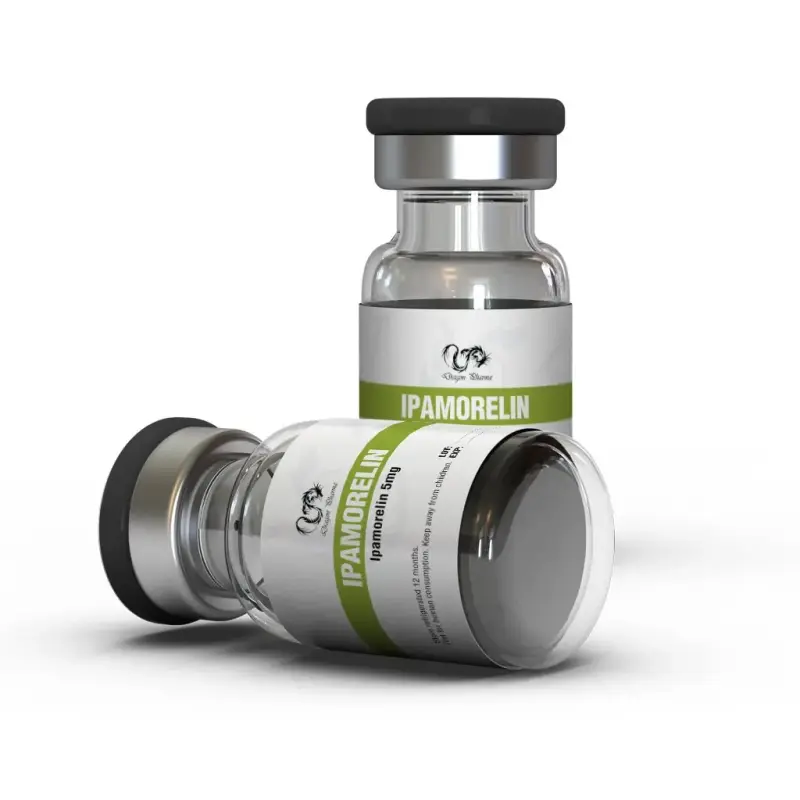
Ipamorelin 5mg from Dragon Pharma arrives as a single lyophilised vial: a freeze-dried pentapeptide powder that has to be dissolved before any laboratory work begins. The molecule belongs to the growth hormone secretagogue family and acts on the ghrelin receptor, so its readout is a pituitary growth hormone pulse rather than a change at an androgen receptor. Reference literature describes it as selective, meaning it releases growth hormone with a much smaller rise in cortisol and prolactin than the older peptides in the same group. The label states the peptide mass, so working concentration follows from the millilitres of solvent used and is never read off a fill line.
The pharmacokinetic anchor for this vial is human data. Terminal half-life is about two hours with a clearance of 0.078 L/h/kg, measured in clinical work, and that single number drives the whole protocol: nothing is esterified, nothing is converted slowly, so the response tracks the injection curve directly and a once-daily shot cannot hold a level. Empty-stomach timing matters for the same reason, because food blunts the growth hormone pulse. Researchers who want a releasing-hormone signal alongside a secretagogue usually pair it with CJC-1295 Dac, while Tesamorelin covers the same idea with a different analogue profile.
The vial fits bench work where the endpoint is an endogenous hormone pulse, and community writing about it concentrates on sleep quality, appetite and recovery rather than on size. Timelines are quoted in months because vendor protocols run 12-16 weeks with a four-week break between blocks. Every vial needs a solvent, which makes Bacteriostatic water the natural companion purchase, and a somatropin reference such as Dragontropin is useful for comparison studies. Anyone inside a testing programme should be clear that the peptide is prohibited at all times under WADA class S2.
Dosage Protocol
No regulator has approved a human performance dose of this peptide, so the rows below are the published research and vendor reference values for the material. They are reference arithmetic for laboratory use, not a prescription for any person.
| Research amount | 200-300 mcg per injection, two to three times daily, is the vendor and community reference figure; a human sport dose is not confirmed in reviewed sources |
| Reconstitution | Bacteriostatic water into the 5 mg vial; the vendor method uses 5 mg plus 2 ml for 2500 mcg/ml, where 10 units on a U-100 scale equal 250 mcg |
| Timing | Empty stomach, roughly two hours after the last meal; before sleep and around training are the two windows quoted in practice |
| Course length | Vendor protocol gives 12-16 weeks followed by a four-week break |
| Route | Subcutaneous injection; rotate sites and keep the injected volume small |
| Female | The sources used here contain no verified female schedule, and no human performance dose is established for men either |
| Administration | The roughly two-hour half-life is the reason the schedule matters as much as the amount, since levels fall quickly between administrations |
Stacking and Combinations
The reviewed sources contain no validated combination protocol, so what follows is a set of bench pairings drawn from growth hormone peptide writing rather than a plan. Each pill leads to the product page and every item sits inside the Dragon Pharma section.
What to Expect
- Sleep and recovery reports. The changes most often described by users appear in the first 1-3 weeks of a block.
- Hormone pulse timing. Growth hormone rises within an hour of an injection, but the subjective effect accumulates slowly.
- Body composition. Vendor protocols are written in months, not weeks, so a 12-16 week block is the realistic frame.
- Appetite. A ghrelin effect after the injection is commonly reported and has to be planned around if diet is controlled.
- Frequency burden. With a two-hour half-life, one injection per day cannot hold a level, so the schedule itself is the main commitment.
- Evidence limit. The sport dose for this peptide is not confirmed by reviewed human sources, so every published protocol here is a vendor figure.
- Testing status. The peptide is an example substance in WADA class S2 and is prohibited at all times.
Side Effects and Management
Reported events are the ones described for the growth hormone peptide class as a whole, and they are mainly dose-related rather than compound-specific. The larger limitation is the thin human safety literature.
Storage and Handling
Solvent volume and cold storage are the two things about this vial that are genuinely documented, so the rows below collect exactly those values. Other research materials from the same section include Epitalon, GHK-CU and IGF-1 LR3.