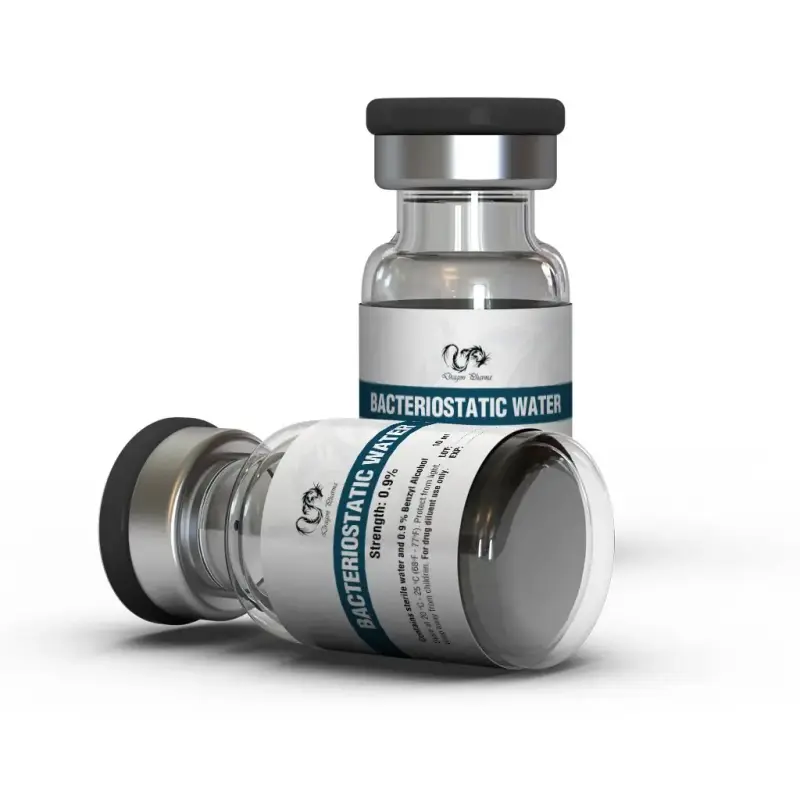
Buy Bacteriostatic Water by Dragon Pharma at Best Anabolic Steroids. This vial is a diluent, not a compound: sterile non-pyrogenic water with 0.9 percent benzyl alcohol, supplied in a multi-dose container for reconstituting lyophilised peptide and hormone powders. It has no dose, no cycle and no half-life of its own. What it does have is a measurable job - turning a cake of powder into a concentration you can draw accurately on an insulin syringe - and a shelf life that starts ticking the first time the septum is pierced.
Product Overview
Bacteriostatic water for injection is sterile, non-pyrogenic water to which 0.9 percent benzyl alcohol has been added, which works out at about 9 mg per millilitre. The pH is close to 5.7, within a 4.5 to 7.0 range. The alcohol is the entire point of the product: it suppresses microbial growth, and that is what allows one container to be entered more than once over a period of weeks.
That single property separates it from plain sterile water, which contains no preservative. Sterile water can be used to dissolve a powder, but an unpreserved container has to be treated as a single-use item once opened, which is impractical when a peptide vial is drawn from daily. Bacteriostatic water is the version that survives repeated draws.
Two things about the purchase itself should be stated plainly. The volume of the container is not fixed in the reference material used for this page, so check the label on the vial you receive rather than assuming a number. And this is a solvent, so nothing on this page describes a dose of the product itself - the amounts below are volumes of water added to something else.
How the Preservative Keeps a Multi-Dose Vial Usable
Benzyl alcohol at 0.9 percent acts as a bacteriostat rather than a sterilant. It does not sterilise a vial that has been contaminated; it makes the environment hostile enough that organisms introduced by a needle are unlikely to multiply between draws. That distinction is why technique still matters even when the water is preserved.
The mechanism behind its limit is the same one that makes the product unsuitable for some patients. Benzyl alcohol is metabolised to benzaldehyde and benzoic acid, and in newborns the clearance pathways are immature, which is why preserved water is explicitly not for neonatal use. The preservative is doing useful work in a multi-dose container for an adult research protocol and is a hazard in a neonatal one.
What to Expect When the Powder Meets the Water
- A clear solution. Correctly reconstituted powder dissolves into a transparent liquid with no cloudiness or floating particles.
- Slower microbial growth. The benzyl alcohol is what makes repeated draws reasonable over the life of the container.
- Measurable draws. Once a known volume has been added, every unit on a U-100 syringe corresponds to a fixed amount of peptide.
- A dated deadline. After the first puncture the default period of use is 28 days at refrigerator temperature, counted from the day the septum is entered.
- An unopened shelf life. A sealed container keeps for two to three years at room temperature, so it can be ordered ahead of the powder it will dissolve.
- A hard stop. Cloudy liquid, particles or a changed appearance mean the vial is discarded, not filtered and used anyway.
- No effect of its own. Nothing about training, recovery or blood work changes because of the water; the compound in the powder is what does the work.
Volumes, Strengths and the U-100 Arithmetic
There is no dose of a diluent, so the table below is a volume guide rather than a protocol. The row that matters is the middle one, because the volume you add is what sets the concentration and therefore what each unit on the syringe delivers.
| Starting point | 1-2 ml added to a peptide vial, calculated from the nominal powder weight and the concentration you want |
| Common dilution | 5 mg powder plus 2 ml water gives 2.5 mg per ml, a convenient step size on a U-100 scale |
| Stronger dilution | 10 mg powder plus 2 ml water gives 5 mg per ml, fewer units per draw for larger amounts |
| Upper limit | Do not push past the volume at which the solution turns cloudy or will not dissolve cleanly |
| Female | The same arithmetic applies; there is no separate female rule for a solvent |
The conversion is worth writing down once. On a U-100 insulin syringe, 0.1 ml equals 10 units. At 2.5 mg per ml, 10 units is 250 mcg; at 5 mg per ml, the same 10 units is 500 mcg. Add the water slowly down the wall of the vial, swirl rather than shake, and label the vial with both the concentration and the date so the numbers are never reconstructed from memory days later.
Pairing It with the Peptides in This Catalogue
Every lyophilised product in the range needs a diluent, so this vial is not so much a stack partner as the piece of equipment that makes the others usable. The Dragon Pharma products below are the ones most often ordered with it, and each one has its own preferred dilution.
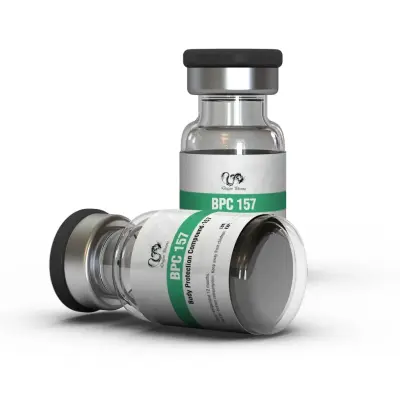
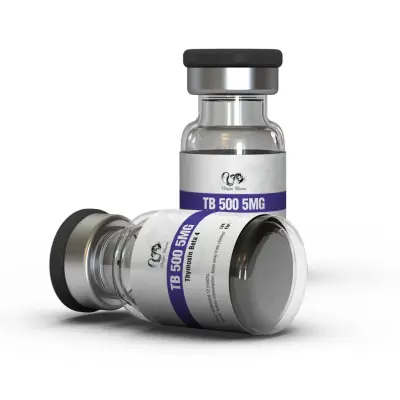
A blended repair product such as BPC 157 and TB 500 in one vial uses the same technique but sets a different concentration, so the arithmetic is redone for each product rather than reused.
Why No PCT Applies to a Diluent
Recovery sections exist on this site because anabolic compounds suppress natural hormone production. A solvent does neither of those things, so the honest answer is that nothing needs restarting after the water is used up.
That last row is the practical one. The most common error with a preserved vial is not a chemical one; it is a container that was punctured months ago and used again because nobody wrote the date on it.
Injection Risks and the Handling Precautions
The risks attached to this product are the risks of injection technique and of using the wrong water for the wrong patient, not the risks of a drug.
Storing It Before and After the First Puncture
An unopened container is undemanding: keep it at room temperature, out of direct light and away from extremes of heat, and it stays usable for two to three years. There is no need to refrigerate stock that has never been entered.
The clock changes with the first needle. Once the septum is punctured, move the container to the refrigerator at 2-8 degrees Celsius and treat it as usable for around 28 days, the figure that CDC and USP practice gives for a preserved multi-dose vial. Write the puncture date on the label, wipe the septum with an alcohol swab before and after every draw, and never leave a needle in the stopper. Discard the container when the date passes even if liquid remains, and never decant the remainder into another container, because a transferred volume carries no guarantee of sterility and no expiry date you can trust.
Buying Bacteriostatic Water Online
Anyone ordering lyophilised peptides needs one of these with the order, and the argument for buying it here is that the diluent arrives with the same shipping schedule as the powders it is meant for, from a single supplier with a declared 0.9 percent benzyl alcohol composition. The page above gives the dilution figures for the common concentrations, the U-100 conversions, the 28-day post-puncture rule and the handling warnings, so the arithmetic can be checked before the first vial is mixed rather than during a hurried injection. Order it here with the peptides from the same brand and the reconstitution becomes one documented step instead of a guess.