Product Overview
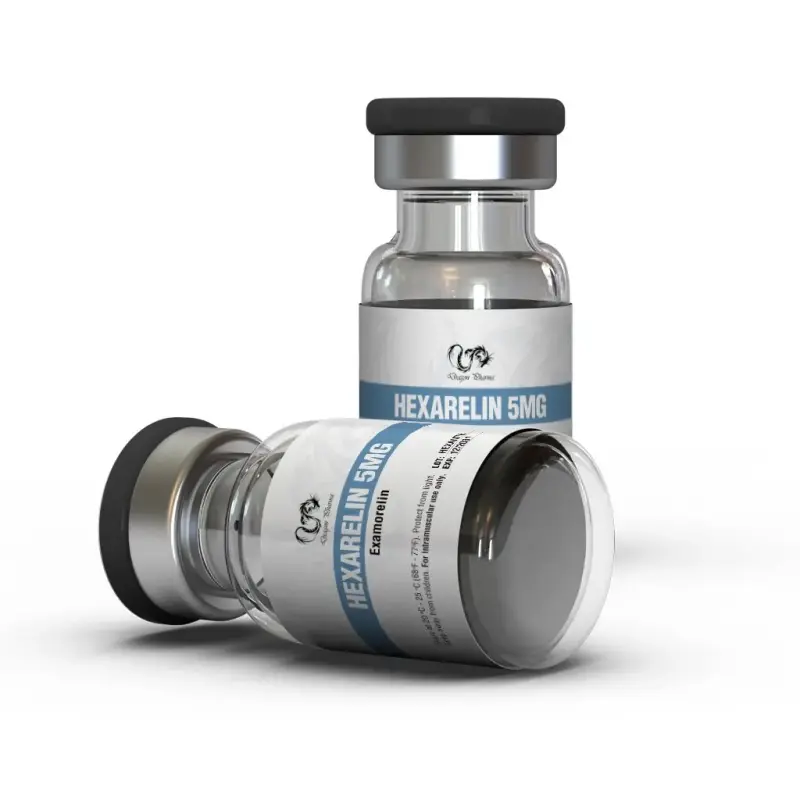
Hexarelin is a laboratory-built hexapeptide, sequence His-D-2-methyl-Trp-Ala-Trp-D-Phe-Lys-NH2, catalogued internationally under the INN examorelin and also referenced by the research codes EP-23905 and MF-6003. It sits in the growth hormone secretagogue family and works at the ghrelin receptor, the same GHSR target that the body's own ghrelin uses to provoke pituitary release of growth hormone. Dragon Pharma ships it as a 5 mg lyophilised powder in one vial, sealed for storage and placed in the catalogue as a research material rather than as a medicine.
What separates this peptide from its classmates is the size of the pulse. Comparative work puts hexarelin ahead of the GHRH analogues in raw GH output, and designs that engaged both arms at once reported synergy rather than a simple sum, because the two act on different receptors. The price is selectivity. Where Ipamorelin 5mg is written up as the cleanest member of the group, hexarelin lifts prolactin, ACTH and cortisol in people at modest amounts, an effect that appears early and tracks the dose. Elimination is quick, roughly 55 minutes, so the pituitary receives a sharp spike instead of a sustained signal.
Two boundaries set the frame. Repeated stimulation blunts the response, and the published figure is a 50-75 percent loss of effect across weeks to months, which is why long uninterrupted runs are described in the sources as pointless. The compound also never reached a market: development halted at phase II for growth hormone deficiency and chronic heart failure, no regulator approved it, and sporting codes list it in WADA class S2, prohibited at all times. Readers comparing the GHRH arm of the same axis should keep the CJC-1295 DAC 5mg and Tesamorelin 5mg cards open alongside this one.
Research Amounts and Vial Maths
The vial holds 5 mg of powder and the arithmetic that follows from it is the practical part of the sheet. Amounts below are the research conventions gathered for this card, quoted as laboratory reference values and not as clinical guidance.
| Vial | 5 mg lyophilised powder, single vial, productID 1156 |
| Diluent | Bacteriostatic water allowed to run against the glass wall, then swirled |
| Dilution | Two millilitres into the 5 mg vial yields 2.5 mg per millilitre; a 0.1 ml draw then measures 250 mcg |
| Vial life | A daily amount of 100 mcg stretches one 5 mg vial to roughly 50 days, and a 2 mg vial to about 20 days |
| Research range | 100-200 mcg subcutaneously, fasted, once or twice daily |
| Block design | 4-6 weeks of use followed by 6-8 weeks away from the peptide |
| Female | No confirmed protocol appears in the sources consulted; the material is not approved for any human use |
| Storage | Powder at 2-8 C away from light; the made-up solution at 2-8 C for no more than 28-30 days and never frozen |
Suggested Protocols
Three arrangements reflect how this vial is written up in research material. Each pill opens the matching product page inside the Dragon Pharma range.
What to Expect
- Growth hormone surge. The peak arrives fast, inside the first hour after a subcutaneous injection, and it is the largest reported for this peptide class.
- Synergy with a GHRH. Combined dosing is described as producing a stronger GH rise than either peptide alone, because the receptors are different.
- IGF-1. This is the murkiest area: some research finds no increase, other work reports a small one, so a large IGF-1 jump should not be the expectation. The AOD 9604 card covers the opposite design, a fragment chosen to avoid IGF-1.
- Corticotroph drift. Prolactin, ACTH and cortisol edge upward in a dose-dependent way and become visible even at small amounts, which is the clearest difference from the cleaner peptides.
- Appetite. Hunger often increases, as with other ghrelin-class secretagogues, though reports place it below the strong appetite effect seen with GHRP-6.
- Tolerance. Effectiveness falls by 50-75 percent over weeks to months of continuous exposure, so an off period is part of the design rather than an optional extra.
- Status. Not marketed, no approval anywhere, and prohibited in sport at all times under WADA class S2.
Side Effects and Management
The profile follows the mechanism, so the issues worth planning for are hormonal and local rather than hepatic.
Desensitisation and Off Periods
This is the section that replaces post-cycle therapy, because the peptide does not touch the gonadal axis and there is no shutdown to reverse.