Product Overview
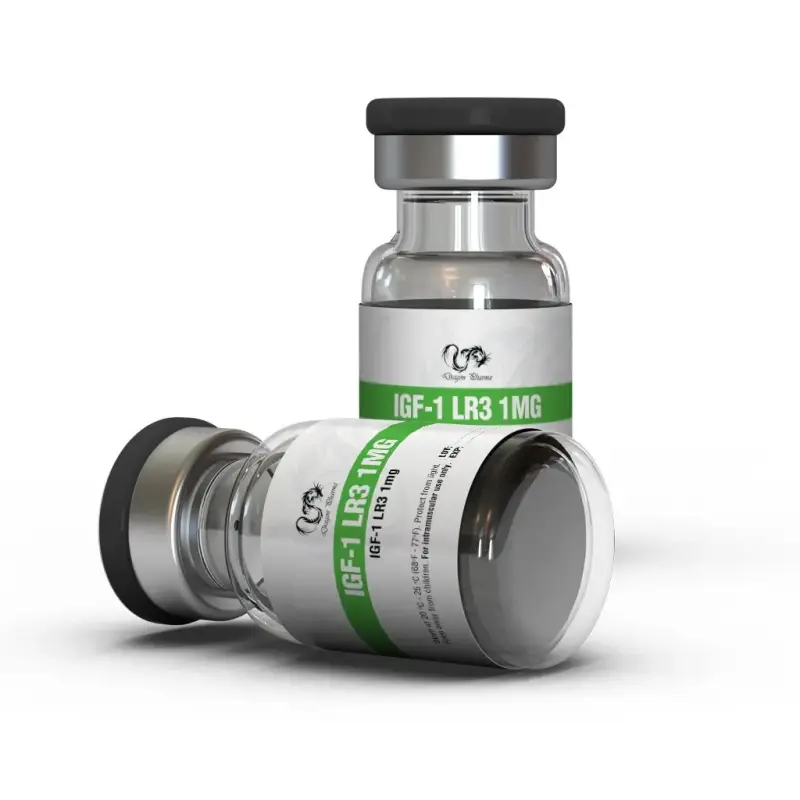
Dragon Pharma ships this peptide as a single lyophilised 1 mg vial, a freeze-dried powder that has to be dissolved before any bench work starts. The molecule is an engineered relative of insulin-like growth factor 1. Position 3 of the chain carries arginine in place of glutamic acid, and thirteen further amino acids are attached at the N-terminus, so the peptide is 83 residues long where the natural factor is 70. The point of those edits is binding behaviour rather than raw potency on paper: native IGF-1 is largely mopped up by IGF binding proteins, while the LR3 variant has poor affinity for them and therefore leaves more free peptide in circulation, with a stronger and more drawn-out signal as the result.
Duration is the one figure the sources do not settle. The main text of the reference entry places the half-life at roughly 20 to 30 hours and notes about 12 to 15 hours for the unmodified factor, while the infobox on the same page lists an elimination half-life of 56 to 72 hours. Those numbers cannot be reconciled and are not averaged here; both are shown, and any planning figure stays approximate. Two further facts frame the card. No approved medicine and no ATC code exist for this analogue - the only licensed IGF-1 product is mecasermin, recombinant human IGF-1 for severe primary IGF-1 deficiency, and it is a different molecule. Insulin-like growth factor signalling also lowers blood glucose, which makes hypoglycaemia a class-level caution rather than a rare footnote.
The natural bench companions are the secretagogues that raise the body's own growth hormone output: Dragontropin HGH, Ipamorelin 5mg, CJC-1295 DAC 5mg and Tesamorelin 5mg. All of them are handled the same way at the bench, with bacteriostatic water as the solvent, and none of them is a finished pharmaceutical product.
Research Use and Vial Handling
The table keeps two kinds of figure apart. The milligram-per-millilitre lines follow from the 1 mg vial and are arithmetic. The amounts come from vendor and forum protocols that have never been tested in a controlled human study, and where the sources say nothing the row says nothing instead of borrowing a number from a neighbouring compound.
| Solvent | Bacteriostatic water dripped onto the inside surface; the freeze-dried cake is never agitated |
| 1 mg in 1 ml | 1000 mcg per ml; on a U-100 scale ten units (0.1 ml) carry 100 mcg |
| 1 mg in 2 ml | 500 mcg per ml; ten units then carry 50 mcg, which fits the smaller reported amounts |
| Reported start amounts | 20-30 mcg a day in community protocols, not in clinical work |
| Reported working amounts | 30-50 mcg a day, again practice rather than evidence |
| Frequency | Once a day in the same protocols, most often placed after training |
| Reported course length | 4-6 weeks, followed by a break |
| Female | Nothing in the assembled source material gives a female schedule, so the row stays empty |
| Half-life for planning | About 20-30 hours in one part of the reference entry and 56-72 hours in its infobox; the disagreement is recorded as it stands |
Once dissolved, the vial belongs in the fridge between 2 and 8 C and must not go through freeze-and-thaw cycles: this is a protein chain, and a stable cold chain is what keeps the chain whole. Whatever volume is chosen, work the concentration out again before drawing, because the amount of peptide stays at 1 mg and only the added water shifts the figure.
Growth-Factor Combinations
Three arrangements appear again and again in research writing. Not one of them was evaluated as a fixed combination in a trial, so they are working layouts rather than tested regimens.
What to Expect
- First hour. A hypoglycaemic feeling - hunger, tremor, sweating - is the class signal of IGF-1 activity and can arrive 30-60 minutes after the injection; keeping carbohydrate within reach is the usual precaution in reported use.
- Day 1-7. Fuller muscles and faster recovery are what users describe first; these are reports from the field, not measured outcomes.
- Week 1-2. Work capacity tends to climb, and appetite often rises with it.
- Week 2-4. The window in which the typical 4-6 week course produces its visible effect.
- Limit of evidence. No controlled study of the LR3 analogue in people was found while this card was built; the licensed IGF-1 medicine covers a narrow deficiency indication only.
- Glucose. The strongest signal in the file is hypoglycaemia, which appears in the warnings of the approved IGF-1 product and therefore applies to the class.
- After the last dose. The effect fades, and long uninterrupted use may blunt the body's own growth hormone and IGF-1 output, which is the reason the reported course is measured in weeks rather than months.
Side Effects and Management
Nothing here is drawn from a safety study of this analogue in healthy users. The list below combines the documented insulin-like effect, the practical problems of subcutaneous work and the class logic that the sources support.
Axis Recovery and Laboratory Follow-Up
This peptide does not touch the androgen axis, so a SERM restart belongs to a different product. What deserves attention after a growth-factor block is the growth hormone and IGF-1 axis itself.