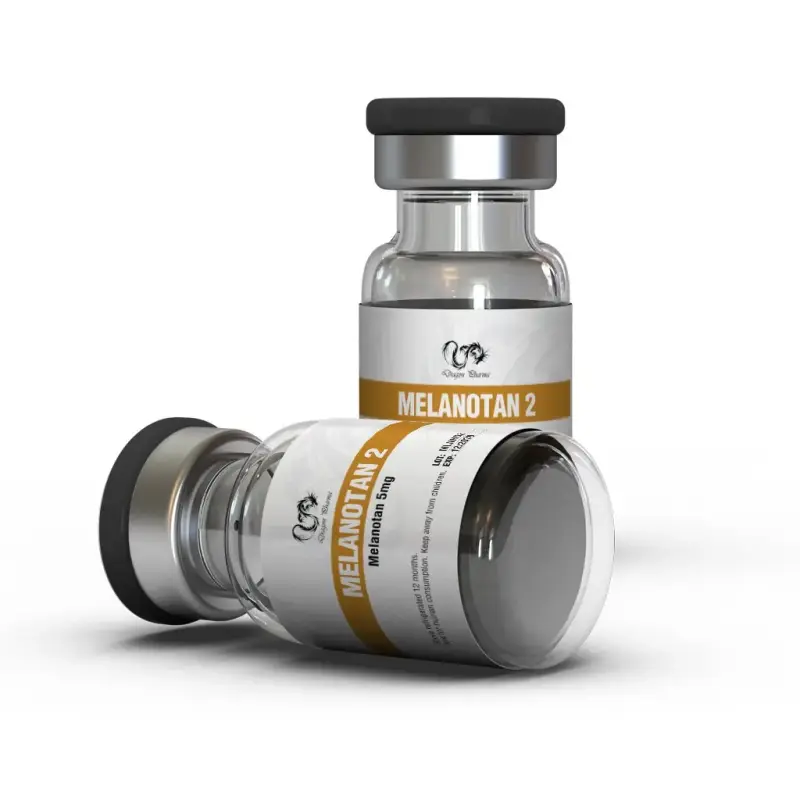
Product Overview
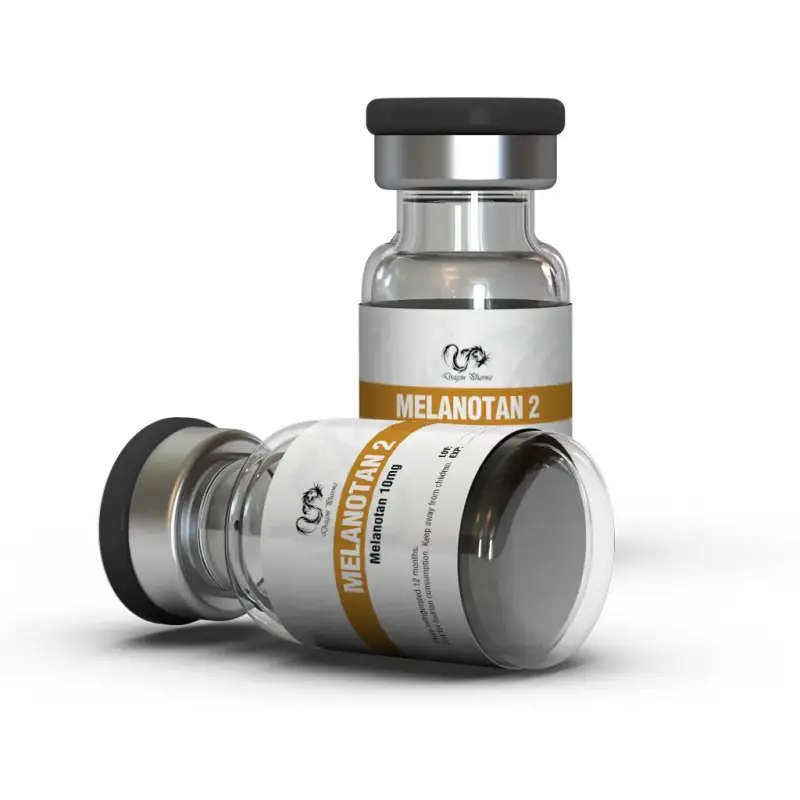
This card carries the two Melanotan II vials of the Dragon Pharma line: the 5 mg fill and the 10 mg fill. Both are the same cyclic alpha-MSH analogue as a lyophilised powder that has to be dissolved before use, and the label mass is the only difference between them.
Because the mass differs by a factor of two, the solvent arithmetic is the thing a buyer actually chooses between. The 5 mg vial is the smaller commitment and the one that suits a short pilot schedule; the 10 mg vial carries twice as much peptide and is the practical choice when the same amount is measured repeatedly.
Two warnings belong at the top rather than at the bottom. No regulator anywhere has approved this substance, and no published human half-life exists, so the figures below are either dilution arithmetic or amounts taken from a single small pilot study, not a validated protocol. As an unapproved substance it also falls under class S0 of the prohibited list, whatever the card is used for.
The Two Vial Sizes
Melanotan II 5 mg
The smaller fill. Mixed with two millilitres of solvent it lands at 2.5 mg per ml: a 250 microgram dose is ten units on a U-100 syringe, drawn up to the 0.1 ml mark. Reconstituting with 1 ml instead gives 5 mg per ml and 500 micrograms in the same draw, which is convenient but leaves less room for error.
Melanotan II 10 mg
The larger fill. Two millilitres of water on the 10 mg powder also yield 5 mg per ml, which puts 500 micrograms in every 0.1 ml. Once mixed the vial holds more solution, which is why the 10 mg size suits a schedule that runs for weeks.
| 5 mg + 2 ml | Strength 2.5 mg per ml; each 0.1 ml holds 250 mcg, or 10 units |
| 5 mg + 1 ml | Strength 5 mg per ml; each 0.1 ml holds 500 mcg, or 10 units |
| 10 mg + 2 ml | Strength 5 mg per ml; each 0.1 ml holds 500 mcg, or 10 units |
What the Peptide Acts On
Melanotan II is a cyclic analogue of alpha-melanocyte stimulating hormone and it is not selective. It activates the pigment receptor MC1, which drives melanogenesis in the skin, together with the central receptors MC3 and MC4, which is where appetite and erectile effects come from. That one molecule reaches all three is the reason its profile was never purely cosmetic.
The pharmacokinetics are the weak part of the record. Secondary reviews quote roughly one to two hours for the half-life, and a related peptide studied under the skin showed an absorption phase between about four minutes and three quarters of an hour, but none of that has been confirmed for this molecule in humans.
Published Research Amounts
The rows below are taken from a small published pilot and from dilution arithmetic. They describe an experiment rather than a protocol.
| Pilot study | 0.025 mg per kg body weight, which for an 80 kg adult equals about 2 mg, or 0.4 ml of a 5 mg per ml solution |
| Pilot escalation | Starting point 0.01 mg per kg, stepped up by 0.005 mg per kg in the same study design |
| Administration | Subcutaneous after reconstitution with bacteriostatic water; the study used a small number of participants |
| Duration | No validated length of use appears in the sources |
| Female | No female protocol of any kind is described in the published material |
Use Context and Combinations
The peptide is not stacked with anabolic products in any published work. What follows is catalogue context only.
What to Expect
- Slow pigmentation. Studies describe colour change building across days of repeated exposure rather than after one injection.
- Flushing and nausea. Both are described shortly after an amount is given, and both track the size of that amount.
- Central effects. The MC4 receptor is why appetite and erectile changes appear in the same reports as the tanning effect.
- Moles. Darkening or new pigmented lesions are the change regulators single out for medical review.
- Limitation. One small pilot with a handful of participants is the entire human record for the amounts on this page.
Side Effects and Management
What follows is drawn from the same small studies and from regulator warnings about unapproved tanning peptides. None of it is a reported frequency for the catalogue vials.
Status, Storage and Monitoring
The regulatory position is the same for either fill size and is worth repeating before the arithmetic is used. Related peptides from the same catalogue include Epitalon, TB-500 and GHK-Cu 10 mg.
Which Vial Size to Choose
The choice comes down to how many times the vial will be entered. A short pilot that ends after a few small amounts is cleaner from the 5 mg fill, because a smaller volume of mixed solution is easier to finish while it is still fresh. A schedule that runs across several weeks draws on the 10 mg fill, which at 2 ml gives the same 5 mg per ml as the smaller vial reconstituted with 1 ml.
Whichever is bought, the order should include Bacteriostatic water, and the arithmetic should be written down before the solvent goes in. Detection reads as not applicable on this page only because the material is a research peptide; the class S0 position and the absence of safety data remain the two facts that matter most.