Product Overview
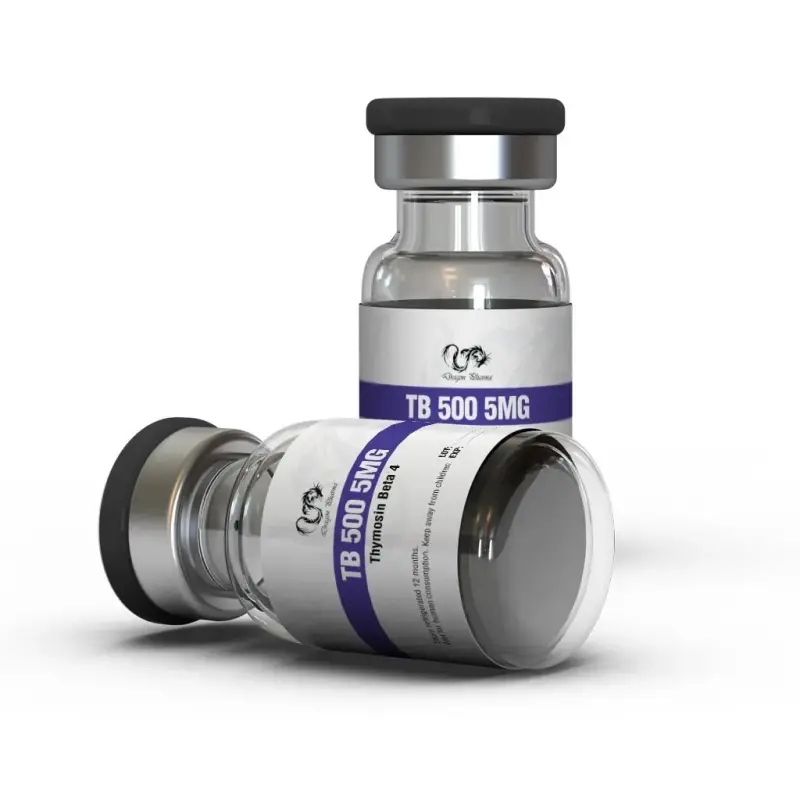
Dragon Pharma TB 500 is supplied as one lyophilised 5 mg vial. The product name is the research shorthand, and the molecule behind it is a synthetic fragment of thymosin beta-4, a peptide that occurs naturally and is studied for actin binding and cell migration. What is inside the vial is a freeze-dried powder with the mass printed on the label, so the working strength is set by the millilitres of water added and by nothing else on the vial. It is a research material: no regulator has approved it, and the absence of clinical labelling applies to every vial on the market.
The defining characteristic of this compound in the sources is what is missing. A human half-life has never been established, and vendors of the material state that directly instead of quoting a figure. Dosing therefore has no pharmacological anchor, and the protocols in circulation are vendor and community constructions built around loading and maintenance rather than around measured elimination. Detection data are equally thin: the only analytical work located for this card comes from veterinary research, where the N-acetylated metabolite LKKTETQ was measured in horse urine and plasma. A horse window cannot be transferred to a human one.
Research interest sits in soft-tissue repair. The molecule is administered systemically in community write-ups rather than injected at the site of an injury, and the mechanism is generally described as systemic rather than local. Because of that, the pairing that appears most often in the same section is BPC 157, a peptide with a different mechanism and a more local reputation, and the two also exist as a single BPC-157 and TB-500 blend. Every vial needs Bacteriostatic water as a solvent. For athletes under testing, note that WADA class S2 names thymosin beta-4, its derivatives and TB-500 specifically.
Dosage Protocol
No approved human dose exists for this peptide and its human half-life was never measured, so the rows below reproduce the vendor reference figures published for the material, together with the solvent arithmetic for a 5 mg fill. They describe laboratory reference work, not a treatment plan.
| Loading phase | 2.0-2.5 mg twice per week, so 4.0-5.0 mg per week, for weeks 1-4 in the vendor protocol |
| Maintenance phase | 2.0-2.5 mg once per week after loading |
| Course length | Vendor guidance is a 6-8 week cycle followed by a break of comparable length |
| Reconstitution | Bacteriostatic water is added to the 5 mg vial; concentration comes from the label mass and the millilitres used, since no human PK data exist |
| Route | Subcutaneous or intramuscular injection; community write-ups use systemic administration rather than injection into a specific tissue |
| Female | Nothing verified for women appears in the sources behind this card, and no human dose is established for men either |
| Administration | With no measured half-life, the weekly totals above are what the vendor reference fixes; the interval itself is not derived from pharmacokinetics |
Stacking and Combinations
No validated combination protocol is described in the sources, so the cards that follow are reference groupings seen in community practice instead of a plan. Each pill opens the matching product page in the Dragon Pharma section.
What to Expect
- Mobility and discomfort reports. Vendor descriptions place the first subjective change within 1-3 weeks of starting a block.
- Full course length. The vendor protocol runs 6-8 weeks, so short blocks have no confirmed timeline behind them.
- Systemic, not local. Community use is described as systemic administration rather than injection into the injured tissue.
- Timeline confidence. With no human half-life, safety or efficacy data, every timeline on this page is a vendor statement.
- Handling burden. Sterility and accurate dosing rest entirely with the user because this is a research vial rather than a pharmaceutical presentation.
- Cold chain. The mixed solution has to be kept cold, and the sources behind this card give no shelf-life figure for the 5 mg presentation.
- Testing status. Thymosin beta-4 and TB-500 are named in WADA class S2 and prohibited at all times.
Side Effects and Management
The honest position on this peptide is that no validated human safety profile exists. What follows are the events reported in user writing and in veterinary work, managed by technique and observation rather than by a documented protocol.
Reconstitution and Storage
Preparation and cold storage are the documented parts of this vial, so the rows below collect those values. The same catalogue section holds Epitalon, Ipamorelin and Tesamorelin.