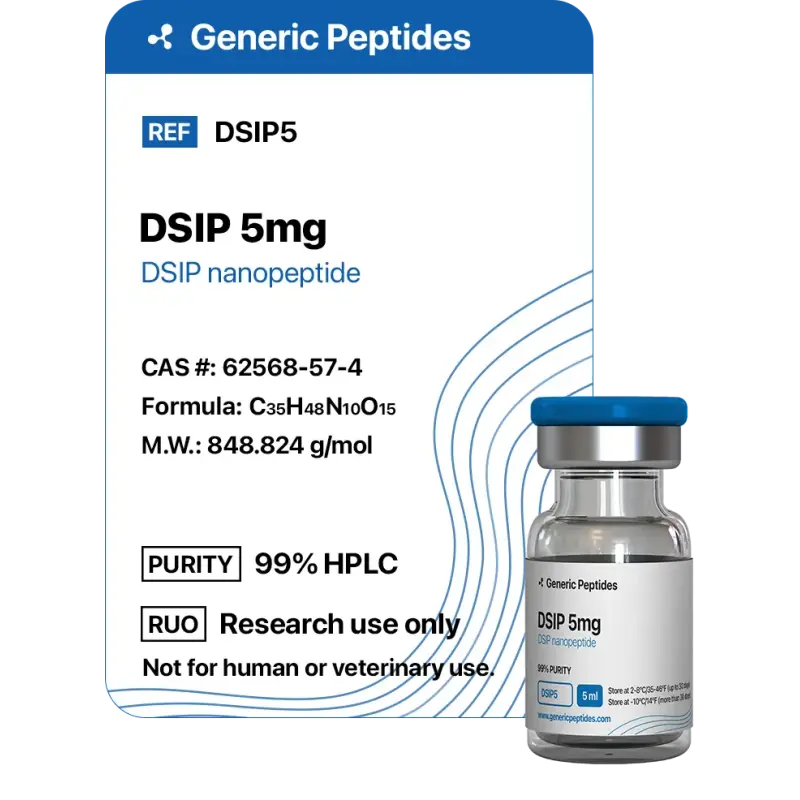
Product Overview
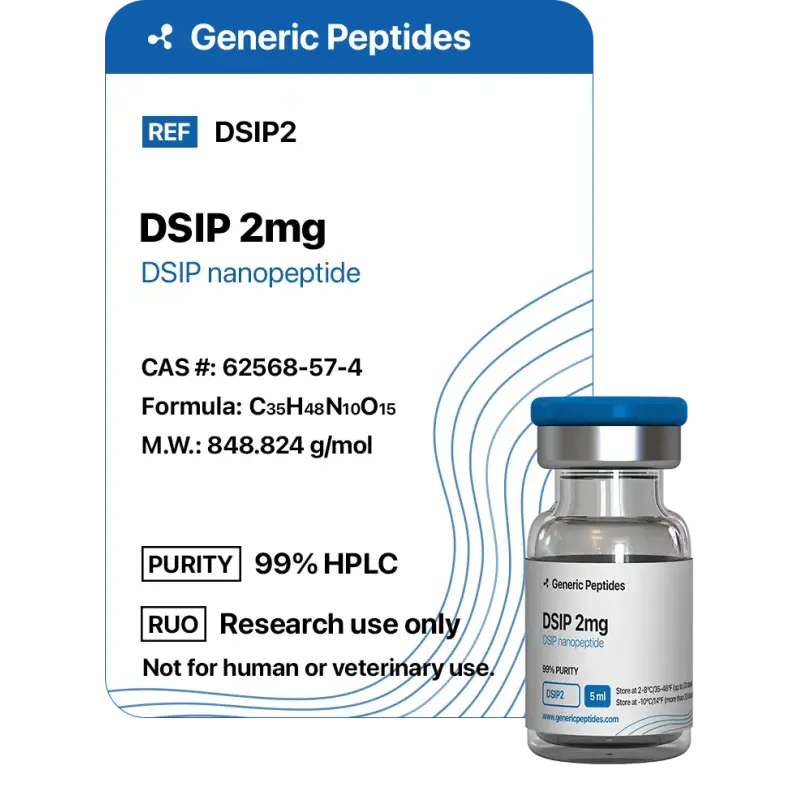
Generic Peptides sells this neuropeptide in two fills, 2 mg and 5 mg, as a lyophilised powder. The sequence is short enough to write out in full, WAGGDASGE, a chain of nine residues with a mass near 850 daltons, first characterised in 1974, when Schoenenberger and Monnier recovered it from blood leaving the brain's venous drainage in sleeping rabbits. The name came from the electroencephalogram pattern the researchers saw afterwards, and the name has followed the molecule ever since, even though the evidence behind it has never settled.
Two structural oddities explain why the literature is thin. No gene, no precursor protein and no receptor have ever been identified for this peptide, so its action in the brain is put down to an interaction with NMDA receptors as a hypothesis rather than a mechanism. Elimination is similarly unresolved: the only measured figure comes from tissue work, where a specific aminopeptidase dismantles the peptide in about fifteen minutes, and other write-ups spread the same estimate from a couple of minutes up to half an hour or more. No human kinetic study has been published, which is why no dosing interval on this page can be traced back to a measurement.
The animal findings are broader than the human ones and are often quoted without that distinction. Animal studies credit it with a fall in basal corticotropin, a rise in luteinising hormone, an action on somatoliberin, anticonvulsant and pain-relieving effects, and a broad dampening of stress responses. Human sleep work is the part that matters to most buyers, and it is contradictory: some studies report more slow-wave sleep with REM suppression, others find no relationship between the peptide and sleep architecture. The vial carries no approval in any country. WADA does not name this substance, but that absence reflects missing data rather than a positive finding of clearance. Readers exploring the calm side of this shelf should look at Selank, and anyone comparing a night-time peptide with a growth-hormone one should read Ipamorelin, which acts on a completely different pathway.
Dosage Protocol
No approved human dose exists. What follows is the research convention printed by vendors, together with the dilution arithmetic that turns a 2 mg or 5 mg fill into measurable volumes.
| Timing | 30-60 minutes before sleep in every vendor text, chosen because of the assumed effect on sleep architecture |
| Amount per day | 100-300 mcg subcutaneously, described as research practice rather than an approved amount |
| Block length | 2-4 weeks, then a break of about 2 weeks in the same material |
| 2 mg in 2 ml | 1 mg/ml, which makes a 0.1 ml pull worth 100 mcg |
| 2 mg in 1 ml | 2 mg/ml, so 0.1 ml carries 200 mcg |
| 5 mg in 5 ml | 1 mg/ml, so 0.1 ml carries 100 mcg, identical to the diluted 2 mg fill |
| 5 mg in 2 ml | 2.5 mg/ml, so 0.1 ml carries 250 mcg |
| Route and coverage | Subcutaneous injection; at 100 mcg a day the 2 mg fill lasts roughly twenty days, and the sources hold no separate evidence base for women |
Suggested Protocols
Joint research on this peptide does not exist, so the cards below are groupings from the same section of the catalogue: first the peptides studied alongside it in sleep and recovery work, then the compounds that address the same complaint through a different route entirely.
What to Expect
- Falling asleep. The most frequently mentioned change in research notes is a calmer onset of sleep, and nobody has confirmed that objectively in a controlled modern study.
- Split findings. Some work reports an increase in slow-wave sleep with REM suppression; other work reports no measurable link to sleep architecture whatsoever.
- What the animal data add. Lower basal corticotropin, higher luteinising hormone, an influence on somatoliberin, anticonvulsant and antinociceptive behaviour: a long list, gathered almost entirely in animals.
- Mechanism on paper only. With no identified gene, precursor or receptor, brain activity is attributed to NMDA receptor interaction as a hypothesis.
- Clearing time. The fifteen minute figure comes from tissue preparations and cannot be carried over to people, and no human profile exists to replace it.
- Approval status. No country has licensed this peptide as a medicine; the vial is sold for research and carries a research label.
- Testing status. The substance is not named on the WADA list, which means the data are absent rather than that use is permitted.
Side Effects and Management
The list below is drawn from vendor notes and user accounts rather than from a monitored trial, because no trial has monitored this peptide in people. Management is therefore observational.
Post-Cycle Therapy
Here the answer is short and honest: there is no hormonal aftermath to manage. The peptide does not suppress the production of testosterone, does not raise oestrogen, and does not interfere with fertility, so the drugs used after an anabolic cycle have no function in a DSIP block. The material that does deserve planning is sleep itself.