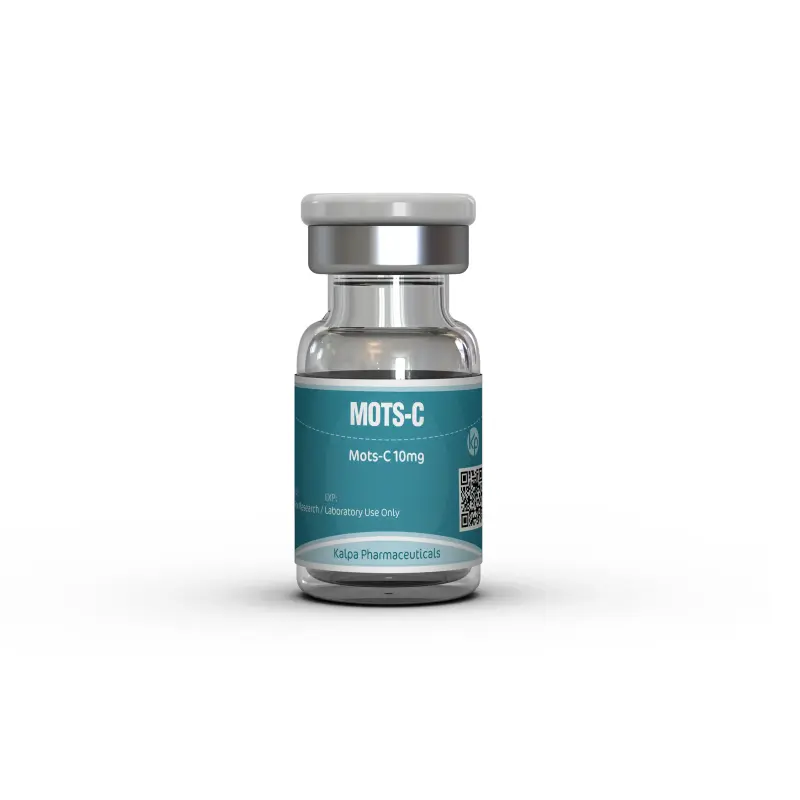
Buy MOTS-c 10 mg by Kalpa Pharmaceuticals at Best Anabolic Steroids. The vial is a freeze-dried powder of a mitochondrial derived peptide: sixteen amino acids coded by a gene inside the mitochondrion itself, which is unusual enough to explain the research interest and the complete absence of clinical routine around it.
The material is a laboratory item, not a medicine. Nobody has an approved indication, an approved dose or a human half-life for it, and the community protocols that circulate are adaptations of animal work and early trial design. That is the frame this page is written in: mixing arithmetic, what the research describes, and where the data stops.
Product Overview
What makes this peptide distinctive is its origin and its proposed role. MOTS-c is described in the literature as a mitochondrial signal that responds to exercise and influences glucose handling in skeletal muscle, which is why it is grouped with the metabolic research peptides rather than with the growth hormone family or the repair peptides. Rodent work links it to better metabolic markers and a longer healthy lifespan in animals.
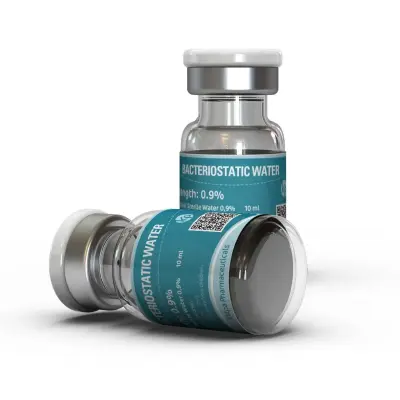
Human evidence is a different picture. Completed interventional trials of the peptide itself are absent, and the most concrete reference point in the project sources is a registered phase 2a study using a fixed once-daily subcutaneous schedule for twelve weeks, with results not yet published. There is also no published human elimination data, so any statement about how long the substance stays active would be invention. The handling rules are the same as for any lyophilised vial in this catalogue, from Bacteriostatic Water to the larger growth hormone packs Kalpatropin 100 IU and Kalpatropin 200 IU, all of which are mixed and stored identically.
Dosage Protocol
This section is mixing arithmetic and research convention, not a prescription. The amounts below come from vendor material and protocol reviews rather than from any clinical dose finding study.
| Beginner | 10 mg of powder in 1 ml of water gives a concentration of 10 mg per ml, so a 10 unit draw on a U-100 barrel carries 1 mg |
| Intermediate | With 2 ml of water the same vial gives 5 mg per ml, so 20 units is 1 mg and 1 ml is 5 mg |
| Advanced | Protocol reviews quote 5-10 mg two or three times a week, or a single 10 mg weekly, over blocks of four to eight weeks |
| Female | No confirmed female data exists in the sources reviewed, which is the honest answer rather than a scaled-down figure |
| Administration | Subcutaneous after dissolution. The registered phase 2a design used one fixed daily injection, which is a useful reference for cadence |
Vial maths worth writing down: at 10 mg per ml a 10 mg bottle holds ten 1 mg draws, while at 5 mg per ml it holds only two 5 mg draws. The water volume chosen therefore decides how long a bottle lasts far more than the injection schedule does. Keep the sealed vial cold, and keep the mixed solution refrigerated and inside the vendor window, without freezing and thawing it repeatedly.
Suggested Protocols
The peptide sits in the metabolic corner of the catalogue, and the arrangements below reflect how it is discussed rather than any validated combination.
The catalogue also holds incretin vials such as Mounjarixyl, which affects body weight through appetite and stomach emptying. That is a different lever from a mitochondrial signal, and the two are not substitutes for one another despite both appearing under a metabolic label.
What to Expect
- The research description. The peptide is studied as a regulator of glucose handling in skeletal muscle, and its natural level is reported to rise with training, which is where the exercise-mimetic label comes from.
- Animal findings only. Rodent work associates it with leaner body composition and improved metabolic markers. Those are animal results and they do not transfer automatically to people.
- No completed human trial of the peptide. Observational work on plasma levels exists; an interventional human dataset does not, and the phase 2a study is still listed without published results.
- Energy claims are unproven. Better stamina and endurance are widely discussed, and there is no human confirmation of either.
- Banned permanently in sport. The peptide is listed as a metabolic modulator, and a therapeutic-use exemption is effectively unobtainable for a substance with no approved indication.
- Nothing here is regulator approved. No agency has authorised the peptide for any condition, which makes the user the entire quality control chain.
Side Effects and Management
Because the human dataset is so thin, a badly mixed or badly stored vial is a larger practical risk than the peptide itself. Cloudy solution, particles or an unlabelled bottle are reasons to discard rather than to continue.
After the Block and Follow-Up
Nothing in this peptide touches the hormonal axis, so a post-cycle protocol built around SERMs has no purpose here. The wall it hits is a data wall, not a suppression wall, and the end of a block is simply a stop.
If a steroid course is running at the same time, the recovery plan belongs to that drug and its ester, whether it is Masteroxyl 100 or a longer testosterone ester such as Testoxyl Enanthate 400. The peptide has no share in that calculation.