Best Anabolic Steroids

Press Enter to search the full catalog.

US Domestic discreet shipping
Third-party batch tested
HPLC & MS verified purity
Trusted Anabolic Manufacturers Only
US Domestic discreet shipping
Third-party batch tested
HPLC & MS verified purity
Trusted Anabolic Manufacturers Only
Back to all products
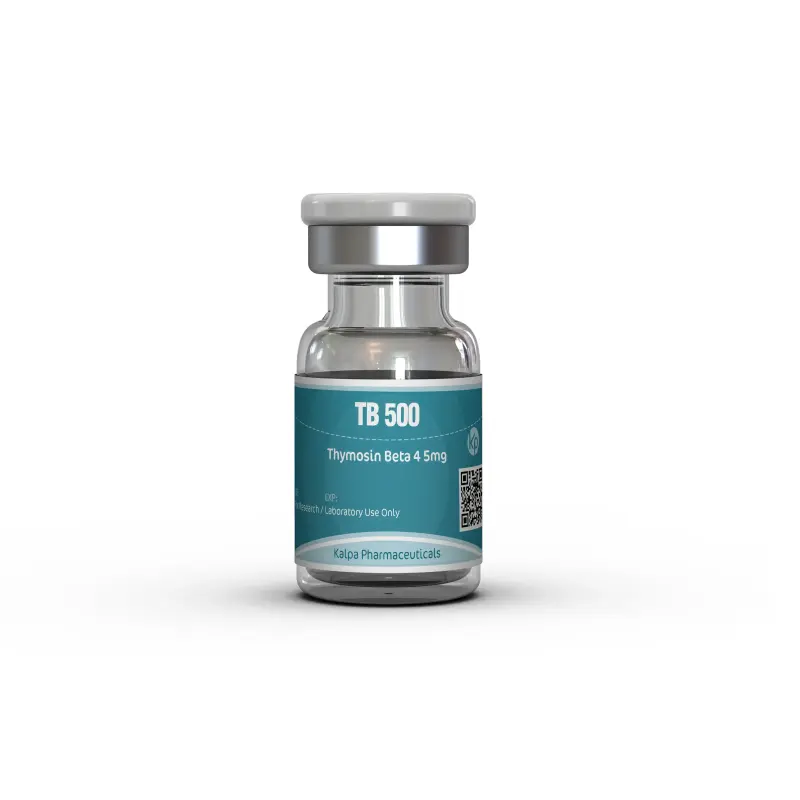
TB 500 Thymosin Beta 4 Fragment - Kalpa Pharmaceuticals

Kalpa Pharmaceuticals

TB 500 Thymosin Beta 4 Fragment - Kalpa Pharmaceuticals

Injection · 5 mg · vial

Out of stock
CompoundThymosin Beta 4 (TB-500)
ClassRepair peptide (research)
Half-lifeNot established in humans
DetectionNo human window set
Liver toxicityLow
Water retentionNone
A 5 mg lyophilised vial of a synthetic fragment of thymosin beta-4, product 1753. The peptide is studied for cell migration and soft-tissue repair, and the usual vendor schedule is a two-dose weekly loading phase followed by a single weekly amount. No human half-life, no validated human dose and no approved indication exist for it, so the timeline below is a convention rather than a measurement.
TB 500 Thymosin Beta 4 Fragment - Kalpa Pharmaceuticals
Order Now, Ships Today
Quality First

All products are manufactured under strict quality standards and independently tested before release. By purchasing, the buyer agrees to use these products in compliance with all applicable laws.

TB 500 from Kalpa Pharmaceuticals is a freeze-dried piece of a protein the body makes on its own, and the word fragment is not decoration: what sits in the vial is a shortened sequence rather than the whole thymosin beta-4 molecule, which is why the name and the chemistry do not line up perfectly.

The peptide circulates in repair discussions rather than in clinic shelves. Nothing here has an approved indication, an approved amount or a human half-life, and the schedules that are followed come from vendor material and from animal work. The page keeps to that boundary.

Product Overview

Thymosin beta-4 is a small protein involved in the movement and survival of cells, and the fragment sold as TB-500 is built around the short sequence that carries that activity. The mechanism discussed in the research is actin binding and cell migration towards damaged tissue, which is a different route from the growth-hormone family and a different one again from the local acting BPC 157 in the same catalogue.

What the peptide does not have is a human dataset. The half-life is listed as not established, and the clearest detection evidence comes from veterinary work, where a metabolite of the peptide was measured in the urine and plasma of horses. There is no equivalent human elimination figure, so a statement about how long the compound stays active would be invention rather than information.

Sporting status is the one area with no ambiguity. Class S2 names thymosin beta-4 and its derivatives, TB-500 among them, and bans them at every moment; with no approved medical use anywhere, a therapeutic-use exemption is not a realistic route.

Dosage Protocol

The amounts below are the vendor schedule that the sources record, not a clinical dose. Mixing arithmetic comes first because every draw depends on it.

Beginner Loading: 2.0 to 2.5 mg twice weekly for the first four weeks
Intermediate Maintenance after loading: 2.0 to 2.5 mg once weekly
Advanced Blocks of six to eight weeks, then a break of comparable length, by vendor direction
Female No confirmed female protocol in the sources reviewed; the vendor material does not separate the sexes
Administration Subcutaneous injection, systemic rather than into the injured area

Mixing decides every draw, so start there. Draw 1 ml of water into the 5 mg vial and each millilitre holds 5 mg: the ten-unit mark on a U-100 barrel is 0.5 mg, and a 2 mg draw fills forty units. Use 2 ml instead and the strength per millilitre halves, so that same 2 mg now needs eighty units. That single choice sets the shelf life of the bottle, since one vial lasts about a week of the loading phase or two to two and a half weeks of maintenance. Add Bacteriostatic Water gently, swirl without shaking, and keep the prepared solution cold and inside the vendor window.

Suggested Protocols

The repair corner of the catalogue is small, and the arrangements below are how the peptides are discussed together rather than validated combinations.

Systemic repair block
TB 500 - four weeks loading, then weekly + BPC 157 - the other repair route + Bacteriostatic Water - mix per vial
Six to eight weeks; TB 500 is used systemically while BPC 157 is often described as the more local acting of the two
Recovery support, different mechanism
Two unrelated systems: one acts on cell migration, the other on growth signalling. Pairing them divides nothing except attention to technique

Someone running a steroid course at the same time needs to remember that this peptide has no share in that plan: the recovery drugs for a hormonal course, Nolvaxyl 20 and Clomixyl 50, work on the axis, which TB 500 does not touch.

What to Expect

  • Reports describe comfort before structure. Vendor and user accounts place the first changes in movement and discomfort within one to three weeks, which is early for a tissue process.
  • The schedule assumes six to eight weeks. Short courses aimed at one event have no documented timeline attached to them.
  • Nothing measurable outside a clinic. No validated marker follows the course, so improvement is judged by how the person feels and moves.
  • The half-life is a blank. With no human pharmacokinetics, timing and duration rest entirely on vendor convention.
  • Safety data in humans are thin. Long-term use in healthy people has never been formally studied.
  • Testing is permanent. The peptide is prohibited at all times in sport, with no realistic route to an exemption.

Side Effects and Management

Redness, itching at the siteRotate injection points, keep the technique clean, apply a cold compress.
Headache, mild malaiseLower the amount or pause; these are user reports, not trial findings.
Unverified long-term profileShort cycles and careful observation, since a research peptide carries the limitation that nobody has mapped its long-term behaviour.
Proliferation concernsA theoretical worry about cell growth signalling; anyone with a cancer history should not use it without a doctor.
Cloudy or particle-filled solutionDiscard the vial. A mixing or storage fault is a bigger practical risk than the peptide.
No validated safety datasetTreat every schedule as experimental and keep notes, since nobody else is tracking it.

After the Block and Follow-Up

This peptide leaves the hormonal axis alone, so a recovery phase built on a SERM has no work to do here. The block simply ends.

OnsetNot applicable; natural testosterone production is unaffected
Option ANot applicable; tamoxifen and clomiphene have no place in a peptide-only plan such as this one
Option BNot applicable; an aromatase inhibitor is equally out of place
Between blocksA pause of comparable length to the block, which is the only guidance in the sources
Follow-upHow the tissue behaves in normal training; no validated laboratory marker exists for this peptide

If a hormonal course is running alongside, its recovery is governed by its own esters and belongs to that course, whether the base is the mix Sustaxyl 350 or an ester such as Testoxyl Enanthate 250. The peptide takes no part in that calculation.

Storage and Ordering

Store the sealed vial in the cold and the dark, and the reconstituted solution in the fridge used inside the vendor window; repeated freezing and thawing is the fastest way to waste a bottle. On delivery, read the batch code, note the expiry, and compare the label against the Kalpa Pharmaceuticals catalogue entry for this strength, since peptide vials are easier to counterfeit than tablets.

Everything ships in discreet outer packaging, and delivery choices sit on the product page beside the pack details.
This material is published for educational and research reference purposes only. The peptide described is a research-grade material supplied for laboratory work and is not presented here as a medicine or as a treatment for any condition. Dosing information reflects published and vendor reference data for the active substance, not a recommendation or a prescription. Nothing on this page should be read as medical advice. Keep all products out of reach of children and follow the regulations that apply in your country.
What is TB 500 and is it the same as thymosin beta-4?
TB 500 is a synthetic fragment of thymosin beta-4 rather than the entire protein. The portion kept is the one associated with actin binding and cell migration, which is the activity the repair research focuses on. It has no approved medical use and no established human half-life.
How do I reconstitute the 5 mg vial?
Let Bacteriostatic Water run down the inside wall, swirl it rather than shaking, and store it cold. One millilitre leaves the strength at 5 mg in every millilitre, so a 2 mg draw measures forty units on a U-100 barrel; two millilitres halve that strength to 2.5 mg per millilitre and the same draw measures eighty.
What is the loading phase, and how long does a vial last?
The vendor schedule loads with 2.0 to 2.5 mg twice a week for four weeks, then drops to the same amount once weekly. At that pace a 5 mg vial covers roughly a week of loading or two to two and a half weeks of maintenance, which makes the bottle count a bigger planning question than the injection technique.
What is the half-life of TB 500 in humans?
Not established. The figure is absent from the reference material, and even the vendor description states that a human half-life is unknown. Animal work has measured a metabolite of the peptide in horse urine and plasma, which is about recovery testing rather than human pharmacokinetics.
TB 500 or BPC 157, and do you inject into the injury?
They are different peptides with different mechanisms, and the community treats them as complements rather than substitutes: TB 500 is given systemically, while BPC 157 is often described as acting closer to the site. Local injection into a joint or tendon is not a documented practice in this material and carries its own risks.
How soon do results appear, and what are the side effects?
Vendor and user accounts place the first changes in comfort and mobility within one to three weeks, and the block is designed to run six to eight weeks. Reported side effects are local redness or itching, occasional headache and mild malaise. There is no validated human safety dataset for long-term use.
Does it need a recovery course, and is it banned in sport?
A recovery course has no part here: testosterone production carries on untouched, so the SERM items sold alongside it are made for hormonal courses instead. Sport is the opposite case: class S2 covers thymosin beta-4 and its derivatives, TB-500 named among them, and they are banned at all times.
Has TB 500 ever been tested in humans, and how do I check a Kalpa vial?
No controlled human trial of this fragment sits behind the schedules in circulation, which is why the amounts are labelled vendor guidance. For the vial itself, read the batch code, note the expiry, make sure the stopper is sealed, and hold the label beside the photo on this page; Kalpa is a widely copied name and peptides are harder to judge by eye than tablets.

No reviews yet

Be the first to share your experience with TB 500 Thymosin Beta 4 Fragment - Kalpa Pharmaceuticals

Log in to write a review

Complete the protocol

Stack it with

View all →
Added to cart