Product Overview
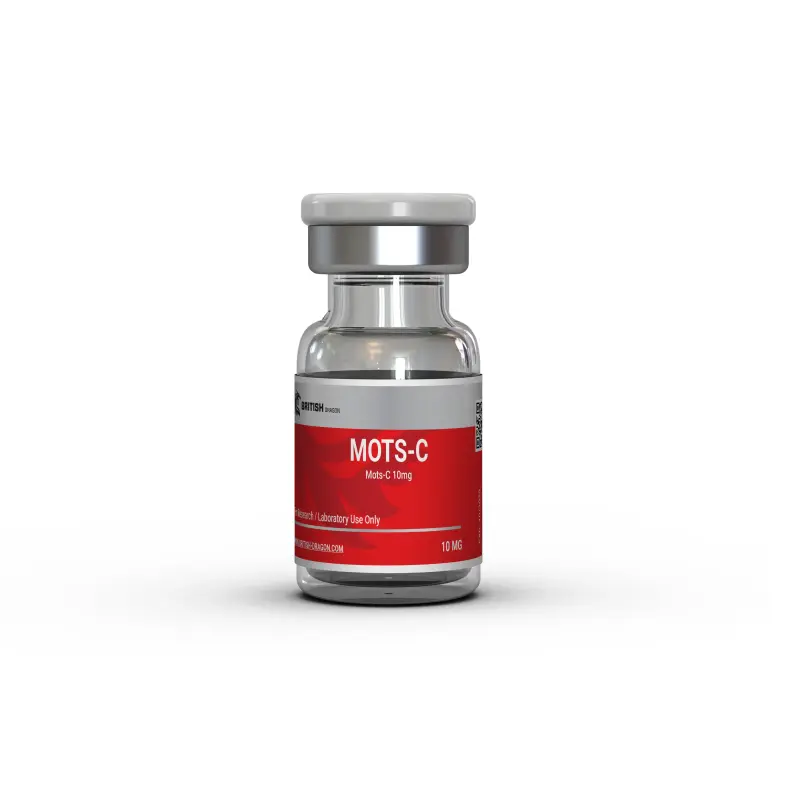
MOTS-c from British Dragon is a 10 mg lyophilised vial of a mitochondrial-derived peptide, one of the small signalling molecules transcribed from the mitochondrial genome rather than the nuclear one. The name stands for a small mitochondrial open reading frame inside the 12S rRNA region, the chain is sixteen amino acids long, and the coding sequence sits in MT-RNR1. Because the origin is mitochondrial, the peptide was first read as an internal communication signal between the organelle and the rest of the cell, and the interest since then has centred on how muscle handles glucose.
Published work divides sharply by species. In mouse models the peptide is credited with better metabolic control, resistance to diet-induced obesity and a longer healthy lifespan, and its circulating level is reported to rise after exercise, which earned it the exercise mimetic label. In humans the picture is thin: plasma-level observations exist, a review from 2023 concluded that no method for clinical use had been established, and the interventional record is limited to a single phase 2a study now running with a fixed once-daily subcutaneous dose over twelve weeks. Any animal figure on this page is animal-only, and it is marked as such because none of it has been reproduced in people.
The vial is a research material with no approval anywhere, so it belongs in the same experimental drawer as the rest of the lab peptide range rather than beside a pharmacy product. Bodybuilders reach for it as a metabolic add-on in a cutting or recomp phase, where the brand's own recomp line offers Somatrobol HGH for lean tissue and Oxanabol for a milder oral option. What the peptide cannot do is replace the calorie deficit that decides whether weight moves at all.
Research Dosing and Reconstitution
No approved dose exists, so the grid below collects research figures from protocol reviews and vendor material. It is a planning reference, not a schedule with clinical backing, and there is no confirmed female protocol in the sources checked.
| Beginner | 5 mg per injection, four weeks, starting at the bottom of the published range |
| Intermediate | 5-10 mg per injection on two or three days of the week, or one 10 mg injection weekly, over four to eight weeks; reviews describe a four-week titration |
| Advanced | 10 mg several times a week for eight weeks; anything above that is unstudied territory |
| Female | No separate female protocol appears in the sources; the research grid is not validated for women |
| Administration | Subcutaneous; a 10 mg vial with 1 mL gives 10 mg/mL, so 1 mg draws as 10 units on a U-100 syringe, while 2 mL gives 5 mg/mL and doubles that count to 20 units |
One arithmetic consequence is worth stating plainly: at 1 mg per injection the vial covers ten doses, at 5 mg it covers two. The confirmed study protocol, by contrast, uses one fixed dose a day for twelve weeks, which makes most community schedules look nothing like the trial design.
Metabolic Research Combinations
Combinations here are speculative. Nothing in the literature pairs this peptide with anything, so the cards below describe how people place it inside an existing block rather than evidence of a working stack. Every pill opens the product it names.
What to Expect
- Glucose handling. The research interest is skeletal muscle glucose regulation, and that is what any monitoring should follow rather than body weight.
- Exercise signal. Circulating levels of the peptide are reported to climb with training, which is the origin of the exercise mimetic description.
- Animal-only outcomes. Improved body composition, less obesity and extended healthy lifespan come from mouse work and have not been shown in humans.
- Human evidence. No completed human trial of the peptide exists, so no timeline for a visible effect can honestly be given.
- Energy and endurance. Widely discussed as the expected payoff, with no human confirmation behind the claim.
- Regulatory reality. There is no approval from the FDA or any other regulator, and sport bans the peptide outright.
- Limitation. With no human safety data, short blocks and self-monitoring are the only defensible approach.
Side Effects and Management
The list rests almost entirely on user reports, because no trial has produced an adverse event table for this peptide. Treat frequencies as anecdotal.
Handling, Storage and Research Status
The powder tolerates cold storage well; the dissolved solution is the fragile part and belongs in the fridge, out of light, for the short window vendors quote instead of the months a sealed lyophilisate survives. That window is vendor guidance rather than a regulatory standard, and it is not published for this particular fill.