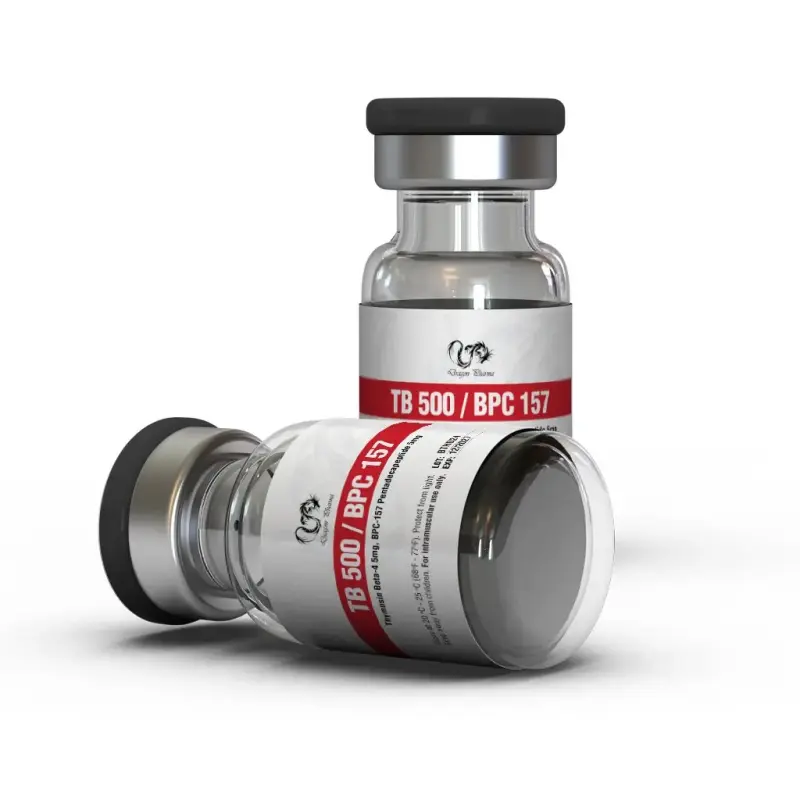
Buy BPC-157 TB-500 Blend by Dragon Pharma at Best Anabolic Steroids. One vial holds a single lyophilised cake containing 5 mg of BPC-157 and 5 mg of TB-500, two repair peptides studied for tendons, ligaments and soft tissue. The pair sits at equal mass, so every draw delivers them in a fixed one-to-one ratio that cannot be adjusted after mixing.
Product Overview
BPC-157 is a pentadecapeptide, a chain of fifteen amino acids derived from a protein found in gastric juice, and it is studied mainly in animal models. TB-500 is the research name for an acetylated heptapeptide, Ac-LKKTETQ, which is a fragment of the larger protein thymosin beta-4, a forty-three amino acid molecule found in most cells.
What arrives is a 10 mg fill in total: five milligrams of each peptide in one lyophilised cake. That matters more than it first appears. A single-peptide vial such as BPC 157 2 mg or TB 500 5 mg lets you set the amount of one compound freely. The blend does not: the ratio is locked at 1:1 from the moment the water goes in.
Neither peptide has an established human elimination half-life, and injectable TB-500 has never been through human clinical trials. The trial data that exist belong to the whole thymosin beta-4 protein delivered as eye drops, which is a different molecule and a different route. The catalogue entry lists the vial under thymosin beta 4 and pentadecapeptide because both names describe its contents.
How the Two Repair Peptides Work
BPC-157 is described as acting on the tissue repair side of the equation: vessel formation, fibroblast activity and the signalling that surrounds an injury. Its stability in gastric juice is chemistry, not a therapeutic claim, and it is one of the reasons the peptide has been studied by more than one route.
TB-500 comes from the actin-binding protein thymosin beta-4, and the fragment is associated with cell migration and the movement of repair cells into damaged tissue. In practice the two are bought together because the pathways they are linked to sit next to each other rather than because a combination trial exists. There is no study of this exact blended vial, in animals or in humans.
One regulatory fact belongs in this section. Thymosin beta-4 and its derivatives, explicitly including TB-500, are named in WADA class S2 and prohibited at all times, so the peptide is screened for in sport even though the injectable form has no human trial record at all.
What to Expect Across a Loading Phase
- Days one to three. The only predictable event in that window is the injection itself; a local reaction at the site is the common report, and no systemic change is expected quickly.
- Weeks one and two. User accounts describe less pain around injured tendons and ligaments at this point. These are reports, not clinical findings, and the sources used here label them as such.
- Weeks two to four. Improved range of motion and tolerance of training load appear in the same kind of account, again without trial support.
- Weeks four to six. This is the loading window used in the community TB-500 protocol quoted below, after which the maintenance step begins.
- The honest limit. No human half-life is established for either peptide, so nothing about the timing above rests on measured pharmacokinetics.
- After stopping. Reported effects fade gradually, and the reference practice is a 6-12 week course of BPC-157 followed by a 4-8 week break between blocks.
- Blend arithmetic. Because the ratio is 1:1, a draw sized for a BPC-157 amount also sets the TB-500 amount, whether or not that is the number you wanted.
Dilution, Ratios and the Recorded Research Amounts
There is no approved dose for this product, and the figures below are the research and community amounts recorded for each peptide separately. They cannot both be followed exactly at once, and the table explains why.
| BPC-157 research amount | 150-375 mcg twice a day in the anecdotal protocols taken from a published review, not a clinical schedule |
| TB-500 loading | About 2.5 mg twice a week for 4-6 weeks in vendor and community protocols |
| TB-500 maintenance | About 2.5 mg once a week after the loading phase |
| Course length | 6-12 weeks for BPC-157, with a 4-8 week break before repeating; no separate female figures are recorded for the blend |
| Administration | Subcutaneous injection; the vendor notes that the effect is described as systemic rather than local to the injury site |
The conflict is visible in the numbers. A TB-500 loading dose of 2.5 mg carries 2.5 mg of BPC-157 with it at a fixed ratio, which is far more of the pentadecapeptide than the 150-375 mcg steps above. Reconstitution decides how the vial is actually used. Two millilitres of diluent in the 10 mg cake produces a 5 mg per ml mix, so a 10-unit draw contains half a milligram of each peptide; five millilitres instead spreads the same powder across 2 mg per ml. Choose the concentration that puts your daily step inside a normally drawable volume, and write it on the vial.
Pairing the Blend with the Rest of the Peptide Shelf
This vial sits in the recovery corner of a peptide protocol rather than in a cycle of hormones, so its partners are chosen for skin, connective tissue and general repair work. All of them come from the same brand.
Growth-hormone-side peptides such as Ipamorelin 5 mg or Tesamorelin 5 mg are usually kept in a separate block, because they are dosed nightly.
After the Last Injection, and Why There Is No PCT
Peptides do not suppress the hypothalamic-pituitary axis, so the recovery blocks written for anabolic cycles do not apply to this blend. What replaces them is a break between courses and a sensible way of judging whether the block helped.
Side Effects and the Limits of the Evidence
The list is short and the reasons behind each entry are worth reading, because most of them come from an absence of data rather than from a clean safety record.
Mixing and Storing the Blend
Before reconstitution the vial keeps at 15-25 degrees Celsius or in the cold at 2-8 C, in its box, and it must never be frozen. Bring it to room temperature on the day you mix it, wipe the stopper, and direct the water down the inside wall rather than onto the cake. Swirl until the solution is clear; shaking a peptide is the fastest way to damage it.
Once mixed, hold it at fridge temperature and use it within roughly 30 days, the general rule for this brand's lyophilised line. Avoid repeated freeze-thaw cycles entirely. Label the vial with the concentration and the date, draw with a fresh needle, and throw the vial away if the solution turns cloudy or shows particles. Keep it out of reach of children and dispose of needles in a sharps container.
Buying the BPC-157 TB-500 Blend Online
This vial is for the reader who wants both repair peptides in one preparation and accepts the consequence that comes with it: a fixed ratio means less freedom and less arithmetic to get wrong. Ten milligrams of powder makes a course of several weeks at 500 mcg of each peptide per draw, and the page above gives the two dilution options, the loading figures, the break between blocks and the storage rule. It ships from Dragon Pharma as a sealed lyophilised cake, with the chemistry of both peptides set out honestly next to the claims that cannot be supported. Order it here with the bacteriostatic water and the recovery peptides from the same line.