Product Overview
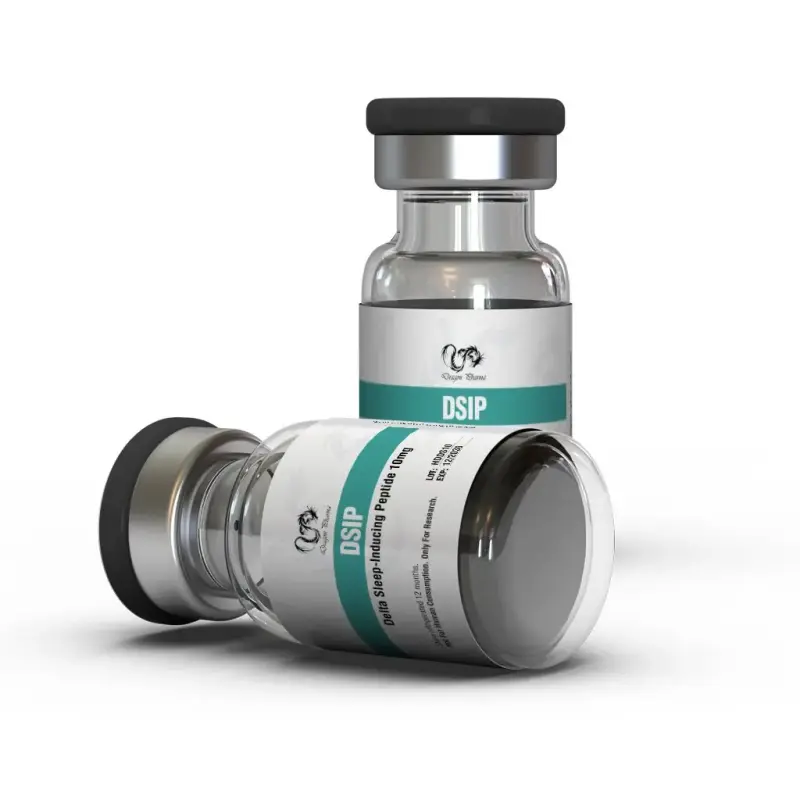
Dragon Pharma DSIP 10mg is a lyophilised vial of the delta sleep inducing peptide, a nonapeptide written as WAGGDASGE and weighing roughly 850 daltons. The molecule was isolated in 1974 by Schoenenberger and Monnier from the cerebral venous blood of sleeping rabbits, which is where the name comes from, and the catalog keeps it among the neuropeptides rather than among the growth or repair materials.
The mechanistic picture remains incomplete, and that matters more here than in most product files. Nobody has identified a dedicated gene, a precursor protein or a receptor for DSIP, so the description of how it acts is hypothetical, and the one link the sources discuss is an action at NMDA receptors in the brain. What does exist is a set of animal observations: a fall in basal corticotropin, a rise in luteinising hormone, an influence on somatoliberin, plus anticonvulsant, antinociceptive and stress-limiting effects recorded in laboratory models. None of that makes a treatment, and the compound is not approved as a medicine in any country.
The sleep question itself is unresolved rather than answered. Some studies report more slow-wave sleep together with suppressed REM, while others find no relationship at all between the peptide and sleep architecture, and the sources used for this page present both positions side by side. A buyer looking for a sedative will not find one here; a researcher looking at a historical sleep peptide will find the primary literature, a dilution chart and no promises. Items that share the same evening and recovery shelf include Epitalon 50 mg and Semax 5mg.
Research Dosing Reference
The rows below separate two things that are often blurred together: published arithmetic for the vial, and vendor convention for research use. Neither is an approved amount, because no approved amount exists.
| Solvent | Bacteriostatic water, run down the wall of the vial and swirled; the powder is never shaken |
| 2 mg vial examples | 2 ml of water gives 1 mg per ml, where 0.1 ml is 100 mcg and reads as 10 units; 1 ml gives 2 mg per ml, where 0.1 ml is 200 mcg |
| 5 mg vial examples | 5 ml gives 1 mg per ml and the same 100 mcg per 0.1 ml; 2 ml gives 2.5 mg per ml, where 0.1 ml is 250 mcg |
| Scaling to this vial | The same proportion on a 10 mg vial gives 1 mg per ml with 10 ml of water; the sources document the 2 mg and 5 mg examples, so this line is arithmetic only |
| Vendor research amount | 100-300 mcg under the skin, given 30-60 minutes before sleep; vendor material and research practice, not an approved dose |
| Block length | 2-4 weeks of nightly use followed by 2 weeks without it, again as a research convention rather than a finding |
| Vial yield | A 2 mg vial at 100 mcg a night covers about 20 days; a 10 mg vial scales from that ratio by simple division |
| Female | The sources contain no female-specific schedule for this peptide, and the card does not invent one |
| Route and timing | Subcutaneous, in the evening; every vendor description ties the timing to sleep onset rather than to training or daytime use |
Suggested Protocols
Three groupings place the vial next to other products in the range. The pills open the corresponding pages, and the sources record no joint study of any of these combinations.
What to Expect
- First thing reported. A subjective change in how quickly sleep arrives; some users describe calmer sleep onset, and modern work provides no objective confirmation.
- Conflicting evidence. Part of the literature reports more slow-wave sleep with REM suppressed, and part of it finds no connection between the peptide and sleep architecture at all.
- Animal-only signals. Lower basal corticotropin, higher luteinising hormone, an effect on somatoliberin, and anticonvulsant, antinociceptive and stress-limiting actions all come from laboratory models.
- Theory, not mechanism. No gene, precursor or receptor for DSIP has been located, and the brain action is described through NMDA receptors as a hypothesis.
- Limitation. Human pharmacokinetics do not exist, and the in-vitro half-life of roughly fifteen minutes cannot be carried over to a person.
- Limitation. The peptide is not an approved medicine anywhere and is supplied purely as a research material.
- Limitation. The compound is absent from the WADA list, which the sources read as a gap in the data rather than a statement of permission.
Side Effects and Management
Nothing below comes from a controlled human study. The entries are vendor observations, user reports and class-level effects shared by injected peptides.
Reconstitution, Storage and Follow-Up
The powder and the solution follow different rules, and the sources are specific about both, so they are listed separately below.