Product Overview
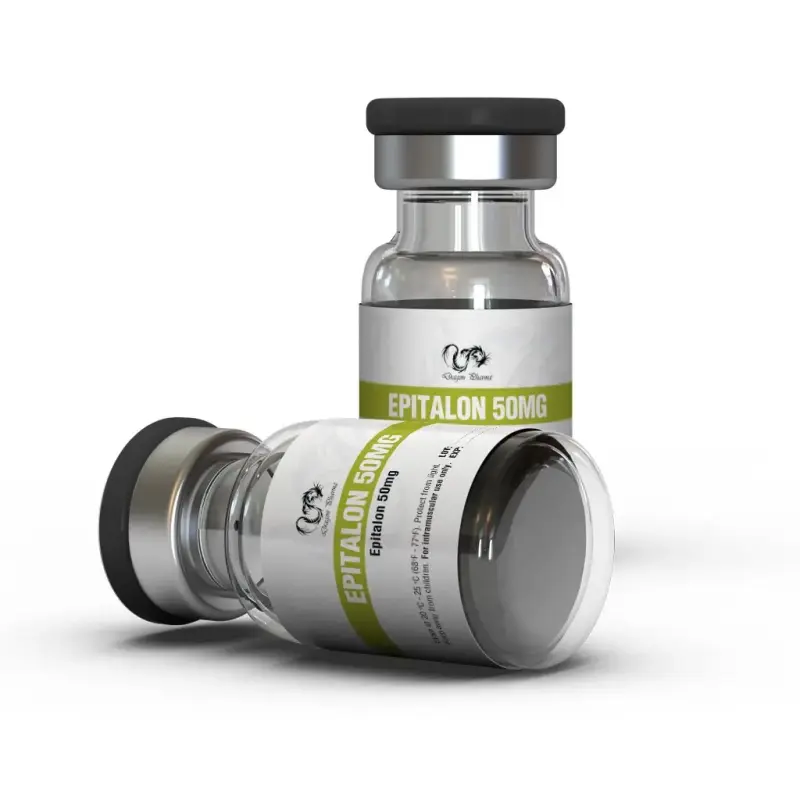
Dragon Pharma Epitalon is one 50 mg vial of lyophilised powder. The peptide inside is a synthetic tetrapeptide built from four amino acids, alanine, glutamic acid, aspartic acid and glycine, which is why it turns up in the literature as AEDG and in older writing as epithalon or epitalone. Its formula is C14H22N4O9 and its molecular weight is 390.35 g/mol, with CAS 307297-39-8 and PubChem CID 219042 as the standard identifiers. Chemically it is a small, unmodified four-residue chain rather than an analogue of a hormone, and that simplicity is part of its appeal in research writing.
The research identity of the molecule is tied to a specific claim. Epitalon is described as the proposed active fraction of epithalamin, a pineal preparation used in Russian work from the 1990s, and the modern interest centres on telomerase, the enzyme that maintains telomere length. In cultures of human cells, exposure over several days produced measurable telomere elongation, and a 2025 review of the mechanisms reported the strongest culture response at 10 ng/ml across 28 days while noting how incomplete the data set remains. The gap that matters is the next step: an effect inside a living organism has not been demonstrated, so every telomere statement about this peptide stops at the petri dish.
A second, separate line of work looks at the pineal gland itself. Epitalon is studied for effects on melatonin output and on the synchronisation of clock genes, and it appears in antioxidant and pineal-protection discussions. That line rests on the same thin base as the first one, mainly small studies with no independent replication. Two facts should frame the whole page: Epitalon is not approved as a medicine in any country, and no human pharmacokinetics have been established, so there is no half-life and no validated dosing interval to work from. The one hard fact is that this is a peptide in a glass vial, and the arithmetic of dissolving it is what the next section can pin down.
Mixing the Vial
Reconstitution is the only part of this material with an unambiguous answer, so the table below deals in volume, concentration and syringe units. The amounts in the lower rows are vendor and research reference points, repeated here because they circulate. The paragraph after the table explains why the highest of them are questioned in print.
| Presentation | One sealed 50 mg vial of lyophilised powder; a bench material, not a medicine |
| Diluent | Bacteriostatic water added against the glass wall, then a gentle swirl; agitating or shaking the solution is avoided |
| Concentration | 50 mg with 25 ml gives 2 mg/ml, so 10 units on a U-100 barrel hold 200 mcg; 50 mg with 10 ml gives 5 mg/ml, where the same 10 units hold 500 mcg |
| Reference amounts | 5 mg a day for 10 days as the low end, 5-10 mg a day for 10-20 days as the middle range, 10 mg a day for up to 20 days at the top, with a repeat roughly once a year in vendor writing |
| Human studies for comparison | Published human work used roughly 0.5-1 mg a day, an order of magnitude below the public protocol, and the discrepancy is discussed in the literature |
| Route | Subcutaneous or intramuscular injection; rotate sites and keep the injected volume small |
| Vial mileage | At 10 mg a day the 50 mg vial covers five days, which is why the 50 mg presentation suits the longer reference protocols |
| Female | No separate female protocol appears in the sources consulted for this card |
That dose-transfer problem deserves a plain sentence. The popular 5-10 mg daily figure traces back to work with epithalamin, a crude pineal extract whose composition differs from a pure tetrapeptide, and published criticism flags this as a possible mistake carried from one literature into another rather than a tested schedule. The practical consequence is that the upper rows of the table above are conventions, not findings.
Research Protocols
No combined protocol for this peptide has been published, so the cards below are shelf pairings from the same research catalogue rather than validated plans. Every pill opens its product page.
What to Expect
- Telomere lengthening in cultures. The effect is documented when human cells are exposed for several days, and the 2025 review places the strongest culture response at 10 ng/ml over 28 days.
- No in vivo telomere proof. The same measurement has not been shown in an organism, and this is the single largest limit on the whole subject.
- Sleep and circadian reports. A parallel line of data covers clock-gene resynchronisation and melatonin, studied separately from the telomerase question.
- Pineal and antioxidant angle. Protection of the pineal gland is discussed in the same body of work, again without independent confirmation.
- Onset measured in weeks. Research designs assess it across a course rather than within days.
- Limitation: no outcome data. Nothing in the sources links this peptide to disease rates or mortality; there are no large independent human trials.
- Limitation: the dose question is open. Published criticism of the transfer from epithalamin to a pure tetrapeptide means the popular amounts rest on an assumption.
Side Effects and Management
The reported profile is short, and the honest summary is that the safety record is thin rather than clean. Nothing in the sources describes a serious event, and nothing describes a long follow-up either.
Stability and Laboratory Notes
Handling comes down to cold storage and honest bookkeeping, because there are no biomarkers that can confirm anything about this peptide in a person.