Product Overview
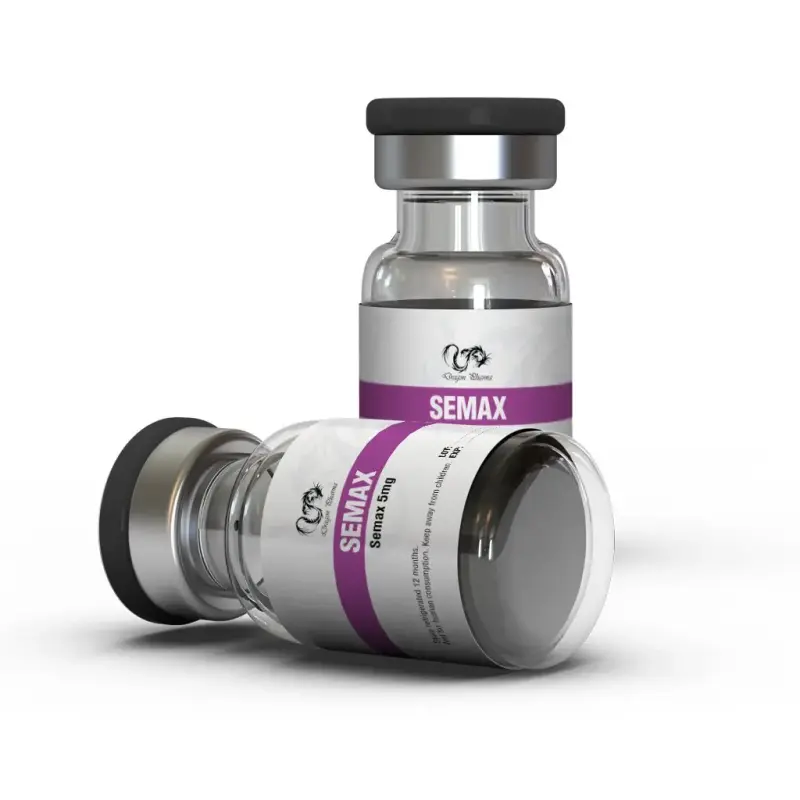
Semax 5mg is shipped by Dragon Pharma as one lyophilised vial of research peptide. Structurally it is a seven residue chain, Met-Glu-His-Phe-Pro-Gly-Pro, designed as an analog of the ACTH(4-10) fragment and therefore sometimes described as a Russian nootropic peptide. The published chemistry is stable and checkable: formula C37H51N9O10S, mass 813.93 g/mol, CAS 80714-61-0, PubChem CID 122178. Because only the mass is printed on the label, the working strength of the vial is decided by how much solvent is added.
The regulatory position is the first thing to understand about this material. Semax was approved by the Russian Ministry of Health in 1994, and neither the FDA nor the EMA has ever approved it, which leaves Russia and Ukraine as the only markets where it is treated as a medicine rather than as a research material. That gap shows up in the data as well: no human pharmacokinetic profile has ever been published for it, so there is no half-life and no measured clearance to build a schedule around. The mechanism is still described as unresolved in review writing, with possible interaction at melanocortin receptors, and the best documented downstream marker is a rise in BDNF and TrkB in the hippocampus, measured in animal models rather than in people.
Human clinical material is scarce and regional. A Russian study published by Filippenkov in 2020 reported better functional and motor recovery after ischaemic stroke when Semax was added, and Russian schemes use a diluted nasal solution several times a day for roughly two weeks. That is a real signal from a small literature, not a registered indication for a research vial. Researchers working on the calming side of the same category often keep a second neuro peptide on the bench, and the longer-term options in the section include Epitalon and NAD+. No vial of this kind can be prepared without a solvent, which puts Bacteriostatic water in the same order.
Dosage Protocol
This peptide has no approved human dose outside Russia, and no human pharmacokinetics were published, so the rows below reproduce vendor research figures and the arithmetic of a 5 mg fill. They are laboratory reference values rather than instructions.
| Beginner | a single 250 mcg dose for 1-2 weeks opens the vendor research range and is used to judge tolerance first |
| Intermediate | between 250 and 1000 mcg per dose, taken one to three times a day across roughly two weeks, giving 500-3000 mcg per day in vendor figures |
| Advanced | Up to 3000 mcg per day in courses; anything higher sits in the research range with no human data behind it |
| Female | The sources behind this card list no female schedule at all, in the same way that they list no confirmed male performance dose |
| Route | Intranasal or subcutaneous; for the 5 mg vial, 5 ml of solvent gives 1 mg/ml, so a 10 unit mark holds 100 mcg |
| Administration | With 2 ml of solvent the same 5 mg vial doubles in strength, so the syringe reading changes while the amount does not |
Stacking and Combinations
This peptide has no validated combination protocol; the pairings below are groupings that recur elsewhere in this catalogue section. Every pill opens its own product page, and all of the items are Dragon Pharma research materials.
What to Expect
- Onset inside a course. Russian schemes look for the cognitive response during the opening days of the two-week course.
- Activating profile. The described effect is closer to stimulation than to sedation, which is the opposite of the calming peptide in the same category.
- BDNF marker. A rise in BDNF and TrkB in the hippocampus is shown in animals; human data on the same marker are limited.
- Recovery context. The strongest human signal is improved functional and motor recovery after ischaemic stroke in a Russian study.
- Preclinical mood data. Antidepressant-like and anxiolytic-like effects are reported in animal models.
- Mechanism gap. Reviews still describe the mechanism of action as unresolved, so the pathway behind any effect is uncertain.
- Evidence limit. Outside Russia and Ukraine this is a research peptide with no Western registration trials behind it.
Side Effects and Management
Events reported so far are either local to the route of use or non-specific, and no long-term human safety data exist. Management therefore rests on dose reduction and observation.
Mixing and Storage
The mixing bench is where this vial is properly mapped out, so the rows below cover solvent, strength and cold storage. Alongside this vial in the same section sit TB 500, Tesamorelin and BPC 157.