Product Overview
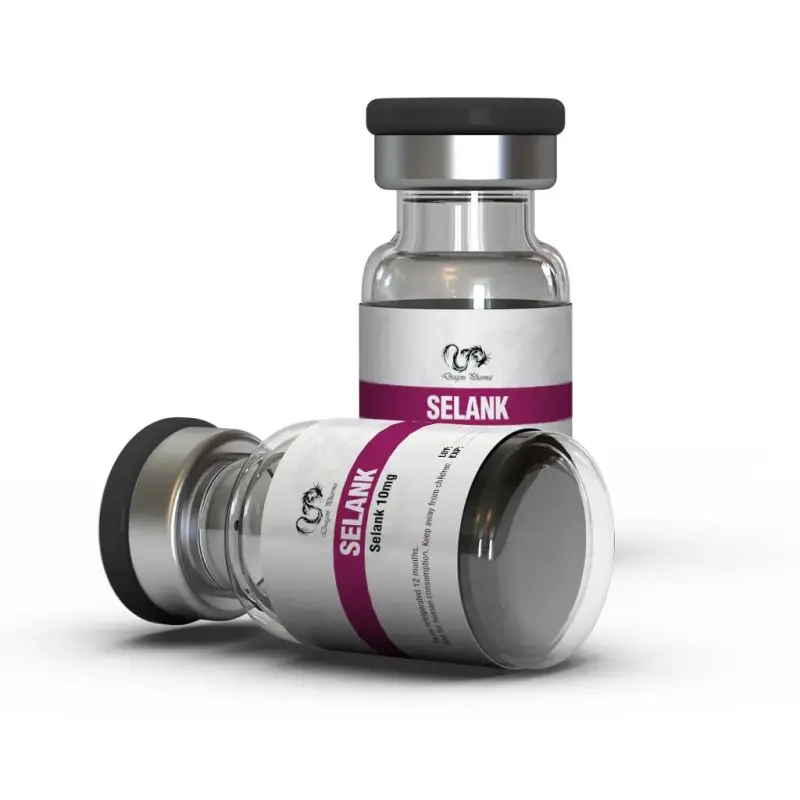
Selank from Dragon Pharma is a lyophilised research peptide in a single vial. The molecule is a seven amino acid chain, Thr-Lys-Pro-Arg-Pro-Gly-Pro, built as a synthetic relative of tuftsin, a natural immunomodulatory peptide. The material was developed at the Institute of Molecular Genetics of the Russian Academy of Sciences, and its published chemistry is straightforward: mass around 752 g/mol, CAS 129954-34-3, PubChem CID 11765600. The label carries the peptide mass, so working strength is set by the volume of solvent added during reconstitution.
What separates this vial from a pharmacy product is not the molecule but the presentation and the paperwork. Selank is registered in Russia, and it is not approved by the FDA or the EMA, so outside that market it circulates strictly as a research peptide. Human pharmacology is thin: the sources behind this card contain no human pharmacokinetic profile at all, which means there is no half-life to plan around and no measured elimination curve. The mechanistic writing instead describes cytokine modulation, including interleukin-6 and the balance of T-helper populations, together with a rise in BDNF seen in rat hippocampus. Only the last of those is a laboratory finding in animals, and animal results do not transfer directly to people.
The clinical evidence that does exist is small and regional. A controlled study published by Volkova in 2016 reported an anxiolytic effect without sedation at low doses, and Kozlovskaya in 2003 compared the compound with benzodiazepines. Both are useful reference points and neither is a large registration programme, which is the honest framing for anyone reading vendor claims. Researchers working on the cognitive side of the same section usually keep Semax 5mg next to it, and longer-term neuro research material includes Epitalon and NAD+.
Dosage Protocol
No approved human dose applies outside the Russian registration, and no human pharmacokinetic profile exists, so the rows below reproduce the vendor research figures and the small Russian clinical scheme. The syringe arithmetic comes from the nominal fill of the vial.
| Beginner | the vendor research range opens at 250 mcg per intranasal dose, run for 1-2 weeks to see how the material is tolerated |
| Intermediate | 250-500 mcg per dose, repeated up to three times a day for roughly two weeks, which is the shape of the Russian nasal scheme |
| Advanced | Up to a total of 500-1000 mcg per day in courses; anything above that is an area of research with no human data |
| Female | No separate female schedule is published anywhere in these sources, so women are covered by no confirmed protocol |
| Route | Intranasal or subcutaneous; the syringe conversion is 5 mg plus 2 ml for 2.5 mg/ml, where 10 units on a U-100 scale equal 250 mcg |
| Administration | Split the daily total across the day for the nasal route; the subcutaneous alternative uses the same range once daily |
Stacking and Combinations
Nothing in the sources qualifies as a validated combination protocol, so the cards below repeat the groupings used elsewhere in this catalogue section. Every pill links to the product page and each item is a Dragon Pharma research material.
What to Expect
- Calming without sedation. Russian work describes an anxiolytic response at low doses without the sedation or memory impairment associated with benzodiazepines.
- Onset inside a course. Clinical schemes assess the response within the first days of a two-week block rather than after weeks.
- Mood signal. An antidepressant-like effect is reported in animal models, which is a preclinical finding.
- Cognitive marker. A rapid BDNF increase was measured in rat hippocampus; human cognitive data remain limited.
- Immune angle. Cytokine modulation, including interleukin-6 and T-helper balance, is part of the described mechanism.
- Evidence limit. There are no Western registration trials, and most published effects come from preclinical work.
- Testing status. The peptide is not named on the WADA list, which means no data exist rather than that use is sanctioned.
Side Effects and Management
Reported events are local or non-specific, and the safety picture is limited by the same shortage of human data that affects the dosing. Management is therefore about lowering the amount and observing rather than following a documented plan.
Mixing and Storage
What is documented here is the preparation rather than the pharmacology, so the rows below cover mixing and storage. Nearby research materials in the same section include Tesamorelin, GHK-CU and Ipamorelin.