Product Overview
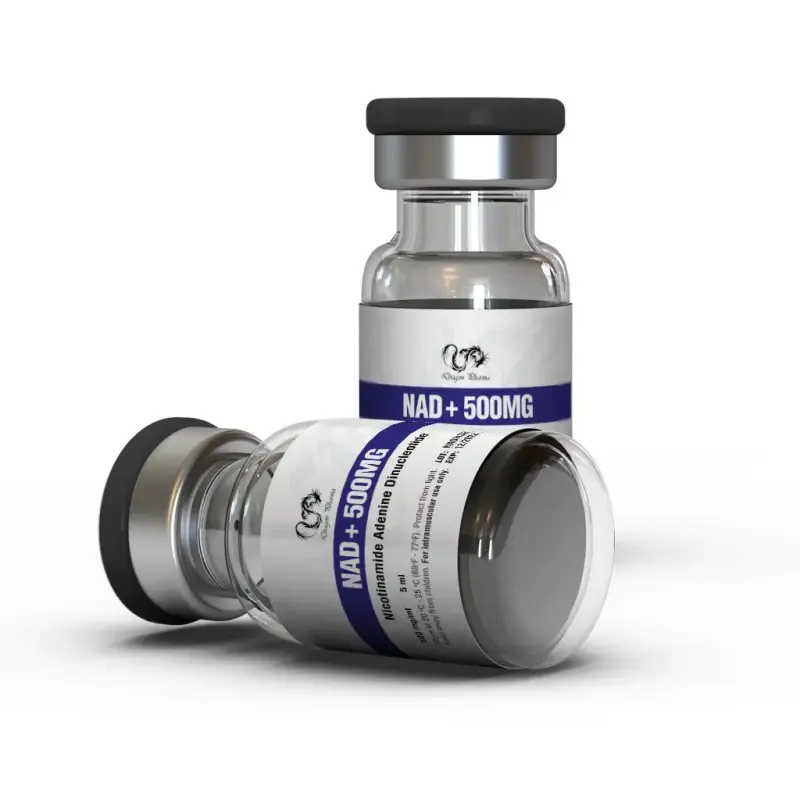
Dragon Pharma NAD+ is a lyophilised vial of nicotinamide adenine dinucleotide, the coenzyme better known by its abbreviation and by the international non-proprietary name nadide. It is not a peptide and not a hormone: the molecule is a dinucleotide built from an adenine nucleotide joined to a nicotinamide nucleotide, with a molar mass of about 664.4 g per mole in the oxidised form, and commercial reference material is sometimes quoted at 663.43 g per mole for the free acid. Because it exists in every living cell, the interest is not in adding a foreign substance but in the size of the pool.
The function is electron transfer. NAD+ accepts electrons in oxidation-reduction reactions to become NADH, and that shuttle sits underneath cellular energy production; the same molecule is also a substrate for the sirtuin enzymes and for PARP, which is why search interest clusters around repair, metabolism and ageing. Cellular levels of the coenzyme are documented to decline with age, and the body rebuilds them through a salvage pathway from nicotinamide and NMN.
The vial is a research material, and the honest summary of the evidence is uneven: plenty of work on NAD+ biology, remarkably little on what giving it to a person does over months. In clinical settings the compound is delivered by intravenous infusion, and most of what is known about how people react comes from that route, not from a vial like this one. That is why the identical molecule appears in two very different product categories, a clinic service and a laboratory powder, and why the same shelf in this brand section holds MOTS-c 10 mg, Epitalon 50 mg and L-Carnitine 500.
Dosage Protocol
No approved human amount exists for NAD+, and the sources behind this card record no standard research amount for repeated subcutaneous use. What can be stated precisely is the mixing arithmetic, which depends on the fill of the vial and the volume of solvent, so the reference figures below are shown per fill. The fill of this particular offer is not recorded in the fact base consulted for this page, which is why the table is built on the reference fills rather than on a single number.
| 100 mg in 2 ml | The solution carries 50 mg per ml, and each ten syringe units deliver 5 mg |
| 250 mg in 5 ml | The solution also carries 50 mg per ml, with the same 5 mg under ten units |
| 500 mg in 5 ml | The concentration doubles to 100 mg per ml, so ten units deliver 10 mg |
| 750 mg in 5 ml | The concentration is 150 mg per ml, so ten units deliver 15 mg |
| The rule behind the rows | Concentration equals milligrams of powder divided by millilitres of water; everything else follows from that division |
| Route in the literature | Intravenous infusion is the route described in clinical practice and in the pilot tolerability work; data on repeated subcutaneous use of our vial are described as scarce in the sources |
| Amounts | No standard research amount and no approved dose could be confirmed; anything presented elsewhere as a fixed NAD+ dose is not supported by the material consulted here |
| Female | No separate protocol for women appears in the sources, and there is no approved amount in any sex |
Suggested Protocols
The groupings below are drawn from how the compound is placed in the longevity and recovery line of the catalogue and from laboratory notes. The sources report no published work on combining these compounds, so these are shelf groupings rather than validated plans.
What to Expect
- Reactions during infusion. Flushing, a feeling of tightness or heaviness in the chest, nausea, headache, fatigue and soreness at the injection site are the observations reported most often in the clinical material.
- Speed drives the experience. The same amount given faster produces stronger symptoms, and slowing the rate makes them subside; that relationship is the single most reproducible finding in the sources.
- Time cost of tolerance. In the 2026 pilot work, moderate to pronounced symptoms lengthened an infusion to a mean of 97 minutes, against 37 minutes for the comparison compound.
- What the molecule actually does. It participates in the NAD+ and NADH redox cycle and in the work of sirtuins and PARP; cellular levels fall with age, and that observation is the whole basis of the interest.
- Route mismatch. Every tolerability observation comes from intravenous work done in clinical conditions, not from a research vial, so extrapolating between the two is a guess.
- No fast external change. The mechanisms sit in energy metabolism and DNA repair, and none of the sources consulted promises a visible result on any particular timeline.
- Long-term unknowns. Data on prolonged use and on clinical outcomes are described as absent rather than merely limited.
Side Effects and Management
The reported reactions are grouped around administration rather than around the molecule itself, which changes how they are managed: the lever is the rate of delivery, with the amount playing a smaller part.
Mixing, Storage and Regulatory Status
There is no recovery protocol to run here, because nothing in this compound suppresses the endocrine system. The schedule that does exist covers how the vial is handled, how long a course is described in the literature, and what its legal position actually is.