Product Overview
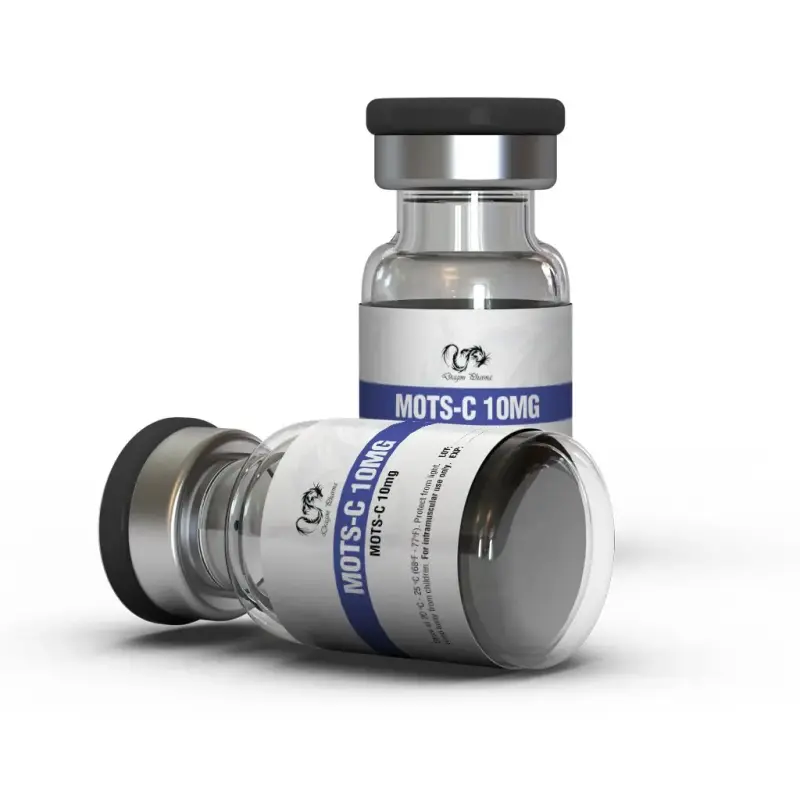
Dragon Pharma MOTS-c is a single lyophilised vial holding 10 mg of a mitochondrial-derived peptide. The name abbreviates the mitochondrial open reading frame of 12S rRNA, type c, and the molecule is sixteen amino acids long, encoded by a gene that sits in mitochondrial DNA rather than in the cell nucleus. It therefore belongs to the small family of peptides the mitochondria produce themselves, which is why it occupies a research category of its own.
Researchers became interested in it because its plasma level responds to physical effort. Levels rise after exercise, and the peptide has been described as an exercise mimetic, which means the search is for some of the metabolic signalling that training produces. The published interest centres on glucose handling in skeletal muscle, where the peptide is studied as a regulator rather than as a fuel. That is the honest frame for this vial: the mechanism is metabolic and the readouts are biochemical.
Weight of evidence matters here. Almost everything available comes from mouse models and from observational work measuring the peptide in human plasma, and the animal findings describe better physical performance, less obesity and a longer healthy lifespan. Interventional human work on the peptide itself is close to nonexistent, and the single registered trial uses a fixed schedule with unpublished results. Searching for this material usually leads to the same shelf as NAD+, Epitalon 50 mg and Semax 5 mg, and the same catalogue holds GW501516 and AOD 9604 5 mg for the other metabolic angles.
Dosage Protocol
This peptide has no established human dose and no approved label, so the figures below are vendor and protocol-review amounts plus the arithmetic of mixing the 10 mg vial. They are reference values for laboratory work, not a treatment schedule.
| 10 mg with 1 ml | Each millilitre then contains 10 mg, so ten syringe units measure 1 mg and fifty of them measure 5 mg |
| 10 mg with 2 ml | Each millilitre contains 5 mg, so twenty units measure 1 mg and a hundred of them measure 5 mg |
| Research amounts | 5-10 mg on two or three days of the week, or 10 mg once weekly, in courses of four to eight weeks; 5 mg per administration over four weeks is quoted as the lower bound |
| Titration note | Some protocol reviews describe 2.5-10 mg with the amount raised over four weeks, which is a description rather than a validated step |
| Medical reference | The one registered interventional study (NCT07505745, phase 2a, Hudson Biotech, started February 2026) uses a fixed amount once a day for twelve weeks subcutaneously; results are not published |
| Vial life | A 10 mg vial covers roughly two days at 5 mg a day, or about four weeks at 5 mg twice a week, which is arithmetic rather than instruction |
| Route and timing | Subcutaneous, usually in the first half of the day; the peptide is associated with training, so laboratory notes place it alongside the training block |
| Female | No separate protocol for women exists in the sources; there is no established human amount for either sex |
Suggested Protocols
The groupings below come from protocol reviews and project reference data rather than from clinical trials. Every card opens a product page inside the Dragon Pharma section.
What to Expect
- No day-one marker. The sources contain no human timeline, so there is nothing to watch in the first three days and no laboratory value that moves on schedule.
- Vendor reports on energy. Weeks one and two are where user write-ups discuss changes in energy and endurance; none of that has clinical confirmation.
- Typical course window. Four to eight weeks is the usual research block described in protocol reviews.
- Metabolic focus. The peptide is studied in relation to glucose metabolism in skeletal muscle, and its own level climbs in response to physical training.
- Animal data only, mostly. In mice, administration is linked with better physical condition, reduced obesity and a longer healthy lifespan; that does not transfer to people automatically.
- No approval anywhere. The peptide is not licensed for any condition in any market.
- Testing reality. In sport it is prohibited at all times under class S4.4, and the sources describe a therapeutic use exemption as extremely unlikely to obtain.
Side Effects and Management
There is no clinical safety database for this peptide, so the reactions below are the ones reported in user accounts plus the practical risks of handling a research vial. Reports are not evidence of frequency, and the absence of problems in short courses proves nothing.
Handling, Storage and Testing Status
Nothing here replaces a recovery protocol, because there is no endocrine suppression to reverse. What the vial does need is correct handling, since the peptide degrades in the same way any lyophilised material does.