Product Overview
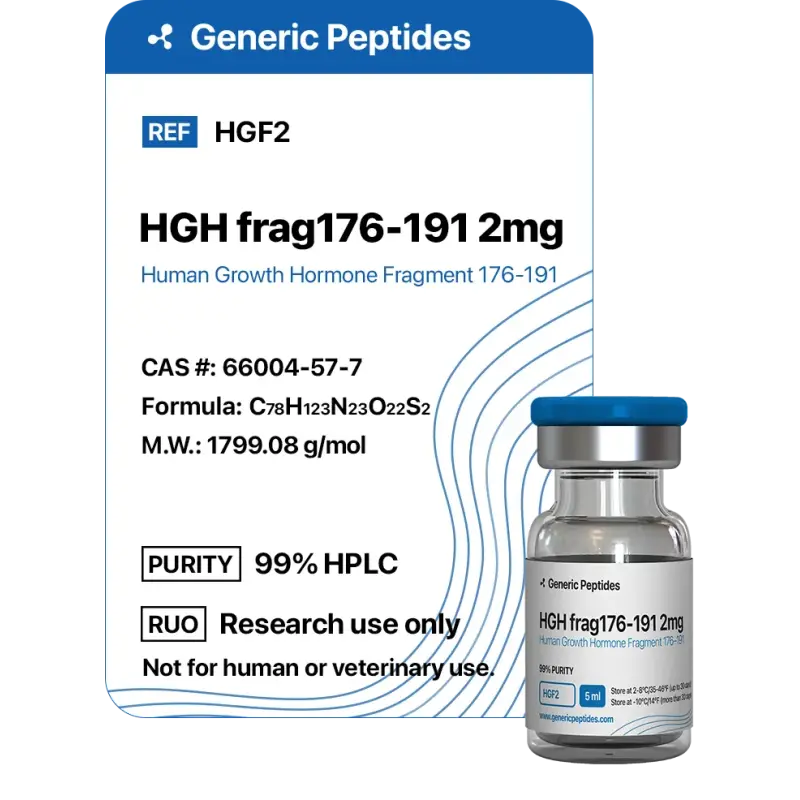
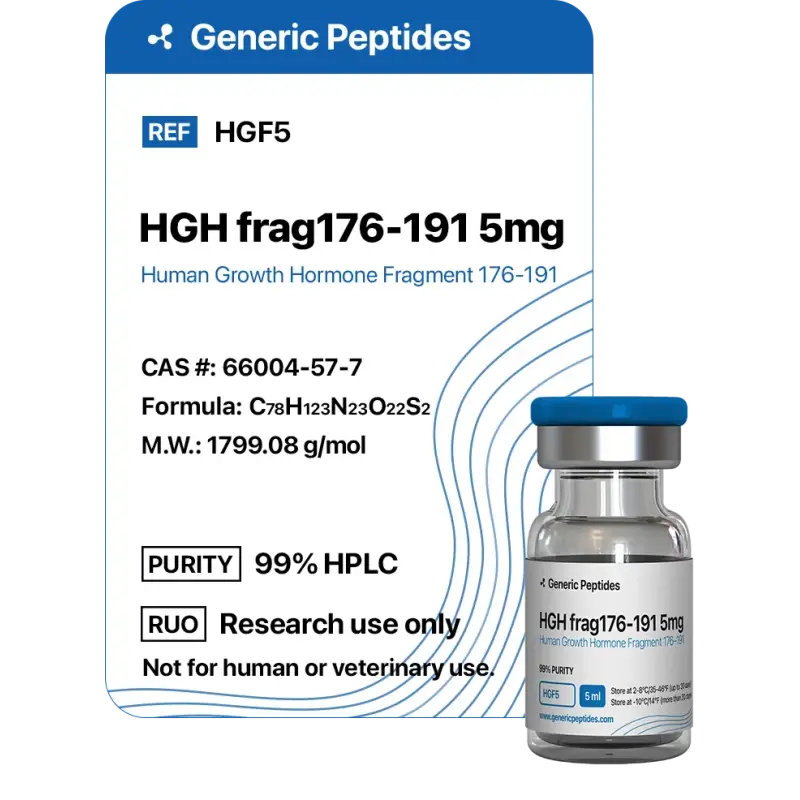
Generic Peptides offers this fragment as two vials of lyophilisate, 2 mg and 5 mg, and the label names a specific stretch of the growth hormone chain rather than the whole hormone. The sixteen residues are Phe-Leu-Arg-Ile-Val-Gln-Cys-Arg-Ser-Val-Glu-Gly-Ser-Cys-Gly-Phe, held in shape by a disulphide bridge, with a molecular mass close to 1817 g/mol. It is a small molecule beside the 191 amino acid parent, and everything attributed to it comes from the assumption that the fat-mobilising responsibility of growth hormone lives in this tail.
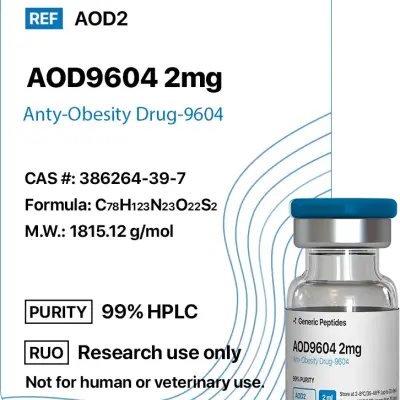
The identification question is the one buyers get wrong, so it belongs early. AOD 9604 is often sold as if it were another name for this material, and it is not: that peptide carries a tyrosine where this sequence has phenylalanine at the front end, and the two are distinct entities with separate reference figures. Both names appear in the same catalogue, and this page describes the native fragment; the other one is on AOD 9604. Read them as related molecules rather than as the same vial under two labels, because the assay and the published work attached to each are not interchangeable.
What the literature actually supports is narrow. Animal models show a fall in fat percentage with the fragment, and in some of those studies the change came without the growth effects of full hormone. The lipolytic action measured on human fat tissue, however, was investigated with the close Tyr-substituted relative and not with the unmodified 176-191 sequence, and the unmodified version has no clinical trial of its own. Nothing in that record produces a human half-life, and no regulator has approved the material. The anti-doping code is just as blunt: growth hormone fragments sit in class S2.2.3 and stay prohibited continuously, so a vial of this kind offers no hiding place either.
Dosage Protocol
These are vendor conventions for research use, not a reviewed schedule. The arithmetic is included because a lyophilised vial gives no dose until the volume of solvent is fixed.
| Vendor convention | 200-500 mcg per day, frequently divided into two injections, blocks of 4-12 weeks |
| 2 mg vial, 2 ml | 1 mg/ml: a 0.1 ml pull on a U-100 insulin syringe measures 100 mcg, and 200 mcg takes 0.2 ml |
| 2 mg vial, 1 ml | 2 mg/ml: the same 0.1 ml pull is 200 mcg |
| 5 mg vial, 2 ml | 2.5 mg/ml: 0.1 ml gives 250 mcg and 0.2 ml gives 500 mcg |
| 5 mg vial, 1 ml | 5 mg/ml: 0.1 ml gives 500 mcg, the top of the quoted range |
| Vial coverage | At 250 mcg daily a 2 mg vial lasts about eight days and a 5 mg vial about twenty |
| Route | Subcutaneous injection in research notes, with the amount split across the day in most write-ups |
| Women | No separate evidence exists in the sources for women, and none for men beyond vendor convention |
Suggested Protocols
The fragment is researched in two different conversations, and the cards below separate them: one compares it with the full hormone, the other with the appetite-side products that also appear in fat-loss work. None of these is a validated combination.
What to Expect
- No trial of the native fragment. Human testing was never carried out on the unmodified sequence, so any expectation is built from animal data and from a related peptide.
- Fat mobilisation in models. Animal work records a lower fat percentage, and in part of that work no growth effect of full hormone appeared alongside it.
- IGF-1 question. Animal data do not show an IGF-1 rise, but the same has not been confirmed in people, so the claim stays provisional.
- Where the human fat data come from. The study on human adipose tissue used the close AOD 9604 relative, which is why marketing language about proven fat loss needs reading twice.
- Frequent dosing. The related peptide clears in minutes in vendor reviews, which is why research notes divide the daily amount into two injections.
- Prohibited status. The fragment is named directly in WADA class S2.2.3 and banned at all times, with no therapeutic use exemption available for it.
- Research label. The vial carries no approval anywhere, so purity and sterility are the buyer's responsibility rather than a regulator's.
Side Effects and Management
Because the human exposure record is empty, the events listed here are the ones a reader would expect from an injected peptide and from the growth hormone family, with the caveat stated where the evidence stops at theory.
Post-Cycle Therapy
A peptide line does not use recovery drugs, and this fragment is a clear example of why. It does not shut down testosterone production, it does not raise estradiol, and it does not act on the testes or the pituitary in the way an anabolic agent does. Adding a SERM or an aromatase inhibitor to it would be a habit borrowed from steroid practice with no mechanism behind it.