Product Overview
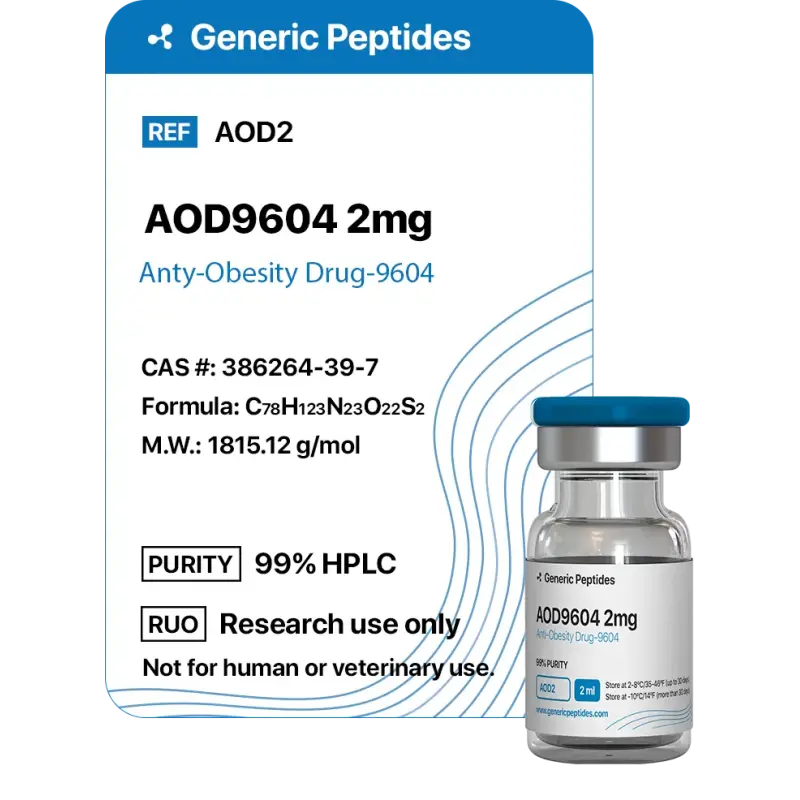
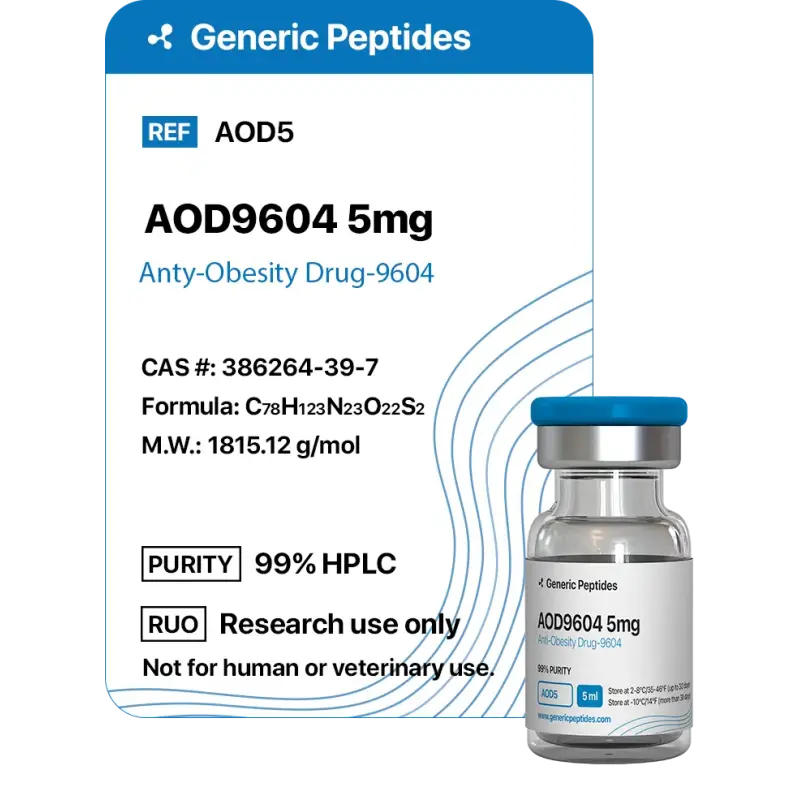
Generic Peptides carries this one as two vial sizes, 2 mg and 5 mg of lyophilisate, both the same molecule: a sixteen amino acid stretch taken from the end of human growth hormone, residues 176 to 191, with a tyrosine swapped in at the front where the native hormone has phenylalanine. The design intention was narrow and is easy to state. Grow the fat-mobilising part of the hormone, leave behind the part that pushes IGF-1 and fluid upwards, and end up with a peptide that a person could dose for body composition without the systemic growth effects of the full 191 amino acid hormone. Whether that intention survived contact with trials is the more interesting question, and it is answered further down this page.
Two facts should be fixed in place before the numbers. First, the only human elimination figure a reader might hope for does not exist; nothing in the sources behind this card states an established human half-life for the material in these vials. Second, the detection story is not a broad window but a measurement method. Urine screening by LC-MS/MS has been used for this compound with a limit of detection reported at 50 pg/ml, and the exact period over which a person would remain detectable has not been confirmed. WADA class S2.2.3 names growth hormone fragments as prohibited in sport, which places the vial in the same category as the other fragment products on the shelf.
That shelf matters here, because this section of the catalogue holds two names for very nearly the same idea. Generic Peptides also lists HGH Frag 176-191, a close relative rather than a second name for the identical material, and the two are sold as separate products with separate labels. Readers comparing this vial against full-size growth hormone work should look at Somatropin, which does raise IGF-1, and at the secretagogues that ask the body to make its own hormone, such as Ipamorelin. The difference in what each of those does to the IGF-1 axis is the whole argument for this peptide existing at all.
Dosage Protocol
The amounts below are vendor research conventions for a laboratory vial, not a schedule any agency has reviewed. Dosing arithmetic is given alongside so that a reader can see where each figure comes from.
| Entry level | 250 mcg daily by subcutaneous injection, run for 4 weeks in vendor write-ups |
| Mid range | 250-500 mcg daily across 4-12 weeks, often timed before fasted cardio |
| Top of range | 500 mcg daily, held to no longer than 12 weeks in the same write-ups |
| Dilution, 2 mg vial | 2 mg plus 2 ml gives 1 mg/ml, so 0.1 ml on a U-100 syringe is 100 mcg |
| Dilution, 5 mg vial | 5 mg plus 2 ml gives 2.5 mg/ml, so 10 units is 250 mcg; 5 mg plus 1 ml gives 5 mg/ml and 10 units is 500 mcg |
| How long a vial lasts | 2 mg at 250 mcg a day is about 8 days; 5 mg at the same amount is about 20 days |
| Route | Subcutaneous in community use; the clinical trials of this molecule used oral dosing |
| Women | The sources contain no separate protocol for women, and no approved amount for men |
Suggested Protocols
Nothing here has been tested as a combination in humans, so treat the groupings as a map of the section rather than a plan. The first grouping is the one the product is usually bought for; the others exist to show which neighbouring products work through an entirely different route.
What to Expect
- Mechanism on paper. The fat-mobilising action is attributed to greater beta-3 adrenergic receptor expression, and that work was done in mice rather than in people.
- IGF-1 left alone. Early studies support the claim that this fragment does not lift IGF-1, which is its advertised separation from full growth hormone.
- What the trial showed. Over 12 weeks, participants on the active material lost an average of 1.8 kg more than those on placebo.
- What the next trial showed. A later 24-week study failed to demonstrate a sufficient lipolytic effect, and that result matters more than the marketing copy.
- Why the product exists anyway. Development was stopped in 2007 for lack of efficacy, so the vial sold today is a research item with a closed clinical file behind it.
- Timeline expectations. Community write-ups describe change over a span of weeks, and the trial data give no support for anything faster.
- Testing risk. Athletes are screened for growth hormone fragments, so a weak effect is no protection at a doping control.
Side Effects and Management
The clinical record for this fragment is short, and the trial data left no pronounced systemic effect on file. What follows is what appears in the research reports and in user accounts, with the practical response attached.
Post-Cycle Therapy
There is nothing to recover from in the hormonal sense. This fragment leaves the testes alone, the pituitary alone and the estradiol level alone, so a recovery protocol built around SERMs, aromatase inhibitors or hCG has no target on this product. Advice of that kind belongs to a steroid cycle and should not be carried across to a peptide vial.