Product Overview
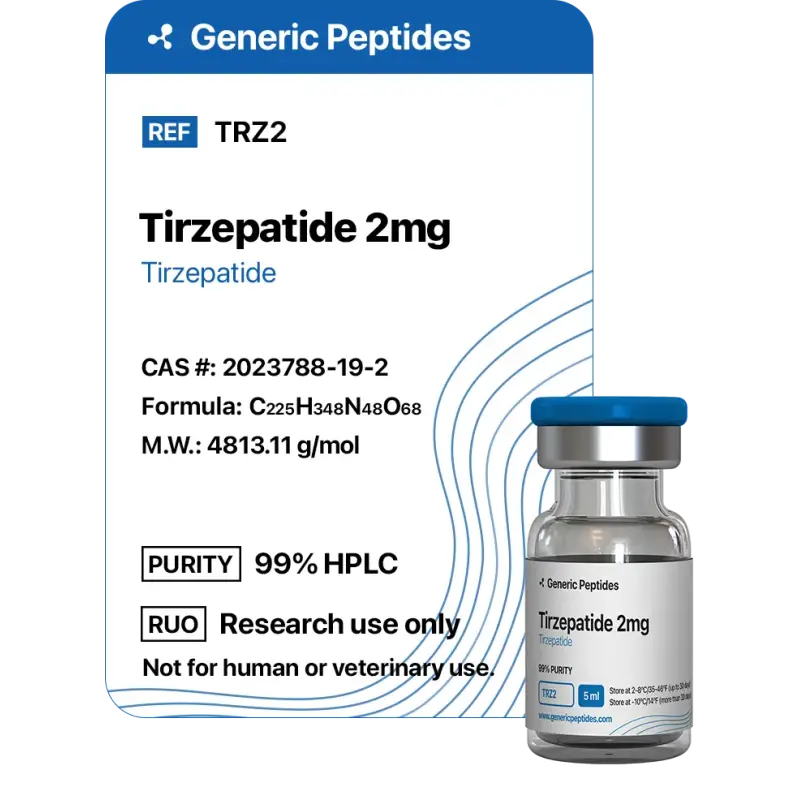
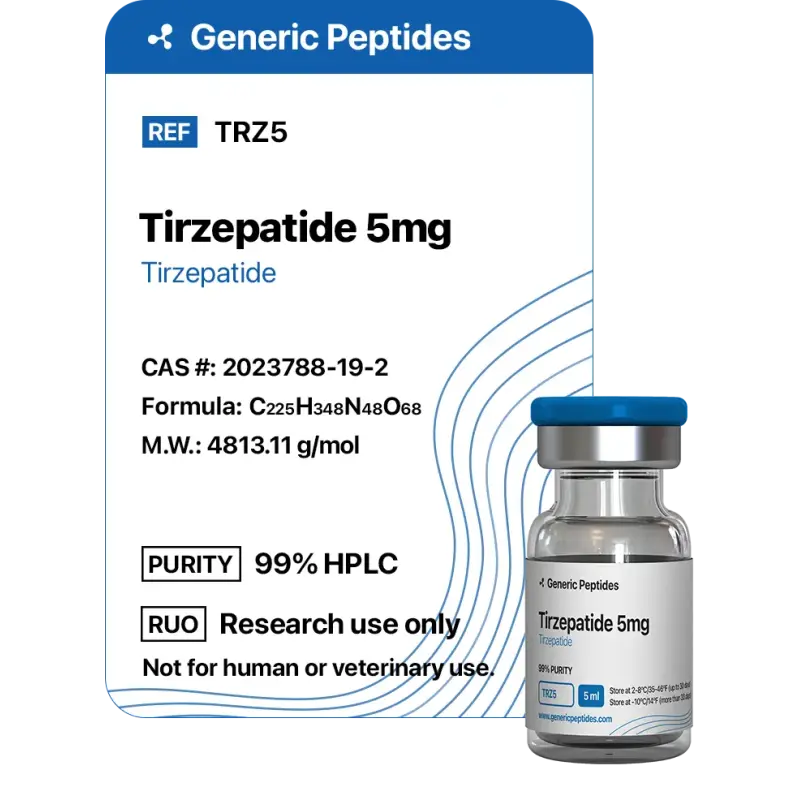
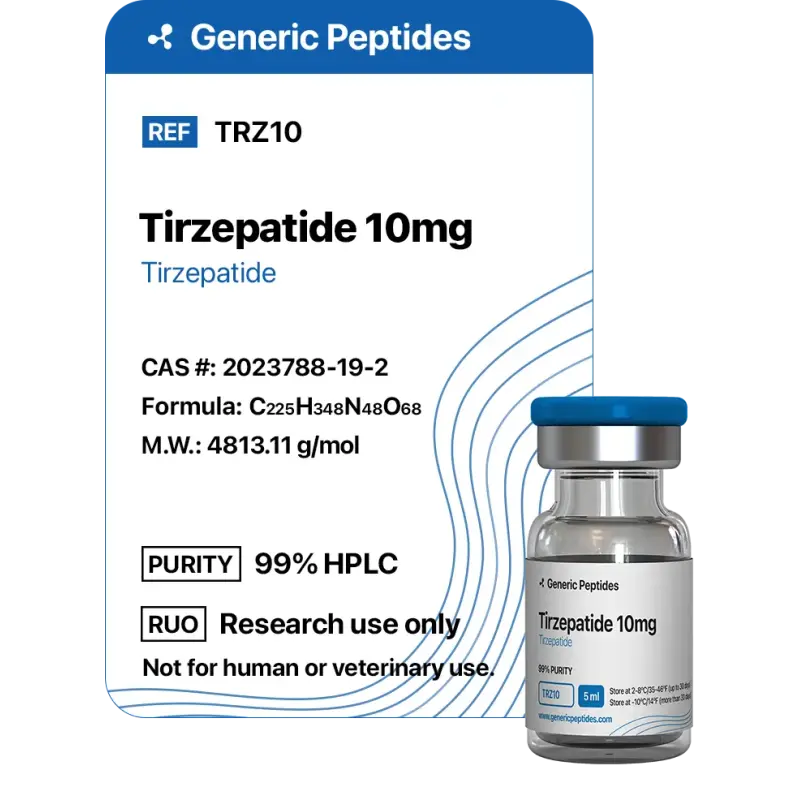
Tirzepatide is one molecule acting on two receptors. It copies the incretin hormones GIP and GLP-1, which is why it behaves differently from the single-receptor medicines of the same family, and it is the active ingredient of the approved Mounjaro and Zepbound injections. Generic Peptides lists a 2 mg, a 5 mg and a 10 mg freeze-dried vial, and none of them arrives pre-measured for a person.
The pharmacology explains the whole product. Stimulating both receptors slows the rate at which the stomach releases food and shifts the hunger signalling reaching the brain. The half-life in population pharmacokinetic work comes out at 5.4 days, close to the 5-6 day figure most references quote, which is what makes a once-weekly injection workable. A vial therefore holds several weeks of material at the lower end of the approved ladder and rather fewer weeks at the top.
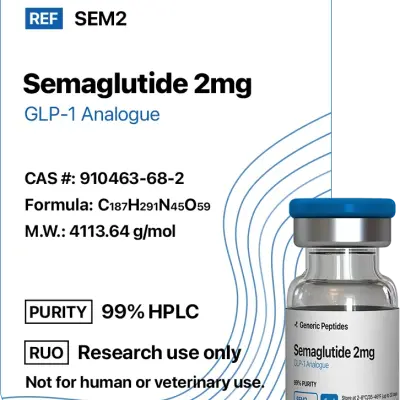
Two regulatory facts deserve the first screen. In sport the class sits outside the prohibited list while remaining part of the monitoring programme, so a tested athlete faces observation rather than a sanction. In medicine the licensed injection carries a boxed warning over thyroid C-cell tumours seen in animals, and the manufacturer's labelling lists a personal or family history of medullary thyroid carcinoma or MEN-2 among the reasons not to use it. A laboratory vial inherits the biology of that warning but none of the oversight that produced it, and the FDA has issued a separate caution about unapproved versions of GLP-1 medicines sold online. Related single-receptor molecules such as Semaglutide are covered on their own page.
Dosage Protocol
The ladder below restates the approved titration so that the published numbers can be read against it. It belongs to a licensed pen, not to a powder, and the sources checked describe no separate female arm.
| Level | Amount | Length | Note |
| Beginner | 2.5 mg weekly | At least 4 weeks | An adaptation step; hunger falls, weight barely moves |
| Intermediate | 5 mg weekly | 4 weeks per step | Raised only when the previous step is tolerated |
| Advanced | 10-15 mg weekly | By tolerance | Top band of SURMOUNT-1; dropout rate climbs with it |
| Female | Same steps, 2.5 mg start | As above | No separate female protocol found in the sources |
| Route | Subcutaneous | Weekly | Rotate the site; the vial is not a pen |
Reconstitution turns milligrams into millilitres, and this is the step people get wrong. Add 1 ml of bacteriostatic water to the smallest vial and every millilitre then holds 2 mg, so the 2.5 mg opening step drains more than a full syringe. Add 1 ml to the 5 mg vial and the strength doubles to 5 mg per millilitre, which turns the same step into half a millilitre, or 50 marks on a U-100 barrel. The largest vial at 2 ml matches that 5 mg per millilitre strength, and at 1 ml it reaches 10 mg per millilitre, where even a starting step is a quarter of a millilitre.
Suggested Protocols
Weight-loss research uses one incretin agent at a time, so the pairs below are catalogue neighbours rather than validated combinations. The single outcome with real weight behind it is SURMOUNT-1, where adults without diabetes received weekly doses for 72 weeks.
Neighbours worth reading before a decision include Tesamorelin where visceral fat is the measured outcome, Somatropin for growth-hormone-driven body composition, and NAD+ for the cellular-energy angle. None of them replaces a calorie plan, and short cycles are foreign to this drug class: the clinical programmes ran for 72 weeks.
What to Expect
- Appetite changes first. Reduced hunger is usually clear within one to two weeks at the starting amount, well before a scale shows anything.
- Weight accrues slowly. Over 72 weeks, SURMOUNT-1 recorded a mean fall of 15.0 percent in the 5 mg group, as much as 20.9 percent in the 15 mg group, and 3.1 percent with placebo.
- Gastrointestinal reactions follow each increase. They typically settle over one to two weeks if the pace of escalation is left alone.
- Dose and dropout move together. Discontinuation for adverse events was 5.1 percent at 5 mg and about 25 percent at 15 mg, so speeding up the ladder costs tolerability.
- Stopping undoes much of it. Roughly 14 percent of body mass was regained within 52 weeks once treatment ended, and the class-wide pattern is that more than half of lost weight returns within a year.
- This is not a quick fat burner. Missed weeks and a finished vial both mean the appetite effect fades while eating habits remain.
- Dosing and sterility are on the user. The vial is research-grade material, not an approved injection.
Side Effects and Management
Almost everything reported is digestive and dose-linked, which makes the speed of escalation the main lever. BPC-157 circulates in peptide discussions as gut support, though it is not part of any incretin protocol.
Post-Cycle Therapy (Not Applicable)
A recovery protocol built around tamoxifen or clomiphene has no place here. Tirzepatide does not suppress the gonadal axis, so there is nothing to restart, and no source describes a SERM protocol for this class.
Storage follows the same logic as any reconstituted peptide: the powder stays cold and protected from light, and the mixed solution belongs in a fridge rather than a freezer, with the exact shelf life for this particular vial not confirmed by the vendor.