Product Overview
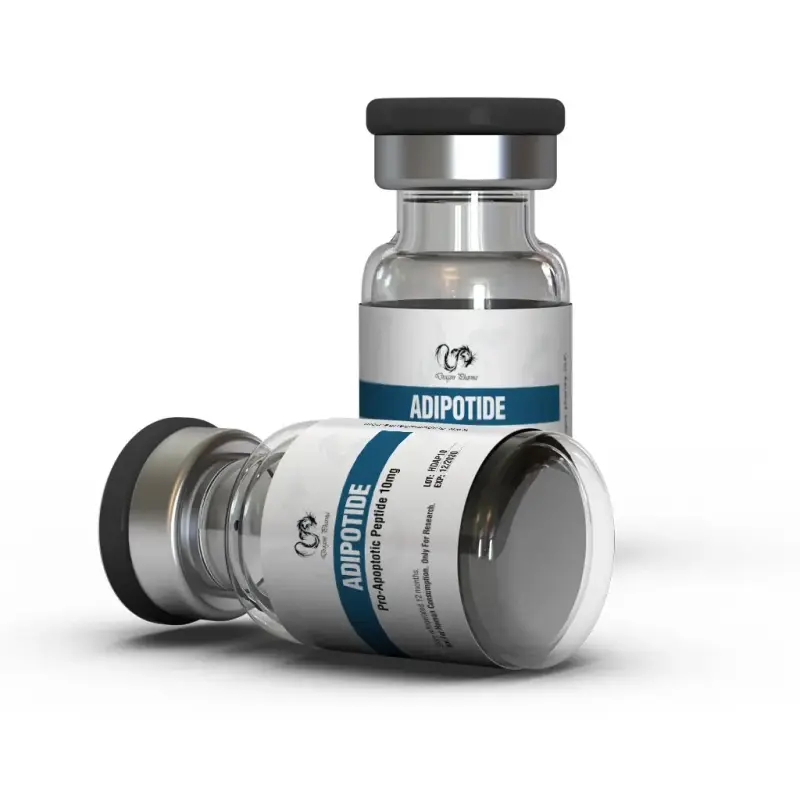
Dragon Pharma Adipotide arrives as a freeze-dried 10 mg vial of prohibitin-targeting peptide 1, a compound also written as prohibitin-TP01 or TP01, and as FTPP, short for fat-targeting proapoptotic peptide. Structurally it is not a natural hormone but a peptidomimetic built from two working parts: a homing sequence that recognises a protein on the endothelial cells of blood vessels inside white adipose tissue, and a proapoptotic domain that kills the cell it has docked onto. The result is not lipolysis in any ordinary sense.
What the mechanism destroys is the vasculature. Endothelial cells lining the vessels that supply white fat undergo apoptosis, the tissue loses perfusion, and the adipocytes that depended on that supply follow. Reviewed animal work is the whole evidence base: obese rhesus macaques treated for 28 days lost around 10.6 percent of body mass and required roughly half the insulin dose they needed before. The same study reported dose-dependent changes in the renal tubules, which captures the problem with the whole idea, because there was no clean separation between the effect that was wanted and the injury that came with it. The program that followed the phase I announcement in the early 2010s never produced peer-reviewed results, and development was halted.
Vial Arithmetic and Reconstitution
The powder is dissolved in bacteriostatic water dripped down the glass, and the vial is turned gently rather than shaken. Two strengths come out of a 10 mg vial, and each is arranged so that the 10 unit line on a U-100 barrel carries a round number of micrograms.
| Doubling the diluent | 10 mg with 4 ml settles at 2.5 mg per ml; the small 5 mg vial matches it with 2 ml |
| Halving the diluent | 10 mg with 2 ml settles at 5 mg per ml; the 5 mg vial matches it with 1 ml |
| The 2.5 mg per ml strength | A 10 unit draw holds 0.1 ml and therefore 250 mcg of peptide |
| The 5 mg per ml strength | A 10 unit draw holds 0.1 ml and therefore 500 mcg of peptide |
| Animal protocol in the sources | Intravenous dosing every day for 28 days in obese rhesus macaques; nothing about it transfers to people |
| Vendor research convention | Notes from vendors put 500 mcg to 1 mg a day subcutaneously forward as a convention, labelled unconfirmed and no recommendation |
| Human dose status | Nothing validated, because no human dataset was ever produced |
With a compound whose safety question is unresolved, the arithmetic matters less than the reason behind it. The source material is explicit that a human protocol does not exist, so any number quoted for the injected amount is a convention rather than a finding.
Animal Data and Research Protocols
The single protocol in the record is a monkey study, not a model of human use. Obese rhesus macaques received daily intravenous injections for 28 days, body mass fell by about 10.6 percent, insulin sensitivity improved to the point that roughly half the previous insulin dose was needed, and renal tubular changes appeared in a dose-dependent pattern. Every one of those four facts belongs to the same paper.
Because the effect depends on shutting down blood vessels, the safety debate is really about selectivity: how much of the vascular action lands outside white fat. Nothing in the sources answers that question for humans. This is also why the compound is referenced next to the rest of the fat-loss shelf rather than as part of it, and why no combination has ever been studied.
What to Expect
- Tenth of body mass in a monkey. The 10.6 percent loss came from 28 days of daily intravenous dosing in obese rhesus macaques, which is the striking number in the file and also a number that comes from animals.
- Insulin sensitivity moved too. In the same study roughly half the previous insulin dose was sufficient, an effect that tracked with the mass loss.
- It is not a lipolytic drug. The sequence runs from endothelial apoptosis to loss of perfusion to adipocyte death, so nothing is burned and the fat is starved of supply instead.
- Narrow window in the animal data. Dose-dependent renal tubular changes showed up in the same treated animals, which means the effect and the damage rose together.
- Limitation. There are no published human efficacy results; the announced phase I never delivered peer-reviewed data.
- Limitation. Human half-life is unknown, a human dose does not exist and this vial is a research product.
- Limitation. The substance is not named in the WADA Prohibited List, which reflects the absence of specific guidance rather than approval.
Side Effects and Management
This is the part of the file that stopped the program, and it should be read before the fat loss figures rather than after them.
Renal Monitoring, Storage and No PCT
There is no post-cycle protocol here, because the compound does not touch the hormonal axis at all. The monitoring that follows from the source is one line long and entirely about the kidneys.