Product Overview
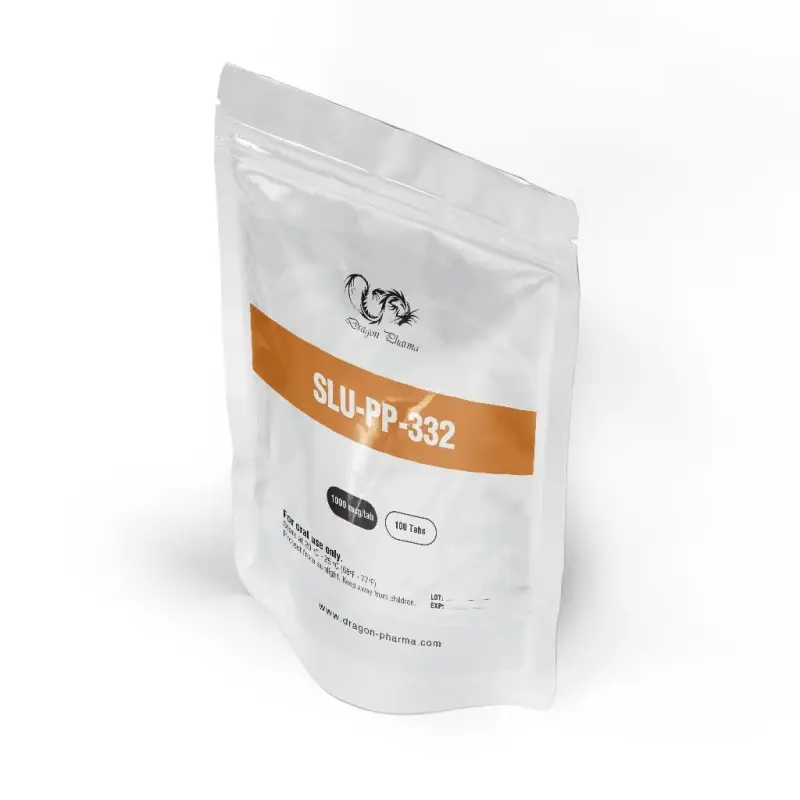
SLU-PP-332 from Dragon Pharma is sold as an oral research material rather than as an injectable peptide: one pack holds 100 tablets of 1000 mcg (1 mg), and no solvent arrives with it because nothing has to be dissolved. The compound is a synthetic pan-agonist of the estrogen-related receptors, acting on all three subtypes (ERR-alpha, ERR-beta and ERR-gamma). That receptor family sits in the metabolic control of skeletal muscle and liver, which is why the substance appears in the literature under the label exercise mimetic: the preclinical readout looks like a chemical echo of training rather than a hormonal signal.
It is worth being precise about what the molecule is not. There is no steroid nucleus and no androgen receptor activity, and it is not a SARM, so the usual aromatisation question does not arise and no estrogen control is part of the picture. All of the published pharmacology comes from mice. In the core study the animals received 50 mg/kg intraperitoneally twice daily for 28 days, and at 30 mg/kg the measured exposure was 0.2 micromolar in plasma with 0.6 micromolar in muscle tissue six hours after the dose. Those numbers describe a mouse experiment and cannot be divided or multiplied into a human tablet figure.
The name of the compound never became a licensed medicine and no regulator has approved it for any indication, so the material stays a laboratory item with a research label. Users who compare it with other metabolic tools inside this section usually end up reading about GW501516 (Cardarine) and MOTS-c 10mg, both of which are studied in overlapping metabolic territory with completely different mechanisms.
Tablet Strength and Research Amounts
No human dose exists, because the compound has never been through a human study. The table below separates the vendor presentation from the preclinical figures, and it keeps the milligram-per-kilogram mouse arithmetic in its own row so that nobody confuses the two.
| Tablet form | 1000 mcg (1 mg) per tablet, 100 tablets per pack; oral administration, no reconstitution step |
| Vendor reference | One tablet daily over 4-8 weeks appears in vendor and community writing; some reports describe two tablets daily. No clinical confirmation exists for either figure |
| Preclinical basis | 50 mg/kg intraperitoneally twice daily for 28 days in mice; this is not a human schedule and must not be converted unit by unit |
| Oral bioavailability | A 2025 publication describes SLU-PP-332 itself as a compound without oral bioavailability, which is why analogues were being designed |
| Conversion error | Milligram-per-kilogram values from mouse injections do not translate into micrograms per tablet for a person; that arithmetic is the single most common mistake around this material |
| Female | No verified protocol for women appears in the sources behind this page, and there is no human male protocol either |
Exercise-Mimetic Combinations
Nothing here was ever tested as a combination in a controlled trial, so the cards below only show how the compound is grouped in research writing. Each capsule opens the product page inside the Dragon Pharma section.
What to Expect
- Preclinical endpoint. In mice the compound raised energy expenditure and fatty acid oxidation and reduced fat accumulation. The human version of that sentence has never been measured.
- Weeks 1-2. Vendor and forum writing describes gradual metabolic shifts. There is no clinical schedule to compare against.
- Weeks 2-4. Self-reports mention changes in appetite and endurance. These are user observations, not trial results.
- Weeks 4-8. The usual course window quoted in vendor material. Nothing in the literature supports or contradicts that length.
- The 2025 caveat. The parent molecule is described as having no oral bioavailability, which is the exact reason chemists were working on analogues. Any expectation built on the tablet is therefore an extrapolation.
- Ceiling. Everything known about the compound rests on mice, so the honest expectation is uncertainty rather than a promised result.
Side Effects and Research Limits
There is no human safety database for this compound. The items below are the boundaries that the sources state plainly, plus the practical errors that show up around a research material sold in tablet form.
Monitoring and Bench Handling
The compound does not suppress the gonadal axis, so no post-cycle protocol belongs to it: stopping is simply stopping, and the axis was never switched off. What a research period needs instead is observation and a defined end date.
For metabolic reference points outside this card, the section holds Cagrilintide and Mazdutide as appetite-pathway materials, and Tirze-Pep 10mg for comparison work. None of them shares a mechanism with SLU-PP-332, and none of them changes the fact that this compound has no human data behind it.