Product Overview
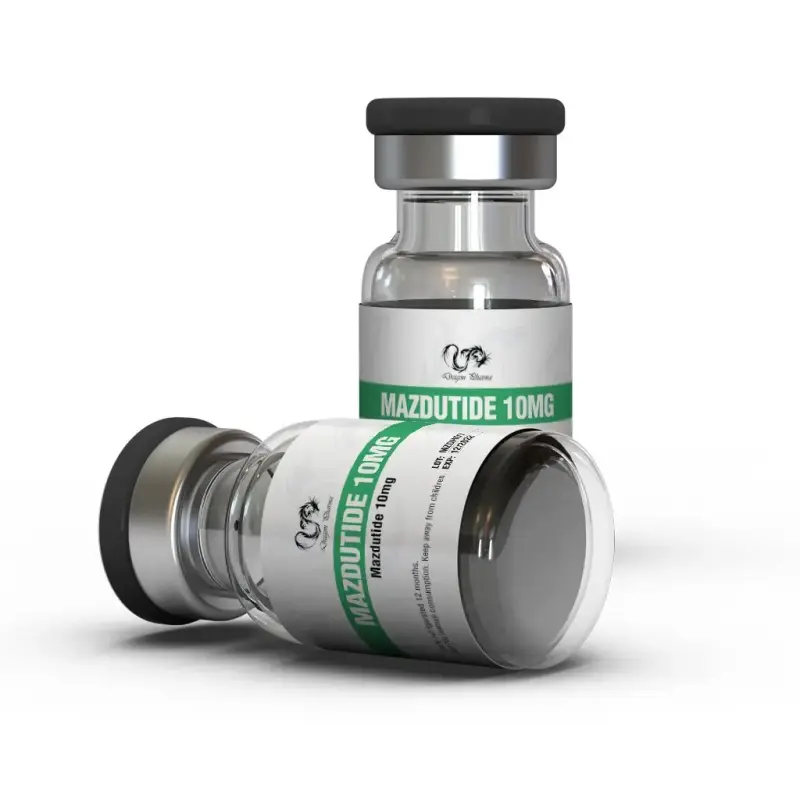
Dragon Pharma Mazdutide is supplied as one 10 mg vial of lyophilised powder, and the substance inside is a synthetic peptide known in trial registries as IBI362 and LY3305677. It is built as an analogue of oxyntomodulin, the gut hormone released after a meal, and its defining feature is that it acts on two receptors instead of one: the GLP-1 receptor that governs satiety and glucose-dependent insulin release, and the glucagon receptor, which adds an energy-expenditure signal to the same molecule. That dual design is what separates it from the single-receptor incretins.
The practical consequence of the structure shows up in its timing. Phase 1 work published in 2025 reports a half-life of about eight days at the 16 mg dose, which is long enough for a weekly subcutaneous injection to hold a stable effect, and that interval is the schedule described throughout the trial material. Two dose levels, 9 mg and 10 mg, were carried through a multiple-ascending-dose phase 1b programme, and phase 3 results released in May 2025 described a clinically meaningful reduction in body mass among Chinese adults with overweight or obesity. For readers weighing the alternatives, the Tirze-Pep 5mg and Cagrilintide pages cover the two other incretin strategies in the range, while the SLU-PP-332 card covers a research compound whose target is not a gut hormone receptor at all.
Two things must be said without decoration. The first is regulatory: the injectable form was approved for sale in China in June 2025, while outside that market the peptide remains experimental and the sources consulted contain no data on unsupervised self-administration. The second is arithmetic. A 10 mg vial has to be reconstituted and dosed in units, and a dilution error silently changes the whole escalation schedule, so the maths below belongs in the plan before the first injection. Data on long-term safety beyond the trial period is not established.
Research Dosing Reference
The figures below are the trial and vendor reference values collected for this card, presented as research data rather than as medical advice.
| Frequency | Once a week, subcutaneously; the roughly eight-day half-life is what supports that interval |
| Trial amounts | 9 mg and 10 mg in the phase 1b multiple-ascending-dose work |
| Half-life reference | 16 mg, the dose at which the 2025 phase 1 paper describes a half-life near eight days |
| Trial outcome | Phase 3 results from May 2025 report a clinically meaningful fall in body mass in Chinese adults with excess weight |
| Reconstitution | 10 mg powder plus bacteriostatic water; the dose is read in mcg or units, so the dilution has to be written down |
| Storage | Keep the made-up solution at 2-8 C, protected from light and never frozen |
| Female | No confirmed protocol for this card's context; pregnancy and breastfeeding questions sit outside what the sources cover, so no figure is given |
Suggested Protocols
Nothing is stacked onto an incretin casually, and the arrangements below follow the comparisons named in the source material. Each pill links to the Dragon Pharma page it names.
What to Expect
- First day or two. Appetite drops and nausea is possible in the window right after the injection.
- Weeks 1-2. Portions shrink and the first drop on the scale usually appears, driven mainly by intake rather than by any metabolic trick.
- Weeks 2-12. In the clinical programmes the bulk of the body mass reduction landed in the first quarter of treatment, so early weeks carry most of the change.
- Weeks 12-20. Some participants continued to lose without flattening out, which comes from the phase 1 work at 16 mg rather than from phase 3.
- Gut tolerance. Nausea, constipation or loose stools are the everyday complaints and they follow the dose, which is why titration is slow.
- After stopping. Appetite and body weight tend to return in part, the general behaviour of the incretin class rather than a mazdutide-specific finding.
- Status limit. Outside China this is a research peptide, and the sources offer no guidance for running it without clinical supervision.
Side Effects and Management
Most of what is reported is gastrointestinal and settles as the dose is stepped up slowly. Each entry states how often it appears and what drives it.
Weekly Titration and Storage
The frame below takes the place of a post-cycle section, because a peptide that does not touch the HPTA has nothing to restart.