Product Overview
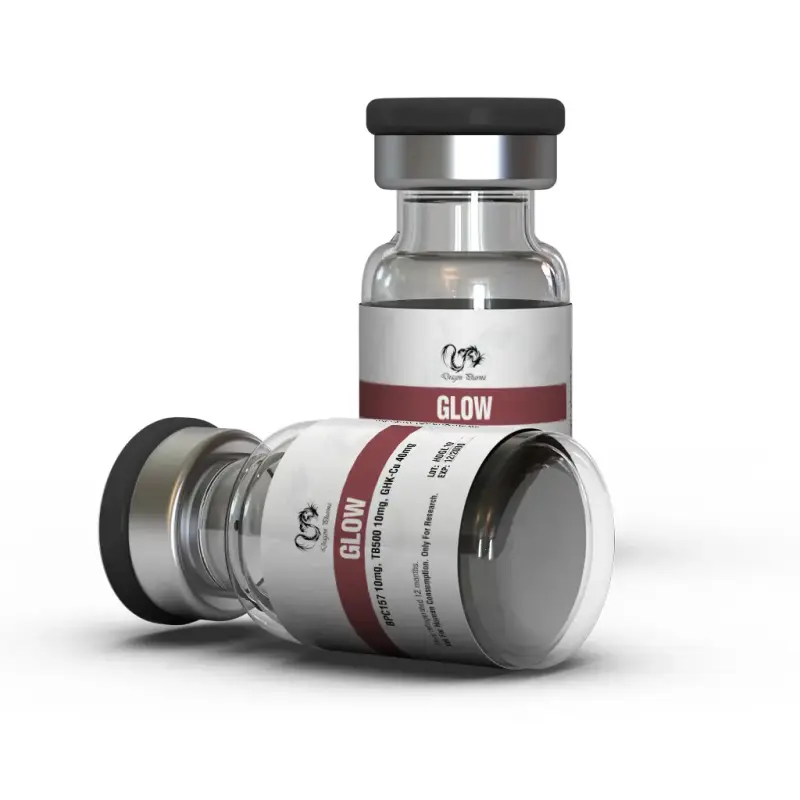
Dragon Pharma Glow Blend arrives as one lyophilised vial with 60 mg of peptide inside, shared between BPC-157, TB-500 and GHK-Cu. The catalog knows the same grouping under the name Glow peptide, and the three components come from very different places. BPC-157 is a chain of fifteen amino acids taken from a gastric protein. TB-500 is the research label for the acetylated heptapeptide Ac-LKKTETQ, a piece of thymosin beta-4. GHK-Cu is a copper-carrying tripeptide, glycyl-histidyl-lysine, which binds the metal ion at the middle of its short sequence. The three form one product because they divide a single repair job instead of repeating it: BPC-157 and GHK-Cu carry the connective tissue and skin side, TB-500 is the structural fragment, and the 5:1:1 ratio fixes their relationship, so dosing runs off the volume of the mixture rather than three separate schedules.
Vendors describe the mixture at a ratio of roughly 5:1:1, GHK-Cu first, then BPC-157, then TB-500, and the label remains the authority on the actual weights per peptide. A related option in the same portfolio is the four-peptide Klow version, which adds the anti-inflammatory tripeptide KPV and grows to an 80 mg fill. Buyers who want to handle the components one at a time can order the standalone GHK-CU 10 mg vial, the BPC 157 2 mg vial, the TB 500 5 mg vial or the pair-only BPC-157 / TB-500 blend.
Where the research interest sits is worth stating plainly. Connective tissue and skin are the areas with the most commentary, GHK-Cu has been examined on the skin surface and in cell culture, and the bulk of the remaining evidence for the peptides in this vial is preclinical. Nobody has run a controlled human study on the three of them combined, and the sources consulted for this page make that limitation explicit.
Dilution and Research Amounts
What follows reproduces the numbers the sources state. The component figures are vendor conventions and model-level observations, the combined figure is an extrapolation, and the peptides inside one vial are not separable.
| Solvent | Bacteriostatic water, added slowly; the cake is swirled, never shaken |
| Strength at 3 ml | 60 mg in 3 ml gives 20 mg per ml, so 1 mg of total peptide sits in 0.05 ml and 2 mg in 0.1 ml, which is 10 units on a U-100 scale |
| Strength at 6 ml | 60 mg in 6 ml gives 10 mg per ml; 1 mg is 0.1 ml or 10 units, 2 mg is 0.2 ml or 20 units |
| BPC-157 reference amount | 150-375 mcg administered twice daily in published reviews of user practice, not in controlled human work |
| TB-500 reference amount | Vendor material describes a loading stage near 2.5 mg given twice weekly for 4-6 weeks, followed by a weekly 2.5 mg amount |
| GHK-Cu reference amount | 1-2 mg a day in systemic animal models; human data for this peptide come from a topical preparation, not from an injection |
| Combined reference amount | 1-2 mg a day across a 4-8 week course is derived from the rows above and is not a study finding |
| Vial yield | At 1 mg a day the 60 mg fill covers 60 days; at double that it covers 30, which is arithmetic rather than advice |
| Female | The sources consulted contain no verified female schedule for this blend, and none is written in here |
| Route | Subcutaneous; the described action is not local, so the injection does not have to land at the tissue of interest |
Stacking and Combinations
Three groupings reflect the way this vial is discussed next to the rest of the range. The pills open the corresponding Dragon Pharma pages and the shared accessory in each case is the preserved water.
What to Expect
- Opening days. A reaction where the needle entered is the only expected event; a fast systemic response is not something the sources describe.
- Weeks 1-2. Reduced pain around sprains and tendon trouble shows up in user accounts. Clinical support for the claim is absent, so the account stays an account.
- Weeks 2-4. Ease of movement is the theme of forum posts from this stretch; no measured endpoint backs it.
- Weeks 4-8. The course length most often quoted for the blend, while the TB-500 component is handled with a loading phase of its own across 4-6 weeks.
- Skin thread. GHK-Cu was studied in fibroblasts and on the surface of the skin, where collagen synthesis was reported; a 2018 human study kept the material on the skin for 12 weeks.
- Limitation. Two components are prohibited in sport at all times, BPC-157 under class S0 and TB-500 under S2, and injected TB-500 has no human trial record.
- Limitation. GHK-Cu is described in the sources as pushing both metalloproteinases and their inhibitors, and BPC-157 carries an unresolved question about angiogenesis.
Side Effects and Management
The list below is a component-level picture, not a safety record for the mixture. Most entries are local or unconfirmed, and the long-term picture for a three-peptide vial is simply not documented.
Dilution, Storage and Shelf Life
Powder and solution behave differently, and the sources are clear on the limits of each state, which is why they are split below.