Product Overview
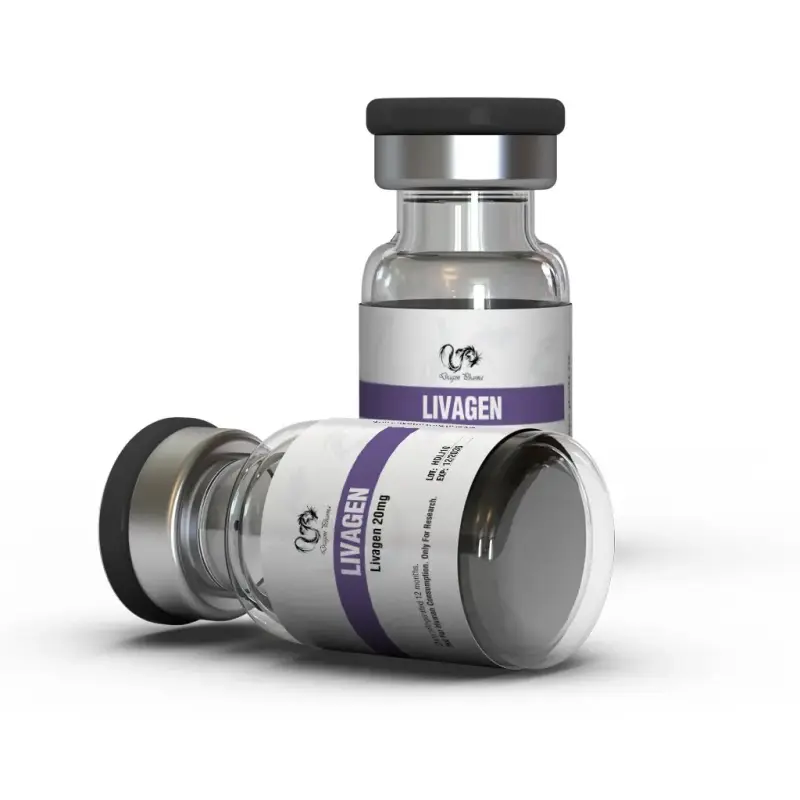
Dragon Pharma Livagen is a single lyophilised 20 mg vial of the tetrapeptide KEDA, written out as Lys-Glu-Asp-Ala. It belongs to the group of small bioregulator peptides that Russian research groups produced from the late 1990s into the early 2000s, and the family resemblance matters more than any individual claim: Epitalon, Cortagen, Pinealon, Vesugen, KPV and GHK-Cu sit in the same row, all built from three to four amino acids. The material is offered here as a laboratory reference substance and not as a medicine.
The mechanism language that surrounds the family is molecular, not clinical. Cell-level work on the related KEDW, AEDG and AEDL sequences links them to histone proteins H1, H2b, H3 and H4, and to how accessible promoter regions are to transcription machinery. That is a bench observation about chromatin, and it does not translate into a measured human outcome. The project fact base records the vendor position directly: Livagen is sold as an anti-aging product on relatively limited evidence, and there is no randomised human dataset to put next to that sentence. Users of the family normally describe a liver and general-recovery angle, so this card is written around reconstitution, storage and observation rather than around a steroid-style cycle.
Vial Arithmetic and Reconstitution
The vial ships as a powder, so the first step is dissolving it in bacteriostatic water. Add the water against the wall of the vial and roll the vial between the palms rather than shaking it, because foaming and mechanical stress work against a clean solution. Two concentrations cover almost every arrangement a 20 mg vial allows.
| Vial plus diluent | 20 mg + 2 ml gives 10 mg per ml; 20 mg + 1 ml gives 20 mg per ml |
| Drawing at 10 mg per ml | A 1 mg draw measures 0.1 ml and a 2 mg draw measures 0.2 ml, which charts as 10 and 20 marks on a U-100 barrel |
| Drawing at 20 mg per ml | A 1 mg draw measures 0.05 ml, so a 0.3 ml insulin syringe or similar low-volume barrel is needed |
| Vial duration | 20 days of material at 1 mg a day, 10 days at 2 mg a day; this is arithmetic and not an instruction |
| Dose status | No settled human dose exists; vendor material mentions 0.5 mg to 2 mg a day subcutaneously, and sometimes an oral route, both unconfirmed |
| Course shape in the family records | Short blocks of 1 to 3 weeks, repeated once or twice a year, which is a family convention rather than a validated schedule |
Because the entry point is arithmetic rather than pharmacology, a unit error is the most likely way to get an unexpected amount. Write the concentration on the vial label after mixing and mark the units that equal 1 mg at that concentration, so the number never has to be recalculated from memory mid-injection.
Research Protocols
Livagen is not the centre of a stack in the way an androgen is. In the project records it appears as a short addition to a family block, with the same diluent and the same benchtop habits as its relatives. The arrangements below follow that pattern and every pill opens the matching product page, so a full set can be assembled inside the Dragon Pharma section.
What to Expect
- Days 1 to 3. The realistic early finding is local: a small reaction where the needle went in. Nothing measurable is expected this soon, because no human kinetic study backs a faster claim.
- Weeks 1 and 2. User accounts discuss general wellbeing during short blocks. There is no clinical dataset behind those reports, so they stay reports.
- Weeks 2 to 3. This is the window the family convention uses for a short course; the format ends there rather than stretching.
- Liver angle. The peptide is positioned as liver-targeted, meaning the liver, detox pathways and epigenetic mechanisms in vendor language. Positioning is not the same as a demonstrated endpoint.
- What the science actually shows. Related short peptides bind histone proteins in cell studies. That is chromatin biochemistry, and it is the ceiling of the evidence, not a clinical result.
- Limitation. The evidence base is thin and the compound is not an approved medicine anywhere, so results should be judged accordingly.
- Limitation. No long-term observations and no repeated-course studies in humans were found for this peptide.
Side Effects and Management
Because human exposure data are missing, the list below mixes the ordinary local effects of any subcutaneous peptide with the two practical risks the fact base names outright: an immune reaction to the peptide itself and a mixing mistake.
Monitoring, Storage and No PCT
There is no post-cycle therapy for this material, because it does not suppress testosterone production. What replaces it is a simple observation plan and the storage routine that keeps the powder and the solution usable.