Product Overview
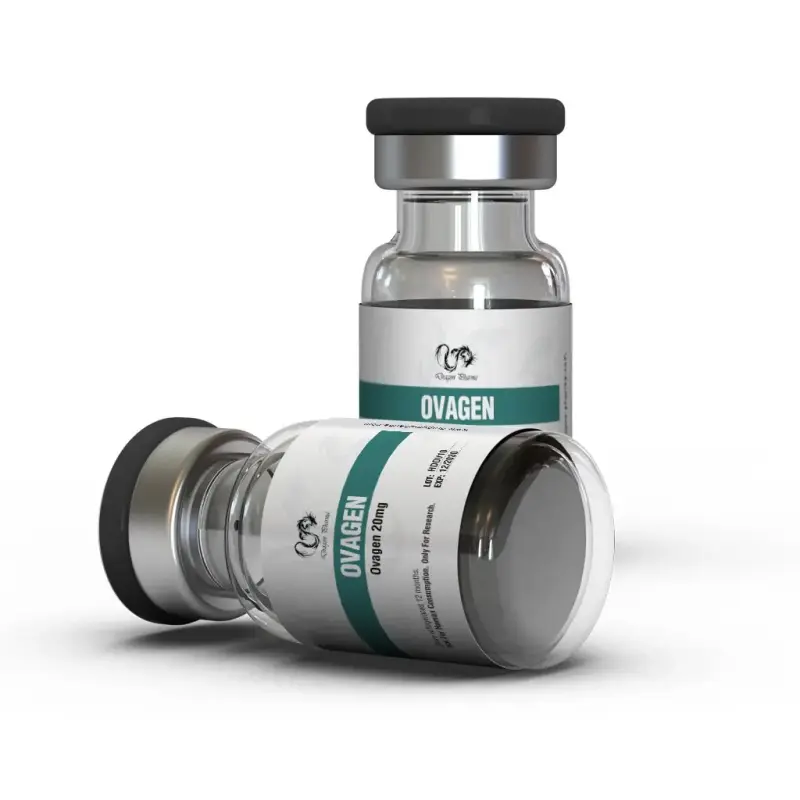
Dragon Pharma Ovagen is a single 20 mg vial of freeze-dried powder. The material inside is the short regulatory tripeptide EDL, assembled from glutamic acid, aspartic acid and leucine, and it belongs to the small bioregulator series associated with the Khavinson research line. There is no ester, no anabolic backbone and no hormonal action in the molecule. The whole idea behind the family is that a chain of only three or four residues can still influence gene expression in cell models, and that is exactly where almost all of the published work stops.
How the vial is presented by suppliers is a hepatobiliary and gut frame. Ovagen is offered next to claims about hepatic and gastrointestinal tissue rather than about muscle, strength or the androgen axis. The same wording repeats from shop to shop, and repetition across vendor pages is not evidence of anything. The fair summary is that the claims trace back to molecular and cell-culture research, while randomised human outcomes have not been reported. A buyer looking for a peptide with a documented human kinetic profile is simply outside the territory this product covers.
Because the content is a lyophilisate, the first real question is not the dose but the solvent. The vial has to be reconstituted with Bacteriostatic water before any figure can be calculated, and the resulting concentration depends entirely on the volume added. The next two sections handle that arithmetic and the way the peptide is grouped in research writing, alongside the gut-focused neighbour BPC 157 and the family relative Epitalon.
Reconstitution and Reference Amounts
There is no established human schedule for this peptide, so the table below is solvent arithmetic and a description of what vendors quote, not a prescription. Every milligram figure is tied to the volume of water added, and the same vial can be diluted to two very different concentrations.
| Solvent | Bacteriostatic water run slowly down the wall of the vial; never shake a lyophilisate |
| With 2 ml added | 10 mg/ml. Ten U-100 units carry 1 mg, and a 0.2 ml draw carries 2 mg |
| With 1 ml added | 20 mg/ml. A single milligram then occupies only 0.05 ml, so a 0.3 ml or low-dead-space syringe is needed |
| Vendor reference range | Supplier pages quote 0.5-2 mg a day under the skin; no controlled trial stands behind any figure |
| How long the vial runs | At 1 mg daily the 20 mg vial provides roughly 20 days of material; at 2 mg daily, roughly 10 |
| Course shape in the project base | Short family blocks of 1-3 weeks, once or twice a year, always with breaks between |
| Stability | Dry powder refrigerated at 2-8 C, shaded from light, never frozen; the mixed solution keeps about four weeks |
| Female | The sources consulted for this card contain no confirmed female schedule; none is offered here |
Research Protocols
Research writing groups this tripeptide in a few arrangements. None of these pairings has been tested as a combination in a controlled study, so they are study arrangements and not established treatments. The durations below follow the family convention of short blocks rather than long courses.
What to Expect
- First days. The only reliably described event in the first 1-3 days is a local reaction where the needle went in; there is no fast systemic effect to watch for.
- Weeks 1-2. User write-ups discuss general tone and digestion, and those reports cannot be separated from expectation because no clinical measurement backs them.
- Weeks 2-3. This is the end of the family-style short block; extending it has no evidential basis in the sources behind this page.
- Liver framing. The peptide is filed under a hepatic and gut profile, but that is positioning rather than a demonstrated clinical outcome.
- Family background. In cell work the short peptides of this series are linked to histone proteins and to promoter accessibility, which is the mechanistic story vendors borrow.
- Evidence ceiling. No human randomised trial exists for the compound, and the source material itself calls the evidence weak.
- Most reported nuisance. Injection-site discomfort is the single best-described unwanted effect across the family, and it is local rather than systemic.
Side Effects and Management
No meaningful frequency data exist for this peptide, so the entries below are class-level observations for short injected peptides and practical safeguards rather than measured rates.
Monitoring, Storage and No PCT
This peptide does not suppress testosterone production, so there is nothing to restart afterwards. What matters instead is a simple observation log, the solvent purchase and cold storage.
Every vial in this group needs a solvent, so Bacteriostatic water is the routine companion order. Users who are also reading about tissue repair look at TB 500, while the skin and connective-tissue peptide GHK-CU 10 mg and the mitochondrial peptide MOTS-c 10mg cover two unrelated research directions. None of them substitutes for the other, and none of them has human outcome data behind this presentation.