Product Overview
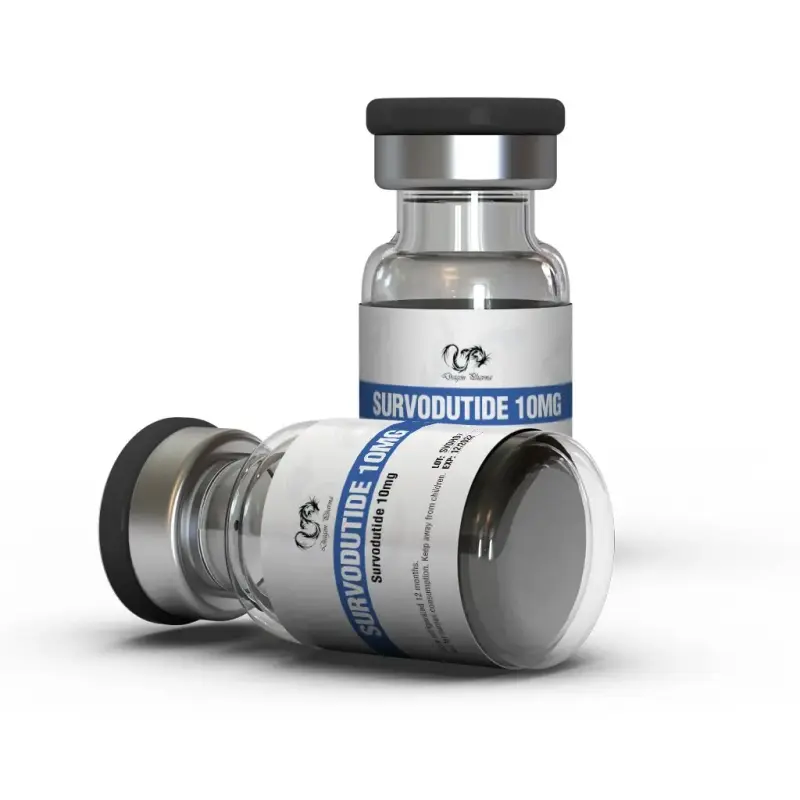
Dragon Pharma lists this material as a single 10 mg lyophilised vial of a research peptide. The compound is survodutide, known by its development code BI 456906 and by the informal name twincetin, and it is being developed by Boehringer Ingelheim. Mechanically it is a dual agonist, switching on both the GLP-1 and the glucagon receptor at once. Sources place it in the glucagon camp rather than with oxyntomodulin, which matters only if the two are confused in a comparison table.
Pharmacokinetics are the strongest data in the file, and they come from published human work rather than animal models. Albumin binding above 99 percent holds the peptide in circulation for roughly six days, and that single figure explains why every trial arm uses one subcutaneous injection per week. One pooled analysis of three randomised trials, 1088 patients in total, found average body-weight reductions of 7 to 9 percent after 4 to 11 months on 2.4 to 4.8 mg a week, about 9 to 15 kg depending on where the participant started. A 2026 programme explored steps up to 6.0 mg a week. The same material has been studied in adults with obesity and a risk of MASLD, where it beat placebo on liver fat measured by MRI-PDFF, and a phase 3 study in that indication, SYNCHRONIZE-MASLD, is the current development step.
None of that makes it a medicine. There is no licence, no approved strength and no label, so the honest description is research material for laboratory work. Inside this section the nearest neighbours are other incretin and amylin researchers: Cagrilintide, Tirze-Pep 5mg, Tirze-Pep 10mg and Mazdutide, each with its own receptor profile and its own evidence base.
Trial-Based Dosing
Because no approved dose exists, the table reproduces what the trials actually gave and labels it as study design rather than instruction. The weekly interval is fixed by the six-day half-life; the size of the step is what the studies argue about.
| Starting step | 0.3-0.6 mg a week subcutaneously, used as the titration floor in the trials |
| Middle step | 2.4-4.8 mg a week, the range behind the 7-9 percent weight change seen in a 1088-patient meta-analysis over 4-11 months |
| Upper step | Up to 6.0 mg a week in the 2026 clinical programme; tolerability, not ambition, sets the ceiling |
| Female | Women were enrolled in the randomised work, but the sources here publish no female step of their own, so the row is left empty |
| Administration | One subcutaneous injection each week, with the next step added only after the current one is tolerated |
| Vial arithmetic | Dissolve the powder in 1 ml and the strength is 10 mg per ml, where a ten-unit draw is 1 mg; use 2 ml instead and the same vial becomes 5 mg per ml, halving every draw |
With a powder, dissolving is part of the work. Run bacteriostatic water down the inside of the glass, then work the strength out again from the volume used, since the vial holds 10 mg whatever happens and only the water moves the figure. Reports show this is where mistakes happen: identical draw volumes mean twice the material at the stronger mix.
Titration Lanes and Catalogue Context
Three layouts appear in research writing. None is a tested combination, and the first one is simply the single-agent pattern the trials used.
What to Expect
- Weeks 1-4. The titration stage. In the randomised work the scale barely moves on the low steps, while gut complaints are most likely on the week the step goes up.
- Weeks 4-12. Appetite and portion size fall, and stomach emptying slows; that is an incretin class effect rather than a survodutide signature.
- Months 3-4. This is where the meta-analysis numbers belong: 7 to 9 percent of body weight, roughly 9 to 15 kg, across 4 to 11 months at 2.4-4.8 mg a week.
- Liver fat. In the MASLD study the compound was better than placebo at reducing fat in the liver on MRI-PDFF, which is a measured endpoint and not a user impression.
- After the weekly injection stops. Weight tends to come back, as it does after any GLP-1 class treatment, so the effect is maintenance-dependent.
- Tolerability is the lever. Gut side effects are mild for most participants but clearly dose-related, and a fast climb up the steps makes them worse.
- Limit. The compound is not approved and its long-term safety in healthy people has not been studied; everything above comes from patients enrolled in trials.
Side Effects and Management
Tolerability here is a digestive story rather than a cardiovascular one, the expected result of driving two incretin-linked receptors together.
Laboratory Follow-Up and Stopping
This is not a cycle in the anabolic sense and nothing here suppresses the androgen axis, so a SERM restart does not belong. What does belong is a metabolic panel and a clear stopping rule.