Best Anabolic Steroids

Press Enter to search the full catalog.

US Domestic discreet shipping
Third-party batch tested
HPLC & MS verified purity
Trusted Anabolic Manufacturers Only
US Domestic discreet shipping
Third-party batch tested
HPLC & MS verified purity
Trusted Anabolic Manufacturers Only
Back to all products
Adipotide 5-10 mg Vials - Generic Peptides Adipotide 5-10 mg Vials - Generic Peptides

Generic Peptides

Adipotide 5-10 mg Vials - Generic Peptides

Injection · 5 mg · vial

In stock · ships within 24h Out of stock Ships from International
CompoundProhibitin-TP01 (Adipotide)
ClassProapoptotic peptidomimetic
Half-lifeNot established, no human data
DetectionNo published window
Liver toxicityKidney is the risk
Water retentionNone described
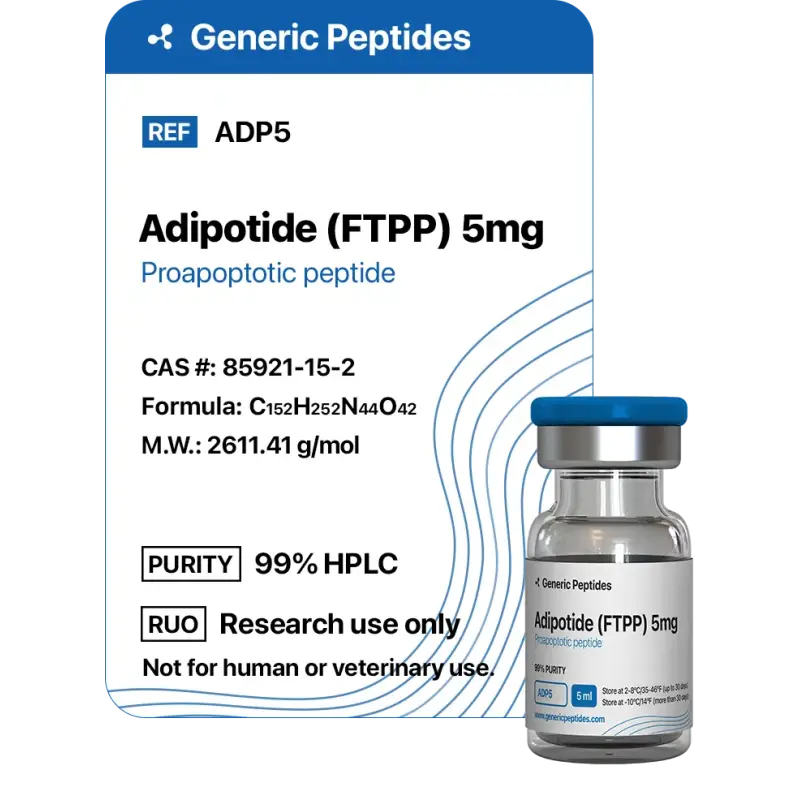
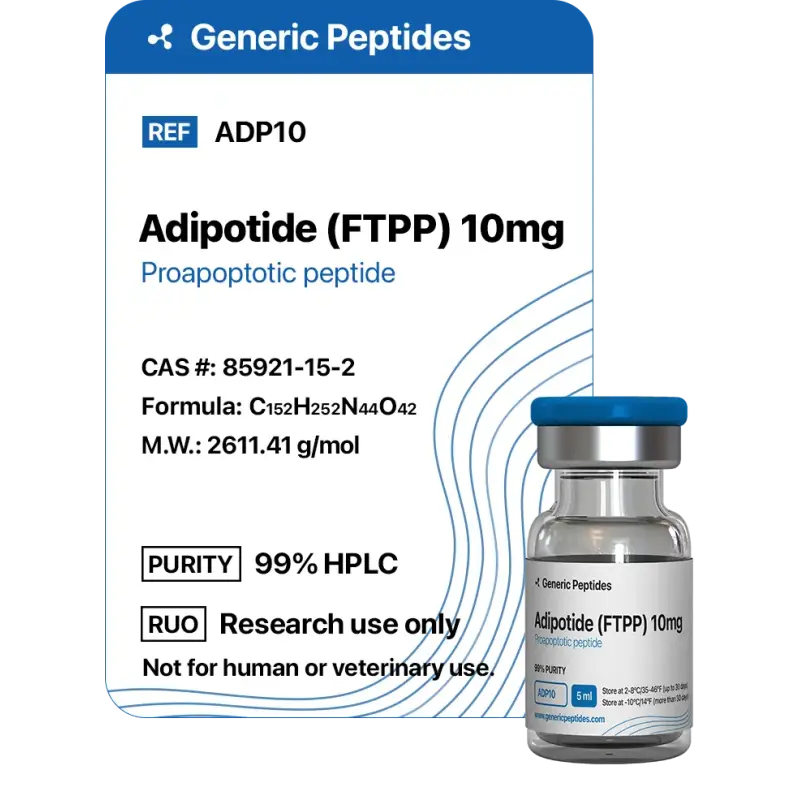
Two lyophilised vials, 5 mg and 10 mg, of a peptidomimetic built from two parts: a homing sequence that docks onto the blood vessels feeding white fat, and a domain that pushes those vessel cells into apoptosis. In obese rhesus macaques given it intravenously every day for 28 days, body mass fell by roughly 10.6 percent and insulin requirement halved, but the same study recorded dose-dependent changes in the kidney tubules, which is why the programme stopped. No human efficacy data were ever published, no human half-life is known, and no dose for people exists. This is laboratory material and the safety question attached to it is unresolved.
Strength

Not available in this combination

Shipping

Not available in this combination

Adipotide 5-10 mg Vials - Generic Peptides
Order Now, Ships Today
$85.00
1
Quality First

All products are manufactured under strict quality standards and independently tested before release. By purchasing, the buyer agrees to use these products in compliance with all applicable laws.

Product Overview

Generic Peptides lists this material as Adipotide (FTPP) in two vials, 5 mg and 10 mg of freeze-dried powder. The catalogue name and the scientific name point at the same construct: a peptidomimetic whose sequence is written CKGGRAKDC-GG-D(KLAKLAK)2, an entity that has also travelled under the names prohibitin-TP01 and TP01. It is not a lipolytic peptide, and reading it as one is the first mistake a buyer can make.

The design is a two-part device. The first block binds annexin A2 and prohibitin on the endothelium of blood vessels that supply white adipose tissue, which in animal work gave the construct its selectivity for fat. The second block is the destructive half: once inside those endothelial cells it disturbs mitochondrial membranes and triggers apoptosis, so the vessel feeding a fat depot is removed and the adipocytes behind it lose their supply. Weight loss follows from a vascular event rather than from a signalling change in a fat cell, and that difference is precisely where the safety problem sits.

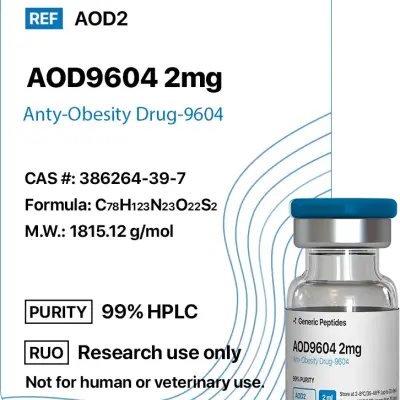
The record of testing is short and ends badly. In obese rhesus macaques dosed intravenously once a day for 28 days, the animals lost approximately 10.6 percent of body mass and needed about half the insulin they had required before, an outcome striking enough to draw attention. Dose-dependent changes in the kidney tubules appeared in the same study, and there was no clean gap between the effect and the damage. A phase I trial was announced in the early 2010s and produced no peer-reviewed results; as of 2019 clinical development of the compound is discontinued. Any reader looking for a fat-loss compound studied in humans should compare this vial with AOD 9604, which works on fat mobilisation instead of on its blood supply, and with the incretin route on Semaglutide and Tirzepatide. None of the three approaches is equivalent, and none was ever tested alongside the others.

Dosage Protocol

There is no human dose of this peptide, and the table is not a schedule. It sets out what the animal study used, what the vendor notes circulate as a convention, and the arithmetic that follows from a 5 mg or 10 mg fill.

Animal reference Daily intravenous dosing for 28 consecutive days in obese rhesus macaques, the only regimen in the sources
Vendor convention Notes circulating in vendor material mention 500 mcg to 1 mg a day subcutaneously; no validated human protocol backs it
Dilution, 5 mg vial 5 mg with 2 ml is 2.5 mg/ml; 5 mg with 1 ml is 5 mg/ml
Dilution, 10 mg vial 10 mg with 4 ml is 2.5 mg/ml; 10 mg with 2 ml is 5 mg/ml
Unit arithmetic At 2.5 mg/ml a 0.1 ml draw from a U-100 syringe holds 250 mcg; at 5 mg/ml the same draw holds 500 mcg
Stability Powder cold and dark at 2-8 C; mixed solution 2-8 C for no more than 28-30 days, never frozen
Route The primate work used the intravenous route; community notes describe subcutaneous use, which is a different exposure
Women No data of any kind, since the compound has no human data in either sex

Suggested Protocols

Combination research with this peptide does not exist, in animals or in people, so what follows is a shelf map. The reason to read the second card carefully is that the three approaches are often confused with one another purely because they are sold under the same fat-loss heading.

Fat-loss line, three separate mechanisms
Three cards from the same shelf with three different modes of action. Nothing in the sources tests them together, and the tokenless safety record of this vial is the reason a reader should not treat the grouping as a plan
Targeting-peptide research bench
Adipotide 5 mg vial - homing plus apoptotic domain + PNC-27 vials - membrane-directed peptide
Both are tissue-directed constructs with a deliberate cytotoxic payload and both stand outside clinical development, for different reasons; they are catalogued as research material, not as a combination
Metabolic monitoring context
Adipotide 10 mg vial + AICAR vials + Retatrutide vials
Listed to show where the neighbouring research sits: metabolic and incretin compounds with published human programmes, in contrast with a vial whose own programme was halted

What to Expect

  • Weight change in animals. Obese macaques lost about 10.6 percent of body mass across 28 days of daily intravenous dosing, which is the only efficacy figure in the sources.
  • Insulin response. The same work reported improved insulin sensitivity, with roughly half the previous insulin amount needed.
  • Mechanism. Fat cells are not signalled to release energy; the vessels feeding them are destroyed first, and the tissue then loses its supply.
  • Kidney findings. Dose-dependent alterations in the kidney tubules appeared in the primate study, showing no separation between useful effect and organ damage.
  • Empty human file. A phase I programme was announced but never published in a peer-reviewed journal, and development has been discontinued.
  • No half-life, no dose. Human elimination was never measured and no human dose was set, so every figure quoted for this vial is either animal work or a vendor convention.
  • Unknown long-term risk. A compound that ablates vessels in one tissue asks a selectivity question that the available data cannot answer.

Side Effects and Management

The concerns attached to this peptide are not cosmetic. They come from a single primate study and from the mechanism itself, and there is no human safety literature to soften or confirm any of them.

Kidney tubule changesKidney function is the one measure that follows directly from the animal data; the sensible response is not to run the vial at all.
Vessels outside fat tissueSelectivity for one vascular bed cannot be assumed in people; without human data the size of this risk is simply unknown.
Injection site reactionRotation of sites and clean technique; a local reaction is the most common event across this class of vial.
Fluid and electrolyte shiftsRapid mass loss can pull fluid and salts with it, so hydration and electrolytes are the theoretical watch items; no human data confirm the pattern.
Weight loss may not followEfficacy has never been demonstrated in humans; buying this peptide expecting the macaque result is the most likely way to be disappointed.
Dilution errorCalculate from the printed milligram figure, swirl rather than shake, and keep the mixed vial cold.

Post-Cycle Therapy

Hormonal recovery has no meaning for this vial, because it does not touch the axis that produces testosterone or estradiol and does not suppress fertility. Tamoxifen, clomiphene or hCG added to it would be treating nothing. What does deserve the slot that PCT normally occupies is monitoring, and the sources point in one direction only.
OnsetNothing to recover: the gonadotropin axis is untouched by this molecule
Option AA SERM would have no receptor to act on and an aromatase inhibitor no enzyme to block
Option BNo hCG or similar gonadotropin belongs in a plan built on a fat-vessel peptide
What replaces itRenal function, which is the single follow-up measure that the primate work makes unavoidable, and the compounds meant for human programmes elsewhere in this section such as Semaglutide carry their own monitoring requirements
WashoutNo half-life exists to base a washout on; with no human clearance figure, the length of any pause is guesswork rather than pharmacology
Follow-upBody weight and general wellbeing, plus a clinician's view if any research material has already been used, since nothing here is reversible by a recovery drug
The information on this page is laboratory and educational reference only. The vial described holds a research peptide, not a medicine, and nothing here is offered as treatment for obesity or any other condition. Figures come from animal research, vendor reference notes and public programme records, reproduced so a reader can see how thin the human evidence is; they are not a protocol, an endorsement or a prescription, and this is not medical advice. Keep the material away from children and respect the law where you live.
What is Generic Peptides Adipotide?
A freeze-dried research peptide sold in 5 mg and 10 mg vials under the trade name Adipotide and the scientific name prohibitin-targeting peptide 1. The sequence is written CKGGRAKDC-GG-D(KLAKLAK)2 and combines a vessel-homing block with a domain that destroys mitochondria. No regulator has approved it, and no human trial results have been published.
How does Adipotide actually work?
Not like a fat burner. The homing part of the molecule docks onto annexin A2 and prohibitin on the endothelium of vessels supplying white fat, and the second part then drives those endothelial cells into apoptosis. The fat depot loses its blood supply as a result. That is a vascular mechanism, so its whole safety question is how cleanly one vascular bed can be separated from the rest.
What results were reported in research animals?
In obese rhesus macaques receiving a daily intravenous dose for 28 days, body mass dropped by roughly 10.6 percent and insulin sensitivity improved to the point where about half the previous insulin amount was needed. The same study recorded dose-dependent changes in the kidney tubules. Those two results arrived together, which is exactly why the programme did not continue.
Why was Adipotide discontinued?
The kidney findings in the primate work removed any comfortable margin between the intended effect and organ toxicity. A phase I programme was announced in the early 2010s, yet not one peer-reviewed result followed it, and development has been shut down since around 2019. No later study exists to read.
Is there a human dose of Adipotide?
No. No human dose was ever established and no human half-life was measured, so nothing can be converted from the animal work with any confidence. Vendor notes quoting a range of 500 mcg to 1 mg daily under the skin are conventions rather than data, and no validated research protocol in people exists for this molecule.
How do you prepare a 10 mg Adipotide vial?
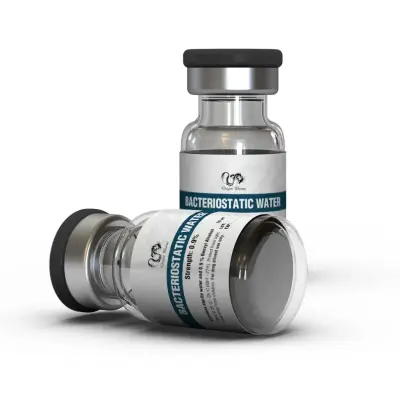
Bacteriostatic water is added down the wall of the vial and the contents are swirled, never shaken. Use 4 ml and the concentration is 2.5 mg/ml, which makes a 0.1 ml pull on a U-100 insulin syringe worth 250 mcg; use 2 ml and it is 5 mg/ml, with the same pull worth 500 mcg. Keep the mixed solution at 2-8 C, use it within roughly a month and do not freeze it.
Does Adipotide need post-cycle therapy?
No, and the reason is straightforward: it does not suppress the gonadotropin axis, so there is no hormone production to restart and nothing for a SERM, an aromatase inhibitor or hCG to do. The follow-up that matters with this compound is kidney function, which is the one measure the animal data force a reader to think about.
Can Adipotide be researched together with other fat-loss peptides?
No study has combined this material with anything, in animals or in humans. Products such as AOD 9604, 5-Amino 1MQ and the incretins act through entirely different mechanisms, so a shelf shared with them does not amount to a protocol, and the unresolved kidney question belongs to this vial alone.

No reviews yet

Be the first to share your experience with Adipotide 5-10 mg Vials - Generic Peptides

Log in to write a review
Adipotide 5-10 mg Vials - Generic Peptides
5 mg · International

Complete the protocol

Stack it with

View all →
Added to cart